Insights on Key Factors Influencing Post-Stroke Depression and Cognitive Decline in Survivors of Acute Stroke
-
By
-
Polona Rus Prelog
-
Matija Zupan
-
Senta Frol
-
September 14, 2026
Clinical Report: Insights on Key Factors Influencing Post-Stroke Depression
Overview
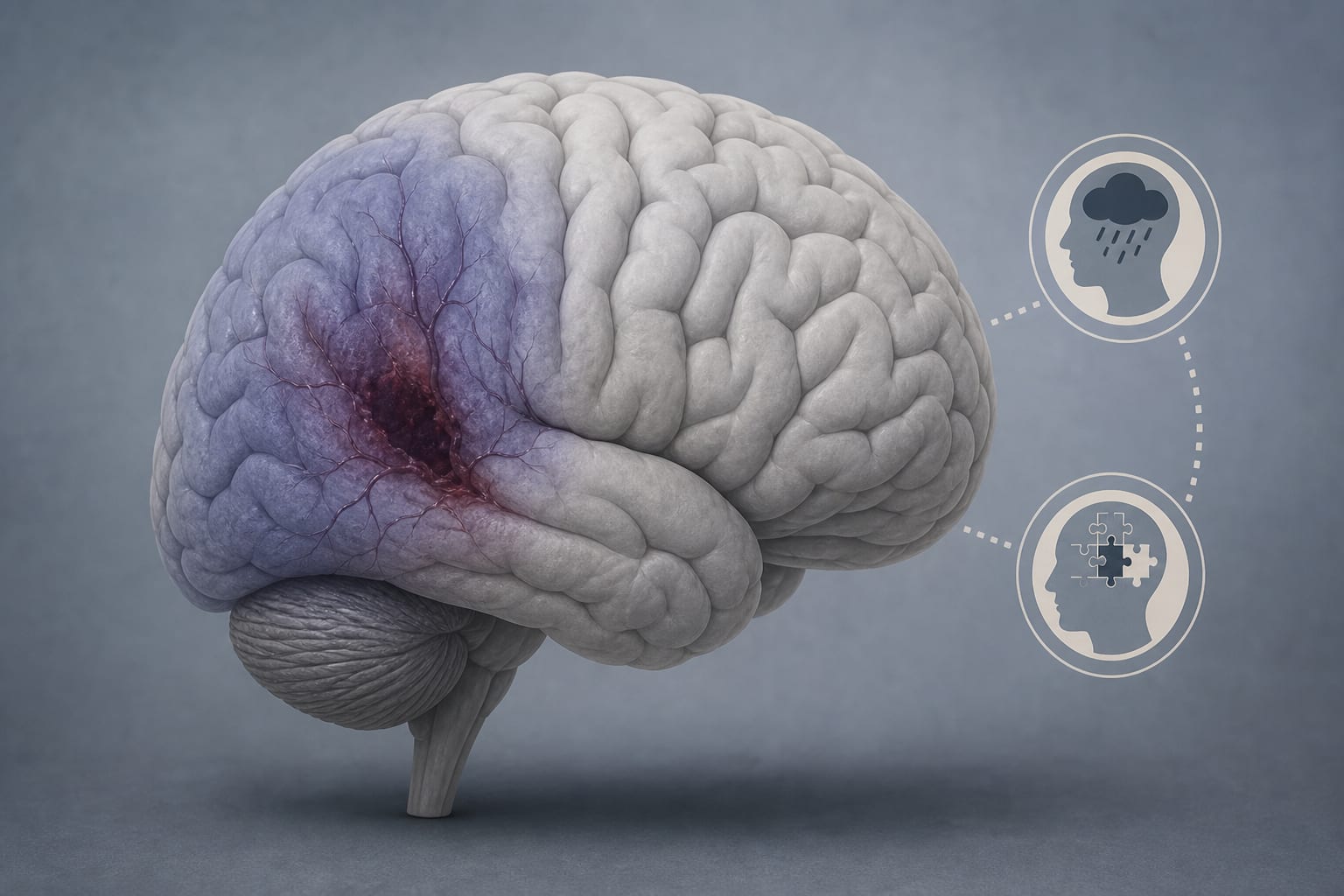
This commentary discusses predictors of post-stroke depression (PSD) and cognitive impairment (PSCI) among acute stroke survivors. Key findings indicate that right-hemisphere lesions, higher baseline PHQ-9 scores, and lower baseline MMSE scores are predictors of these conditions.
Background
Post-stroke depression and cognitive impairment are prevalent complications following acute strokes. Identifying reliable predictors is crucial for intervention and management of these conditions.
Data Highlights
No numerical data provided in the source material.
Key Findings
- Right-hemisphere lesions are a predictor of post-stroke depression and cognitive impairment.
- Higher baseline PHQ-9 scores correlate with increased risk of PSD and PSCI.
- Lower baseline MMSE scores are associated with a higher likelihood of cognitive impairment.
- Operationalizing PSD and PSCI through screening scales affects risk stratification and clinical interpretation.
- Subgroup analyses reveal variations in predictors and outcomes among PSD-only, PSCI-only, and comorbid presentations.
Clinical Implications
Clinicians should consider both mood and cognitive assessments in stroke survivors.
Conclusion
The integrated approach to assessing post-stroke depression and cognitive impairment highlights the need for further research.
Related Resources & Content
- Yan et al., Frontiers in Neurology, 2026 -- Insights on Key Factors Influencing Post-Stroke Depression and Cognitive Decline in Survivors of Acute Stroke
- Frontiers in Psychiatry — Poststroke anxiety and depression: epidemiology, mechanisms, and management strategies
- Frontiers in Neurology — Psychological resilience and functional recovery after acute ischemic stroke: a prospective cohort study
- MDSpire News — Not All Poststroke Cognitive Patterns Plateau
- Cognitive Impairment Following Ischemic and Hemorrhagic Stroke: A Scientific Statement from the American Heart Association/American Stroke Association
- 2026 Guideline for the Early Management of Patients With Acute Ischemic Stroke
- Canadian Stroke Best Practice Recommendations Rehabilitation, Recovery, and Community Participation Following Stroke, 7th Edition Update, 2025
- Revised Diagnostic Criteria for Vascular Cognitive Impairment and Dementia—The VasCog-2-WSO Criteria | Dementia and Cognitive Impairment | JAMA Neurology | JAMA Network
- 2026 Guideline for the Early Management of Patients With Acute Ischemic Stroke: A Guideline From the American Heart Association/American Stroke Association | Stroke
- Canadian Stroke Best Practice Recommendations Rehabilitation, Recovery, and Community Participation Following Stroke, Part Three: Optimizing Activity and Community Participation Following Stroke, 7th Edition Update, 2025 - PMC
- Stroke Survivors Have Almost Three Times Higher Risk of Depression: A Systematic Review and Meta-Analysis - PubMed
- Association between serum inflammatory cytokines levels and post-stroke depression among stroke patients: A meta-analysis and systematic review - PubMed
- oup.silverchair-cdn.com
- Risk factors for dementia and cognitive impairment within 5 years after stroke: a prospective multicentre cohort study.
- Clinical prediction models for post-stroke depression: a systematic review and meta-analysis - PubMed
Based on findings from:
Commentary: Identifying key predictors of post-stroke depression and cognitive impairment in acute stroke survivors
Polona Rus Prelog, Matija Zupan, Senta Frol. Frontiers In Neurology, 2026.
https://www.frontiersin.org/journals/neurology/articles/10.3389/fneur.2026.1931929/full
This content is an AI-generated, fully rewritten summary based on a published scholarly article. It does not reproduce the original text and is not a substitute for the original publication. Readers are encouraged to consult the source for full context, data, and methodology.