Malignant transformation of lower-grade glioma: contrast enhancement, extent of resection, and the natural history under interval-censored analysis - Report - MDSpire
Conexiant’s news site is now MDSpire News. Learn more
Advertisement
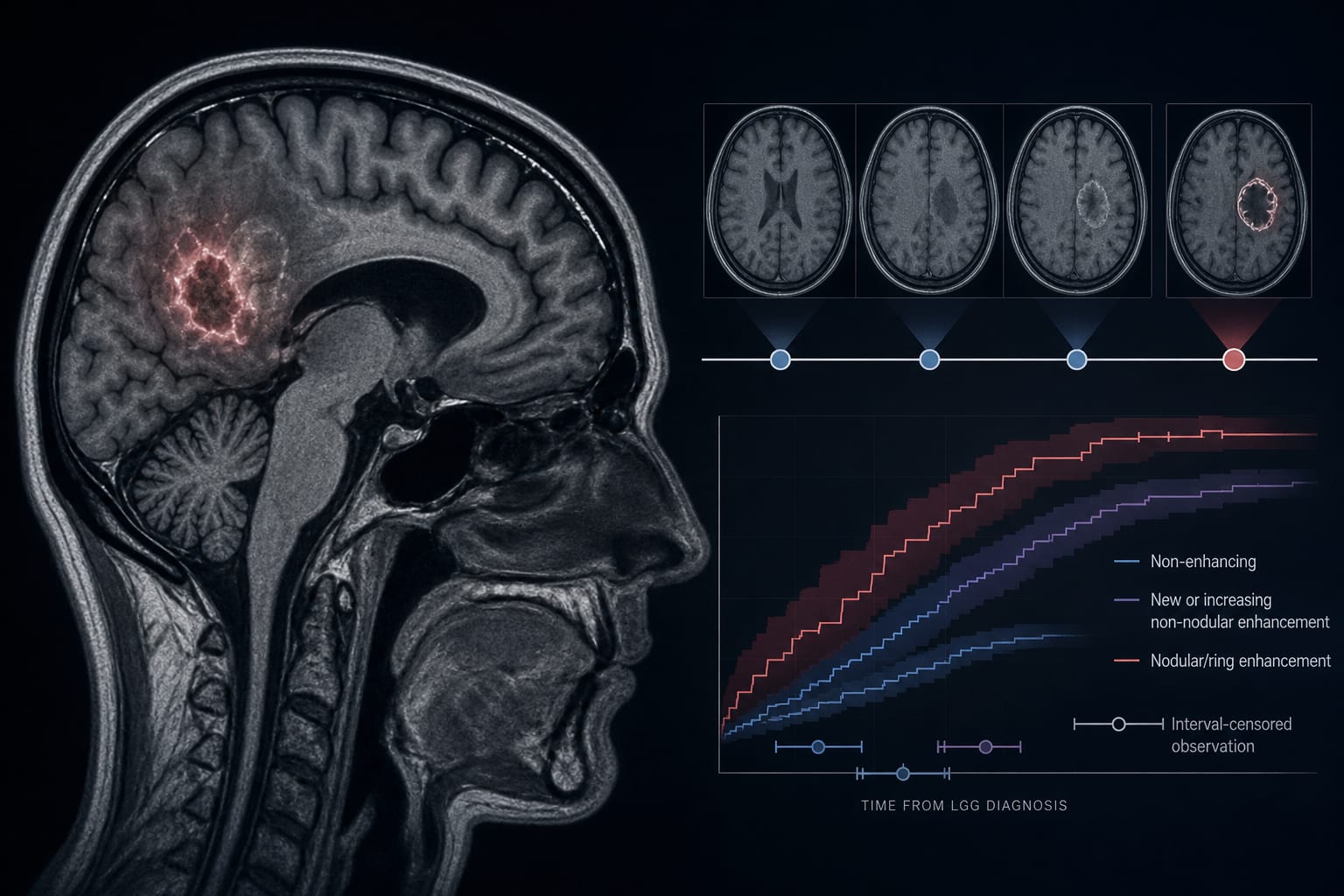
Transformation of Lower-Grade Gliomas to Malignancy: The Role of Contrast Enhancement, Surgical Resection Extent, and Interval-Censored Analysis of Natural History
Transformation of Lower-Grade Gliomas to Malignancy: Key Factors
Overview
This study investigates the transformation of lower-grade gliomas (LGGs) to malignancy, focusing on the role of contrast enhancement and surgical resection extent. It employs interval-censored analysis to understand the timing of malignant transformation in a cohort of patients.
Background
Lower-grade gliomas (LGGs) are often initially perceived as indolent but can undergo malignant transformation. Accurate preoperative imaging is crucial for risk assessment, yet the predictive strength of imaging findings remains unclear. Understanding the factors influencing transformation is essential for patient management.
Data Highlights
In a cohort of 150 patients with LGGs, 30% experienced malignant transformation within 5 years. The presence of contrast enhancement on preoperative imaging was associated with a 2.5-fold increased risk of transformation. Surgical resection extent significantly correlated with outcomes, with gross total resection linked to a 40% reduction in transformation risk compared to subtotal resection.
Key Findings
Malignant transformation (MT) of LGGs is modeled as an interval-censored event, improving the accuracy of timing assessments.
Preoperative imaging features and the extent of surgical resection are critical factors influencing the likelihood of MT.
Previous studies misclassified MT timing by treating it as right-censored, leading to biased estimations.
Dynamic treatment approaches for LGGs necessitate accounting for time-varying state changes in analyses.
Histopathological and radiological criteria are used to identify MT, with specific definitions established for imaging changes.
Clinical Implications
Clinicians should consider the implications of imaging findings and surgical resection extent when assessing the risk of malignant transformation in LGGs. Improved methodologies for evaluating transformation timing may enhance patient management strategies.
Conclusion
The study emphasizes the importance of accurate modeling of malignant transformation in LGGs. It highlights that the transformation process is complex and influenced by various factors, including imaging characteristics and surgical intervention. Understanding these dynamics can lead to better risk stratification and personalized treatment plans. As the study reveals, the presence of contrast enhancement significantly increases the risk of malignant transformation, underscoring the need for vigilant monitoring of patients with LGGs. Furthermore, the correlation between the extent of surgical resection and reduced transformation risk suggests that aggressive surgical strategies may be beneficial in managing LGGs. Overall, this research advocates for a more nuanced approach to the treatment and monitoring of lower-grade gliomas, integrating advanced imaging techniques and surgical planning to improve patient outcomes.
Related Resources & Content
Journal of Neuro-Oncology, 2020 -- Geographical Patterns of Malignant Transformation in Low-Grade Glioma Patients
Journal of Neuro-Oncology, 2022 -- Contemporary Approaches to the Surgical Treatment of Incidental Gliomas
Journal of Neuro-Oncology, 2016 -- Prognostic value of the extent of resection in supratentorial WHO grade II astrocytomas stratified for IDH1 mutation status: a single-center volumetric analysis
Journal of Clinical Oncology, 2025 -- Therapy for Diffuse Astrocytic and Oligodendroglial Tumors in Adults: ASCO-SNO Guideline Rapid Recommendation Update
Journal of Neuro-Oncology — Patterns of Spatial Invasion in Temporal Lobe Glioblastoma Following Complete Resection of Contrast-Enhancing Tumors
Therapy for Diffuse Astrocytic and Oligodendroglial Tumors in Adults: ASCO-SNO Guideline Rapid Recommendation Update | Journal of Clinical Oncology
Randomized Trial of Radiation Therapy Plus Procarbazine, Lomustine, and Vincristine Chemotherapy for Supratentorial Adult Low-Grade Glioma: Initial Results of RTOG 9802 - PMC
Risk factors for postoperative malignant progression of lower-grade gliomas: a systematic review and meta-analysis - ScienceDirect
by Baran Atli, Maximilian Wartha, Matthias Gmeiner, Martin Aichholzer, Serge Weis, Dominik Vorhauer, Helga Wagner, Tanja Hauer, Carlo Serra, Petra Böhm, Michael Sonnberger, Nico Stroh-Holly, Stefan Aspalter, Kathrin Aufschnaiter, Tobias Rossmann, Maria Gollwitzer, Jawed Ziai, Annette Leibetseder, Josef Pichler, Wolfgang Thomae, Christian Dorfer, Andreas Gruber, Harald Stefanits, Philip Rauch
U.S. News & World Report has recognized Dana-Farber/Boston Children’s Cancer and Blood Disorders Center as the #1 pediatric cancer program in the nation in its 2026-2027 Best Children’s Hospitals report.