Esophageal submucosal gland duct adenoma: a case report and pooled analysis of demographic differences between eastern and western populations - Report - MDSpire

Esophageal submucosal gland duct adenoma: a case report and pooled analysis of demographic differences between eastern and western populations

  • By

  • Yuhua Chen

  • Yafei Zhang

  • Liuqing Ge

  • July 2, 2026

  • 0 min

Share

Clinical Report: Submucosal Gland Duct Adenoma of the Esophagus

Background

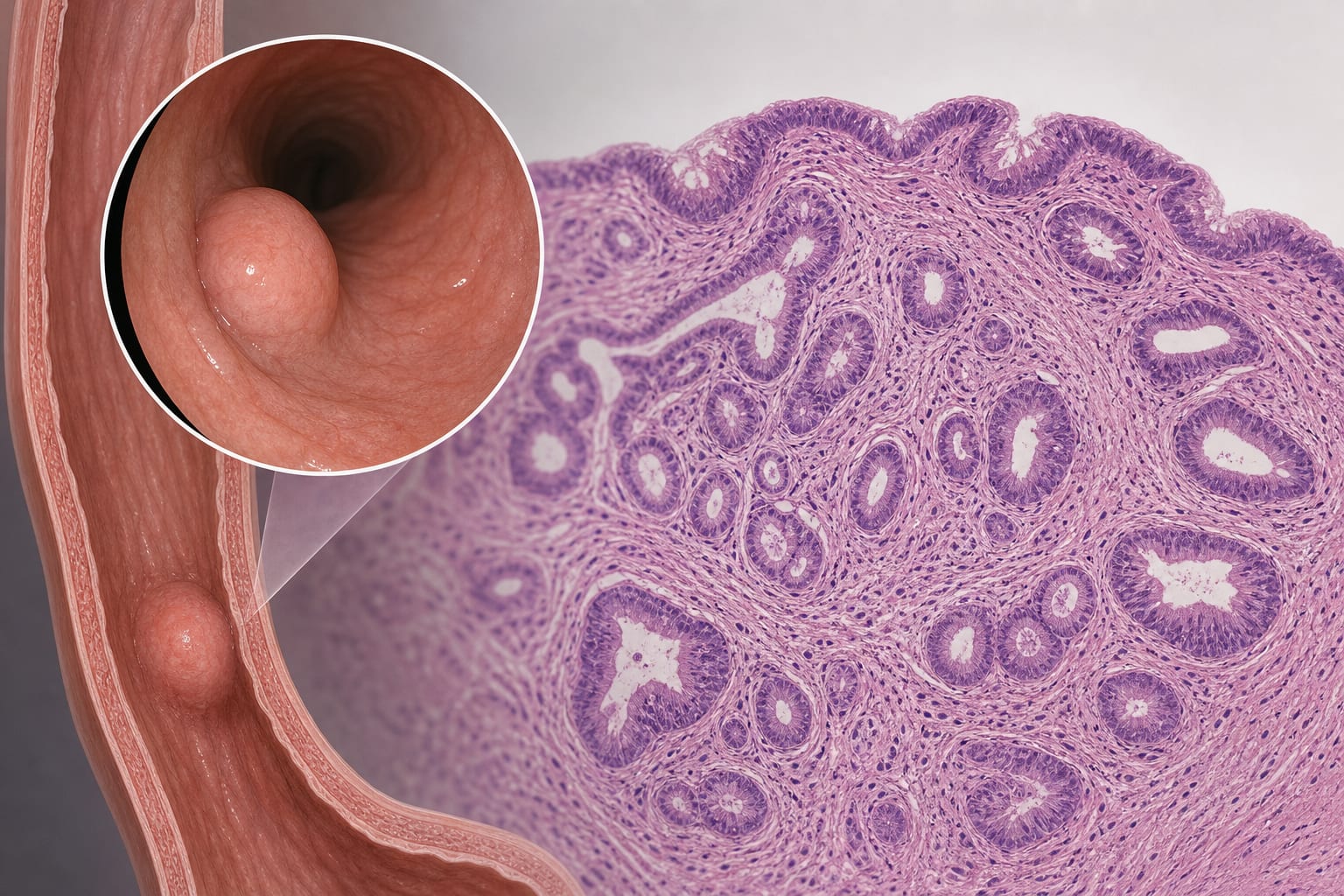
ESGDA is an exceptionally rare benign tumor that typically arises from the ducts of the esophageal submucosal glands. Understanding its clinical profile is crucial, as it may vary significantly across different populations. This study aims to elucidate these variations through a comparative analysis of documented cases.

Data Highlights

CharacteristicEastern Cohort (n=10)Western Cohort (n=10)
Male-to-Female Ratio9:11:1
Location in Distal Esophagus100%40%
Location in Mid/Upper Esophagus0%60%
P Value (Sex Distribution)0.141
P Value (Location Distribution)0.011

Key Findings

  • ESGDA is a rare benign tumor with a male predominance in Eastern populations (9:1).
  • Western populations show a balanced male-to-female ratio (1:1).
  • All Eastern cases were located in the distal esophagus, while Western cases had a broader distribution.
  • Statistical analysis revealed significant differences in tumor location between Eastern and Western cohorts (P = 0.011).
  • Mean age and tumor size were similar across both groups.

Clinical Implications

Clinicians should be aware of the geographic variations in the presentation of ESGDA, particularly the differences in sex distribution and tumor location. This knowledge may aid in the diagnostic process and inform management strategies for patients with suspected ESGDA.

Conclusion

The findings suggest significant geographic patterns in the clinical presentation of ESGDA, warranting further investigation with larger sample sizes to confirm these observations.

Related Resources & Content

  1. Author(s)/Org, Source, Year -- Title
  2. Updates in Surgery — Pathological Examination of Adenocarcinomas Located at the Gastroesophageal Junction
  3. Gastric Cancer — Feasibility study of cap-assisted endoscopic mucosal resection for gastric adenocarcinoma of fundic gland type
  4. Techniques in Coloproctology — Pathological Characteristics and Outcomes in Colorectal Mucinous Adenocarcinoma with Mixed Histological Features: A Nationwide Retrospective Analysis from China
  5. Journal of Gastroenterology — Clinical relevance of the identification of the distal end of the palisade vessel in cases with columnar-lined esophagus: a comment on the study by Hatta et al.
  6. Updates in Surgery — Pathological Examination of Adenocarcinomas Located at the Gastroesophageal Junction
  7. Gastric Cancer — Feasibility study of cap-assisted endoscopic mucosal resection for gastric adenocarcinoma of fundic gland type
  8. Techniques in Coloproctology — Pathological Characteristics and Outcomes in Colorectal Mucinous Adenocarcinoma with Mixed Histological Features: A Nationwide Retrospective Analysis from China
  9. Journal of Gastroenterology — Clinical relevance of the identification of the distal end of the palisade vessel in cases with columnar-lined esophagus: a comment on the study by Hatta et al.
  10. Frontiers | Esophageal submucosal gland duct adenoma: a case report and literature review
  11. AJG-22-0888 46..58
  12. Endoscopic management of subepithelial lesions including neuroendocrine neoplasms | ESGE
  13. Modified endoscopic submucosal tunnel dissection for large esophageal submucosal gland duct adenoma: A case report - PMC

Original Source(s)

Related Content