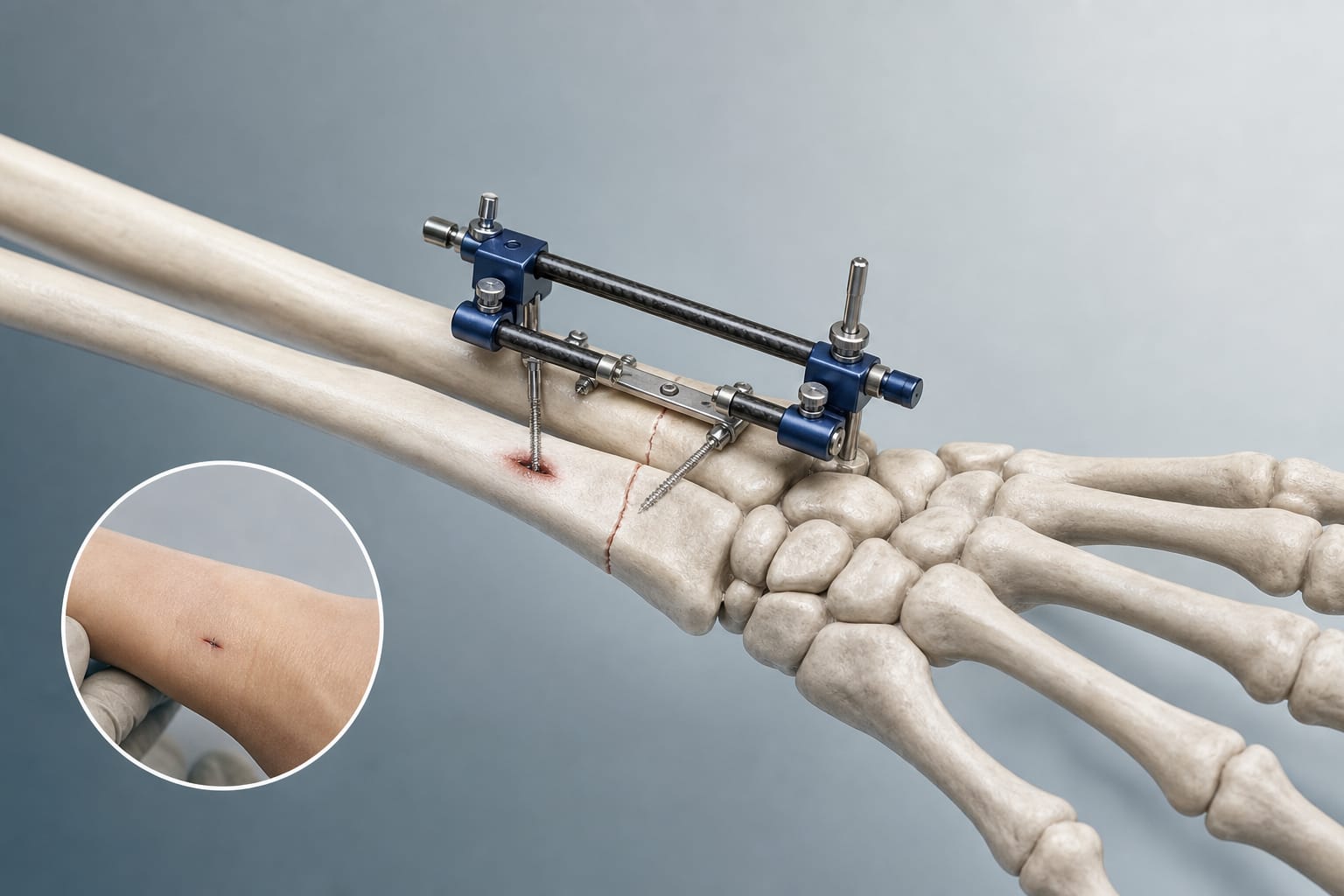
Clinical Report: Minimally Invasive Correction of Distal Radial Malunions
Overview
This study evaluates the effectiveness of a 5 mm incision technique for correcting depressed distal radial malunions.
Background
Distal radius fractures are common, accounting for up to 17% of all extremity fractures, with a notable incidence of malunion. Conventional treatment often requires secondary surgeries for plate removal, leading to increased costs and recovery times.
Data Highlights
Parameter
External Fixation Group
Plating Group
Off Work Time (days)
152 ± 42
210 ± 72
Total Treatment Cost (USD)
32,653 ± 1,234
43,653 ± 3,234
Radial Height (mm)
12.1 ± 3.9
10.2 ± 2.7
Ulnar Variance (mm)
0.5 ± 0.2
1.7 ± 1.2
Mayo Wrist Score
94.3 ± 5.7
92.8 ± 7.1
Patient Aesthetics Score
8.8 ± 1.8
8.1 ± 1.1
Patient Satisfaction Score
8.9 ± 1.6
8.1 ± 1.2
Key Findings
Significant reduction in off work time for the external fixation group compared to the plating group (P < 0.01).
Lower total treatment costs associated with the external fixation method (P < 0.01).
Improved radial height in the external fixation group (12.1 mm vs. 10.2 mm; P < 0.05).
Lower ulnar variance in the external fixation group (0.5 mm vs. 1.7 mm; P < 0.05).
No significant difference in Mayo Wrist Scores between the two groups (P > 0.05).
Higher patient satisfaction and aesthetics scores in the external fixation group (P < 0.05).
Clinical Implications
The findings indicate that a minimally invasive approach using external fixation may provide comparable functional outcomes.
Conclusion
Minimally invasive correction of distal radial malunions via a 5 mm incision is effective.