Tracking performance and surgeon assessment of photoacoustic-based surgical guidance methods - Report - MDSpire

Tracking performance and surgeon assessment of photoacoustic-based surgical guidance methods

  • By

  • Nethra Venkatayogi

  • Karen C. Wang

  • Muyinatu A. Lediju Bell

  • May 23, 2026

  • 0 min

Share

Clinical Report: Evaluating the Efficacy of Photoacoustic Techniques in Surgical Guidance

Overview

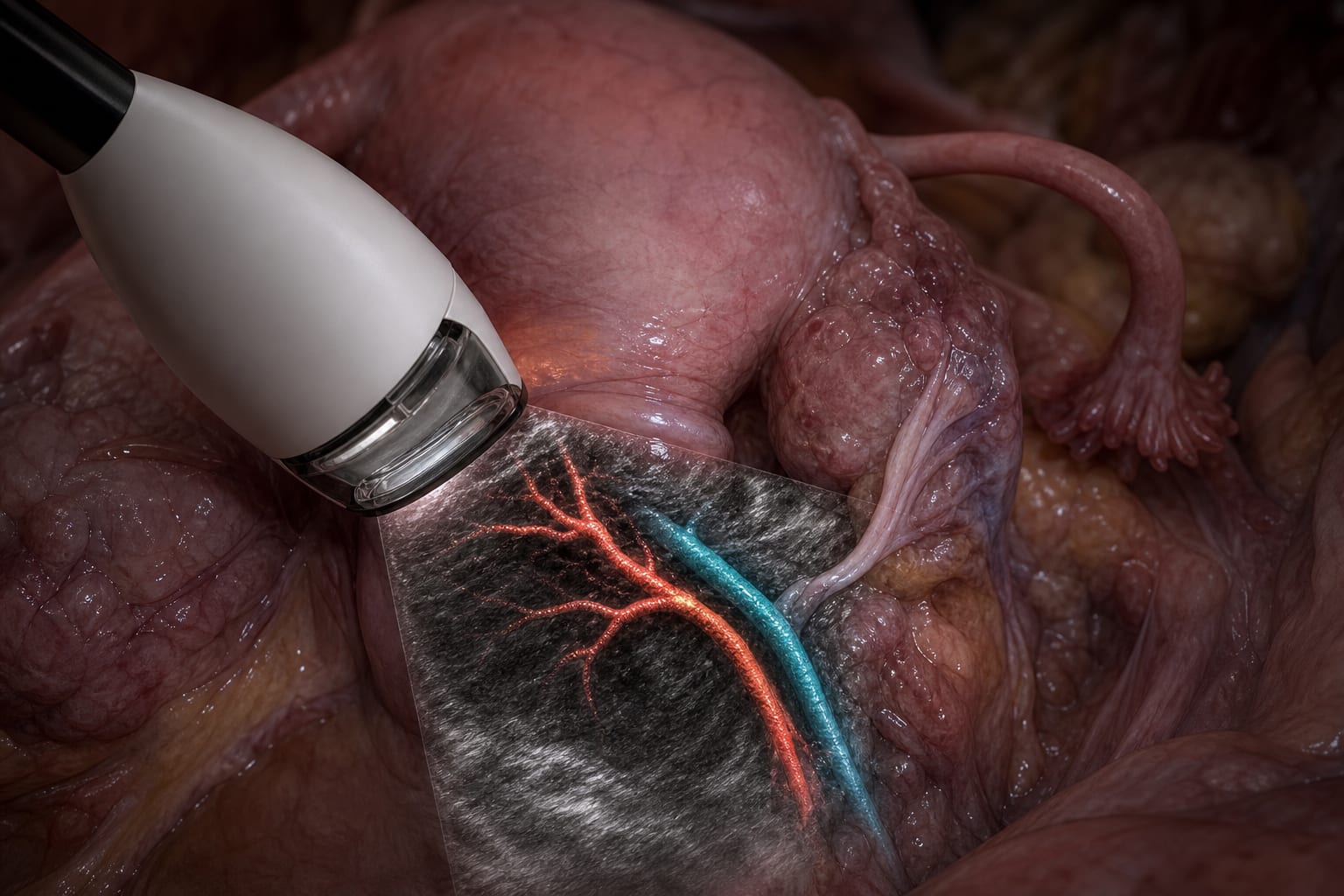
This report evaluates the efficacy of photoacoustic imaging techniques in enhancing surgical guidance and feedback during hysterectomy procedures.

Background

Hysterectomy is the most common nonobstetric surgical procedure among women in the USA, with significant risks associated with ureteral injuries during the operation. Current detection methods for ureters are limited, often lacking real-time guidance and posing radiation risks. Photoacoustic imaging presents a promising alternative that may improve visualization of critical anatomical structures.

Data Highlights

No numerical data provided in the source material.

Key Findings

  • Photoacoustic imaging can differentiate between the ureter, uterine artery, and surgical tools.
  • Tool-to-ureter distances measured by photoacoustic methods were more accurate than those obtained from external cameras.
  • Photoacoustic imaging offers greater tissue penetration depth compared to traditional optical methods.
  • Surgeons received auditory alerts regarding tool proximity to the ureter.
  • Monocular laparoscopic visualization lacks depth perception, which photoacoustic imaging can address.

Clinical Implications

The integration of photoacoustic imaging in surgical procedures may provide real-time feedback on tool positioning relative to the ureter.

Conclusion

Photoacoustic imaging has potential applications in surgical guidance during hysterectomy procedures.

Related Resources & Content

  1. Wiacek et al., Source, Year -- Evaluating the Efficacy of Photoacoustic Techniques in Surgical Guidance
  2. Innovative Microscope-Enhanced Visual Interface and Nasopharyngeal Mapping for Auditory Brainstem Implantation: A Feasibility Assessment in an Ex Vivo Setting
  3. Analysis of Acoustic Signals in Instrument-Tissue Interactions During Minimally Invasive Procedures
  4. Surgical Targeting Visualization: An Evaluation of Concepts and Usability
  5. Advancements in Surgical Acoustics: Creating a Trocar System for Laparoscopic Sound Evaluation
  6. Hysterectomy | ACOG
  7. Indocyanine green for intraoperative ureteral identification in gynecologic surgery
  8. In vivo photoacoustic imaging of swine ureters injected with methylene blue

Original Source(s)

Related Content