PCSK9 promotes atherosclerosis progression through the FOXO3a autophagy signaling pathway - Report - MDSpire

PCSK9 promotes atherosclerosis progression through the FOXO3a autophagy signaling pathway

  • By

  • Yuanjia Shi

  • Jing Zhang

  • Lina Dai

  • Jie Chen

  • Shijia Geng

  • Yan Niu

  • Chongyang Dong

  • Chenlei Li

  • Rujin Liu

  • Ningxia Zhao

  • Xiaomeng Wang

  • Zhanfeng Gao

  • Xi Yang

  • Shang Gao

  • June 15, 2026

  • 0 min

Share

Clinical Report: The Role of PCSK9 in Advancing Atherosclerosis via the FOXO3a Autophagy Pathway

Overview

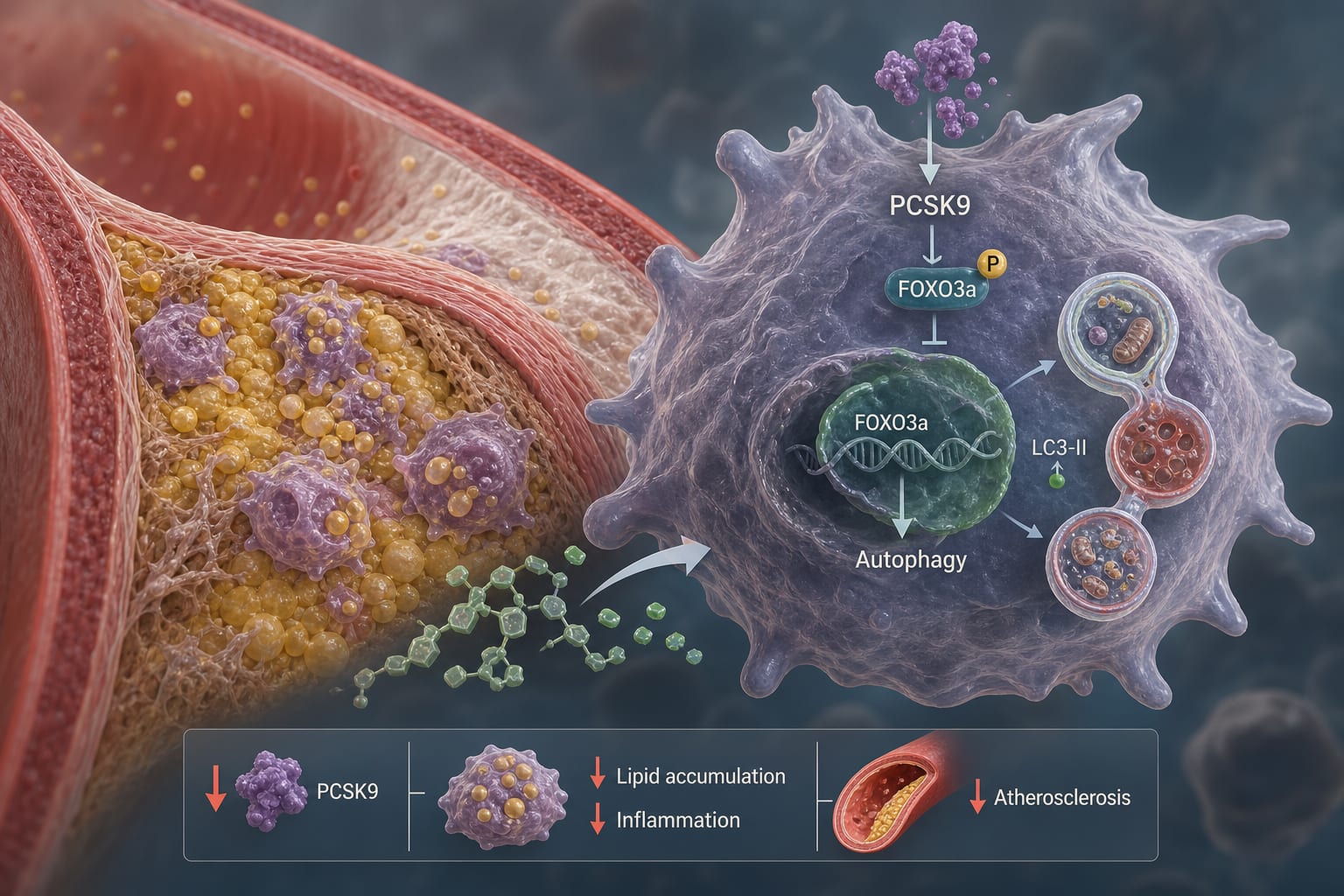
This study investigates the role of PCSK9 in promoting atherosclerosis through the FOXO3a autophagy pathway. It demonstrates that COS can inhibit PCSK9, thereby reducing autophagic injury in macrophages and slowing atherosclerosis progression.

Background

Atherosclerosis is a significant cardiovascular disease characterized by the accumulation of lipoproteins and inflammatory responses in arterial walls. PCSK9 has emerged as a critical regulator of LDL cholesterol levels and is implicated in the modulation of autophagy, which plays a vital role in atherosclerosis progression. Understanding the mechanisms by which PCSK9 influences autophagy could lead to novel therapeutic strategies.

Data Highlights

InterventionEffect on PCSK9Effect on Atherosclerosis
COSReduced expressionSlowed plaque progression
RAPAIncreased expressionPromoted autophagic injury
oe/siPCSK9Altered autophagy extentInfluenced macrophage function

Key Findings

  • PCSK9 enhances autophagic flux and promotes autophagic injury in macrophages.
  • COS significantly reduces PCSK9 expression and slows atherosclerotic plaque progression.
  • FOXO3a is activated by PCSK9, influencing autophagy-related gene expression.
  • Increased levels of PCSK9 and FOXO3a were observed in macrophages from atherosclerotic plaques.
  • Inhibition of FOXO3a with JY2 significantly inhibited autophagy without affecting PCSK9 levels.

Clinical Implications

The findings suggest that targeting PCSK9 may offer a new therapeutic approach to mitigate atherosclerosis by modulating autophagy. The use of COS as a potential inhibitor of PCSK9 could be explored further in clinical settings.

Conclusion

PCSK9 plays a significant role in promoting atherosclerosis through the FOXO3a autophagy pathway. Inhibition of PCSK9 may provide a beneficial strategy for managing atherosclerosis.

Related Resources & Content

  1. Basic Research in Cardiology, 2015 -- Functional Roles of Proprotein Convertase Subtilisin/Kexin Type 9 (PCSK9) at the Molecular and Cellular Levels
  2. Endocrine Reviews, 2023 -- The Biology and Clinical Implications of PCSK7
  3. Basic Research in Cardiology, 2017 -- Regulation of PCSK9 Function in Cardiovascular Disease: Physiological Insights and Therapeutic Approaches
  4. European Journal of Preventive Cardiology, 2023 -- Impact of PCSK9 inhibitors on lipoprotein(a) levels: a multi-centre study
  5. JACC, 2026 -- 2026 ACC/AHA/AACVPR/ABC/ACPM/ADA/AGS/APhA/ASPC/NLA/PCNA Guideline on the Management of Dyslipidemia
  6. New England Journal of Medicine, 2025 -- Evolocumab in Patients without a Previous Myocardial Infarction or Stroke
  7. 2026 ACC/AHA/AACVPR/ABC/ACPM/ADA/AGS/APhA/ASPC/NLA/PCNA Guideline on the Management of Dyslipidemia: A Report of the American College of Cardiology/American Heart Association Joint Committee on Clinical Practice Guidelines | JACC
  8. Evolocumab in Patients without a Previous Myocardial Infarction or Stroke | New England Journal of Medicine
  9. Efficacy and safety of PCSK-9 inhibitors in patients with acute coronary syndrome: a systematic review and network meta-analysis - PubMed

Original Source(s)

Related Content