MRI features and radiomics of the pineal gland in girls do not show significant changes at onset of puberty - Report - MDSpire

MRI features and radiomics of the pineal gland in girls do not show significant changes at onset of puberty

  • By

  • Anna-Mariia Shulhai

  • Michele Maddalo

  • Maddalena Petraroli

  • Francesca Ormitti

  • Benedetta Piccolo

  • Emanuela Claudia Turco

  • Nicola Sverzellati

  • Caterina Ghetti

  • Susanna Esposito

  • Maria Elisabeth Street

  • May 29, 2026

  • 0 min

Share

MRI Characteristics and Radiomic Analysis of the Pineal Gland in Females Show No Significant Alterations at Puberty Onset

Overview

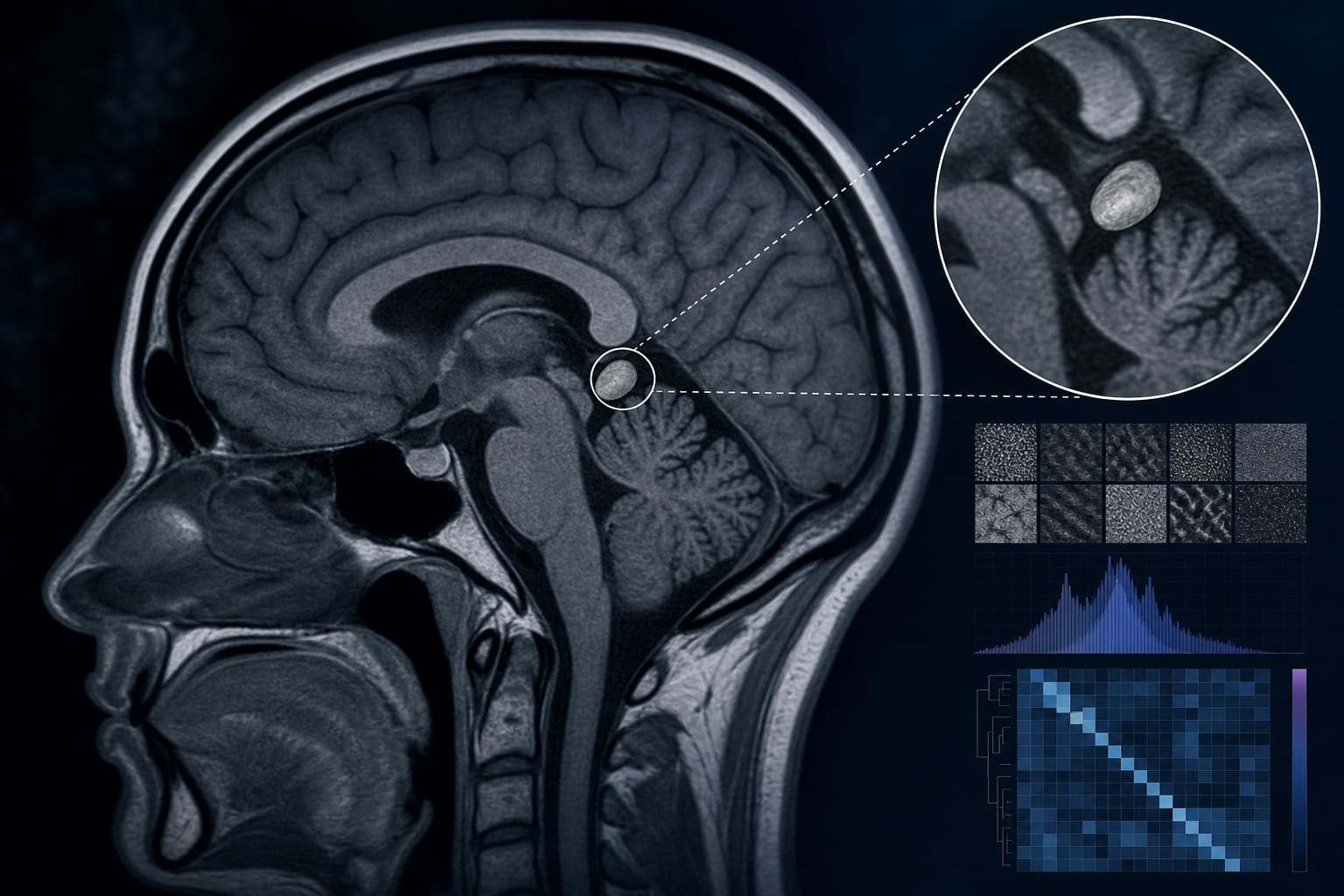
This study investigates the radiomic features of the pineal gland in girls with central precocious puberty (CPP) and finds no significant changes associated with puberty onset.

Background

Central precocious puberty (CPP) is characterized by early activation of the hypothalamus-pituitary-gonadal axis, necessitating accurate diagnostic methods. MRI is commonly employed to exclude central organic causes in CPP cases. The role of the pineal gland and its radiomic features in this context has been debated.

Data Highlights

No significant correlations between cyst features and basal/peak gonadotropin levels were observed. Radiomic analysis yielded ROC-AUC values of 0.64 for Reader 1 and 0.59 for Reader 2.

Key Findings

  • Two radiomic features were identified as predictive of CPP, but with poor inter-reader reliability.
  • The reference model based on pineal cyst features demonstrated a ROC-AUC of 0.52.
  • No significant alterations in pineal gland radiomic features were found at puberty onset.
  • The number and size of pineal cysts were not specific indicators for the onset of puberty.
  • Previous studies indicated varying results for pituitary gland radiomics.

Clinical Implications

The findings indicate that radiomic analysis of the pineal gland may not be a useful tool in the diagnostic workup for CPP.

Conclusion

This study finds that radiomic features of the pineal gland do not show consistent changes associated with puberty onset.
Related Resources & Content

  1. Eide, M., & Ringstad, G., Springer, 2024 -- Assessing the Impact of MRI Biomarkers on Symptomatic Pineal Cysts: A Retrospective Study
  2. Mak, R. et al., The Journal of Clinical Endocrinology & Metabolism, 2025 -- Variations in Serum miR-30b Levels During Minipuberty and Puberty in Female Subjects
  3. Frontiers in Oncology, 2026 -- MRI features of craniopharyngiomas in different age groups and pathological subtypes
  4. Journal of Neuro-Oncology, 2023 -- Clinical Characteristics and Diagnostic Insights of Pineal Anlage Tumors: Treatment Considerations
  5. StatPearls, NCBI Bookshelf, 2025 -- Precocious Puberty
  6. Hong, K. et al., PMC, 2025 -- Brain imaging in girls with central precocious puberty onset between the ages of six and eight: a retrospective observational study
  7. PubMed, 2025 -- Magnetic resonance imaging-based radiomics of the pituitary gland is highly predictive of precocious puberty in girls: a pilot study
  8. Precocious Puberty - StatPearls - NCBI Bookshelf
  9. Brain imaging in girls with central precocious puberty onset between the ages of six and eight: a retrospective observational study - PMC
  10. Magnetic resonance imaging -based radiomics of the pituitary gland is highly predictive of precocious puberty in girls: a pilot study - PubMed

Original Source(s)

Related Content