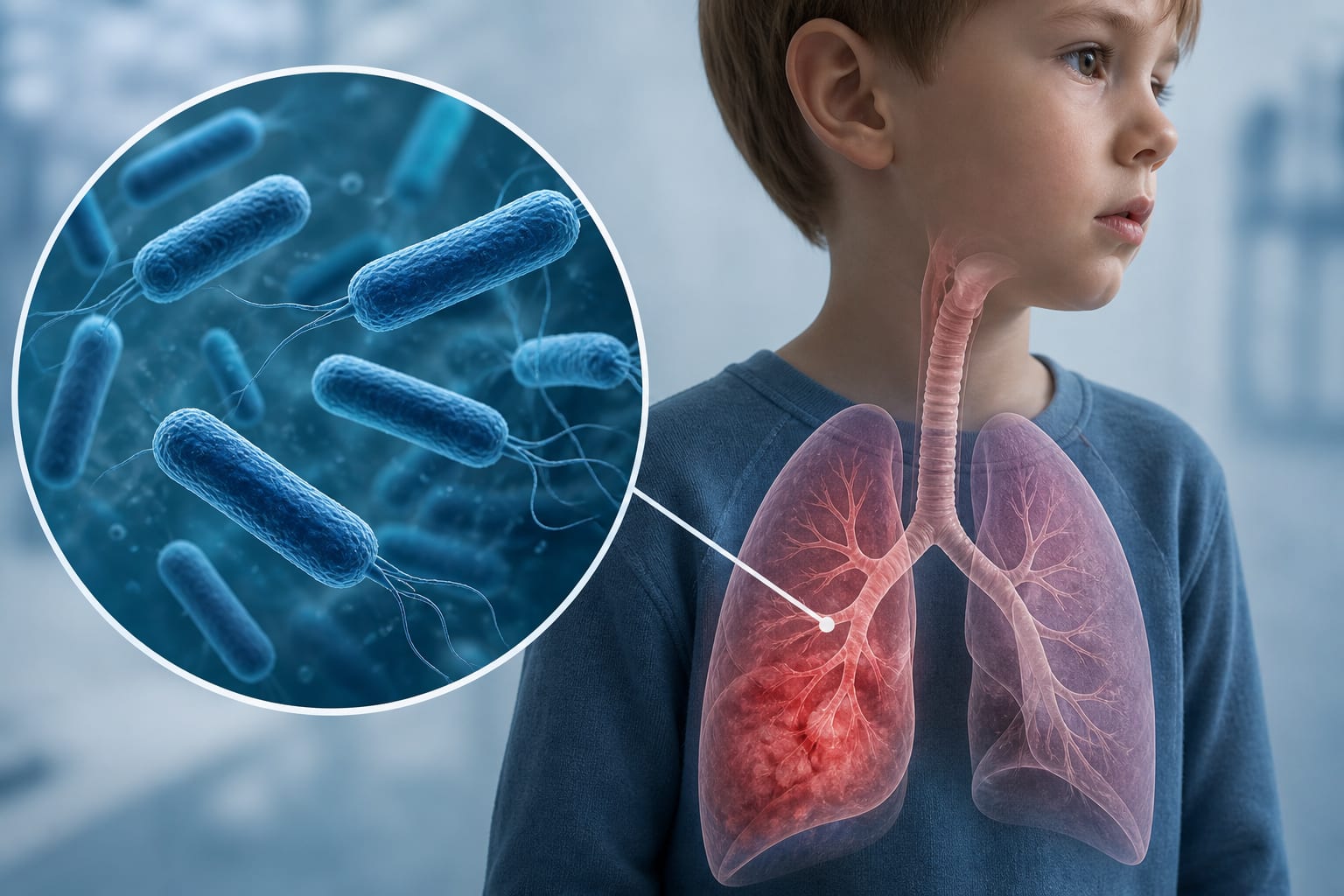
Clinical characteristics and cytokine profiles for early prediction of severe Mycoplasma pneumoniae pneumonia in children: a prospective cohort study - Report - MDSpire

Clinical characteristics and cytokine profiles for early prediction of severe Mycoplasma pneumoniae pneumonia in children: a prospective cohort study

  • By

  • Jiayi Xue

  • Tao Ai

  • Yinghong Fan

  • Cheng Xie

  • Wanmin Xia

  • Li Wang

  • July 10, 2026

  • 0 min

Share

Clinical Report: Early Identification of Severe Mycoplasma pneumoniae Pneumonia

Overview

This study investigates the clinical features and cytokine profiles of children with Mycoplasma pneumoniae pneumonia (MPP) to establish a predictive nomogram for early identification of severe cases.

Background

Mycoplasma pneumoniae is a significant cause of community-acquired pneumonia in children, particularly affecting those under six years of age. Identifying children at risk for severe disease early is critical for timely intervention and improved outcomes. This study addresses the challenge of recognizing severe cases during the early stages of MPP.

Data Highlights

ParameterOdds Ratio (OR)95% Confidence Interval (CI)
Wheezing4.0161.609–10.029
Shortness of breath4.7171.290–16.008
D-dimer3.0321.926–4.773
CRP1.0331.018–1.048
Fever3.4321.658–7.105
Age1.1141.015–1.223

Key Findings

  • 57.3% of children with MPP developed severe Mycoplasma pneumoniae pneumonia (SMPP).
  • Independent risk factors for SMPP include wheezing, shortness of breath, fever, D-dimer, CRP, and age.
  • The predictive nomogram achieved an AUC of 0.818, indicating good discrimination ability.
  • Serum cytokines such as HMGB-1, TFEB, and TNF-α were significantly elevated in the SMPP group compared to the mild MPP group.
  • Dynamic monitoring of cytokines may aid in understanding disease progression in MPP.

Clinical Implications

Healthcare professionals should consider the identified clinical features and laboratory parameters when assessing children for the risk of severe Mycoplasma pneumoniae pneumonia.

Conclusion

The study provides a predictive nomogram for early risk stratification of SMPP in children.

Related Resources & Content

  1. Frontiers in Pediatrics, 2026 -- Mycoplasma pneumoniae pneumonia with and without viral pathogens in preschool-aged children: a comparative study of clinical outcomes
  2. Frontiers in Pediatrics, 2026 -- Clinical characteristics, predictive factors, and therapeutic outcomes of mycoplasma pneumoniae pneumonia with pleural effusion in children: a retrospective cohort study
  3. Frontiers in Pediatrics, 2026 -- Commentary: Comment on 'Comparative analysis of blood routine, C-reactive protein, and biochemical markers in children with Mycoplasma pneumoniae pneumonia and its coinfections'
  4. The Journal of Infectious Diseases -- Nasal Mucosal Cytokines as Potential Biomarkers for Assessing Disease Severity and Class of Pathogen in Children With Community-Acquired Pneumonia
  5. IDSA/PIDS 2026 Guidelines for the Management of Community-Acquired Pneumonia (CAP) in Infants and Children Older Than 3 Months of Age
  6. Low-dose versus high-dose methylprednisolone for children with severe Mycoplasma pneumoniae pneumonia (MCMP): A randomized controlled trial - PubMed
  7. Neutrophil-to-lymphocyte ratio for predicting disease severity and outcomes in children with Mycoplasma pneumoniae pneumonia: a systematic review and meta-analysis - PMC
  8. IDSA/PIDS 2026 Guidelines for the Management of Community-Acquired Pneumonia (CAP) in Infants and Children Older Than 3 Months of Age
  9. Low-dose versus high-dose methylprednisolone for children with severe Mycoplasma pneumoniae pneumonia (MCMP): A randomized controlled trial - PubMed
  10. Neutrophil-to-lymphocyte ratio for predicting disease severity and outcomes in children with Mycoplasma pneumoniae pneumonia: a systematic review and meta-analysis - PMC

Original Source(s)

Related Content