Application of three-dimensional visualization technology on one-step PTCSL for complex hepatolithiasis - Report - MDSpire

Application of three-dimensional visualization technology on one-step PTCSL for complex hepatolithiasis

  • By

  • Yawen Cao

  • Qing Wu

  • Li-Yun Huang

  • Shunqian Wen

  • Zhi-Hao Lai

  • Shuai-Mei Luo

  • Zhao-Wei Ding

  • Cheng Li

  • Yong-Qing Ye

  • July 2, 2026

  • 0 min

Share

Clinical Report: Utilization of 3D Visualization Techniques in One-Step PTCSL

Overview

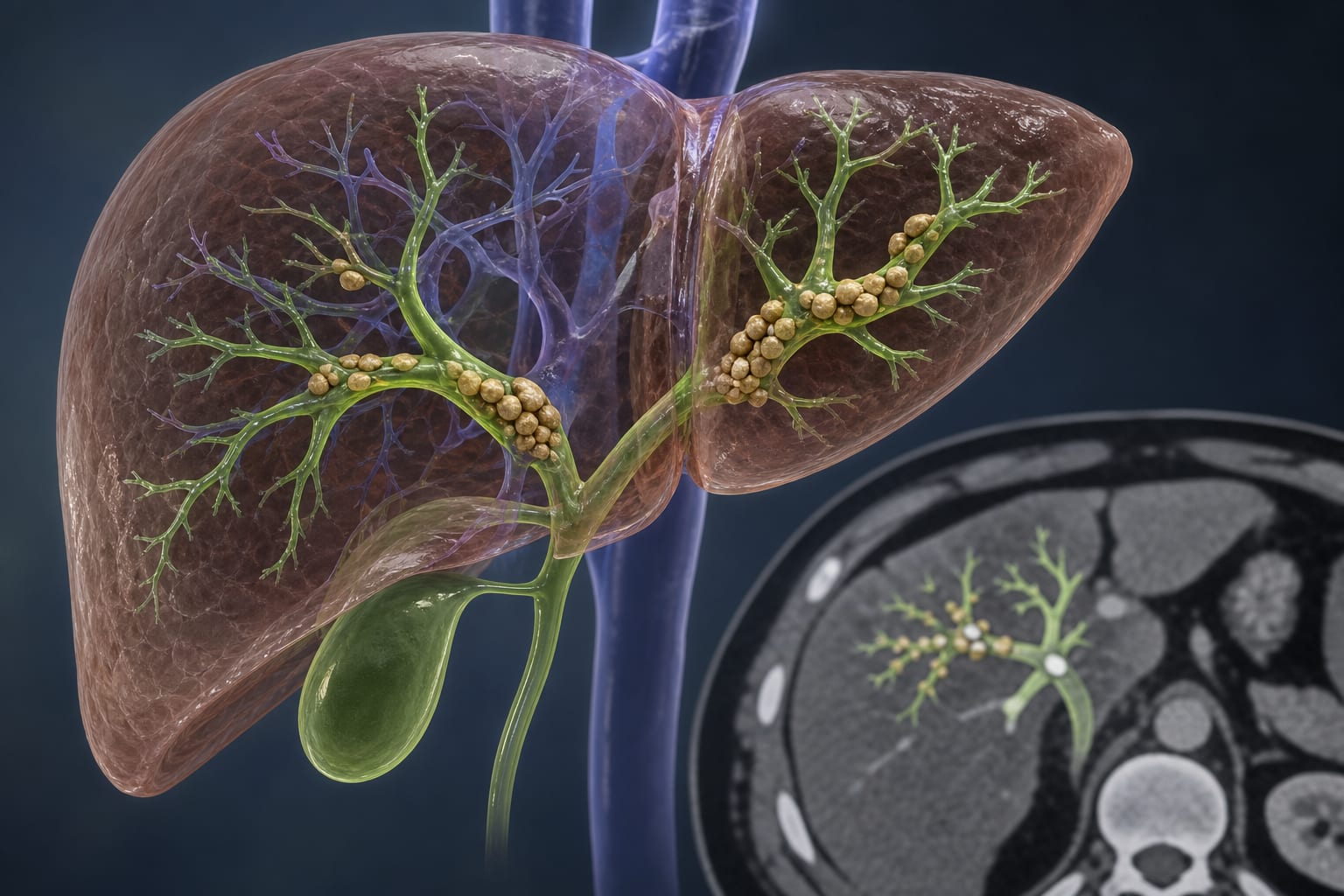
This study investigates the integration of 3D visualization technology into one-step percutaneous transhepatic cholangioscopic lithotripsy (PTCSL) for treating complex hepatolithiasis.

Background

Complex primary hepatolithiasis is a significant challenge in hepatobiliary surgery, characterized by extensive stone distribution and high recurrence rates of postoperative calculi. Traditional surgical approaches, such as hepatectomy, may not be suitable for all patients, particularly those with complex intrahepatic bile duct stones. The introduction of minimally invasive techniques, such as PTCSL, aims to improve outcomes, but challenges remain in accurately visualizing the complex anatomy involved.

Data Highlights

No numerical data or trial results were provided in the source material.

Key Findings

  • 3D visualization technology enhances the understanding of liver anatomy and intrahepatic duct systems.
  • Integration of 3D imaging into PTCSL may reduce intraoperative injuries and postoperative complications.
  • Traditional PTCSL requires multiple surgeries and a long treatment cycle.
  • Patients with complex hepatolithiasis often experience high recurrence rates of stones post-surgery.
  • Soft choledochoscopes facilitate stone extraction compared to rigid ones.

Clinical Implications

The use of 3D visualization in PTCSL may improve surgical planning.

Conclusion

The study supports the incorporation of 3D visualization technology in the surgical management of complex hepatolithiasis.

Related Resources & Content

  1. Employing Immersive Virtual Reality for Surgical Planning: The Role of 3D Liver Models in Hepatobiliary Procedures, Springer, 2021 -- https://link.springer.com/article/10.1007/s00423-021-02127-7
  2. Utilization of Hyper Accurate 3D Technology for Complex Liver Resection Planning: Initial Findings from a Single-Center Study, Updates in Surgery, 2022 -- https://link.springer.com/article/10.1007/s13304-022-01365-8
  3. Impact of 3D Preoperative Simulation on Surgical Outcomes in Liver Procedures, Surgical Endoscopy, 2017 -- https://link.springer.com/article/10.1007/s00268-017-3933-7
  4. Evaluating a Head-Mounted Virtual Reality System Against On-Screen 3D Visualization and 2D CT Imaging for Decision-Making Training in Liver Surgery: A Randomized Controlled Trial, Surgical Endoscopy, 2023 -- https://link.springer.com/article/10.1007/s00464-023-10615-8
  5. Hepatolithiasis: Epidemiology, presentation, classification and management of a complex disease, PMC -- https://pmc.ncbi.nlm.nih.gov/articles/11036492/?utm_source=openai
  6. Endoscopic management of common bile duct stones, ESGE -- https://www.esge.com/assets/downloads/pdfs/guidelines/2019_a_0862_0346.pdf?utm_source=openai
  7. Three-dimensional visualization technology for guiding one-step percutaneous transhepatic cholangioscopic lithotripsy for the treatment of complex hepatolithiasis -- https://pdfs.semanticscholar.org/a06a/bf295d8e631387bd8bd807c3a53f5548e0f7.pdf
  8. Hepatolithiasis: Epidemiology, presentation, classification and management of a complex disease - PMC
  9. Guideline Endoscopic management of common bile duc
  10. Three-dimensional visualization technology for guiding one-step percutaneous transhepatic cholangioscopic lithotripsy for the treatment of complex hepatolithiasis

Original Source(s)

Related Content