Depressive symptoms in chronic kidney disease: the hidden role of uremic toxins - Report - MDSpire

Depressive symptoms in chronic kidney disease: the hidden role of uremic toxins

  • By

  • Hélène Levassort

  • Sophie Liabeuf

  • Julie Boucquemont

  • Gaye Hafez

  • Solene M Laville

  • Celine Lange

  • Luc Frimat

  • Christian Combe

  • Denis Fouque

  • Maurice Laville

  • Christian Jacquelinet

  • Yves-Edouard Herpe

  • Lucile Montalescot

  • Islam Amine Larabi

  • Natalia Alencar de Pinho

  • Ziad A Massy

  • Jean-Claude Alvarez

  • Marion Pépin

  • on behalf of CKD-REIN

  • June 24, 2026

  • 0 min

Share

Clinical Report: The Impact of Uremic Toxins on Depressive Symptoms in CKD

Overview

This study investigates the relationship between uremic toxins and depressive symptoms in patients with chronic kidney disease (CKD).

Background

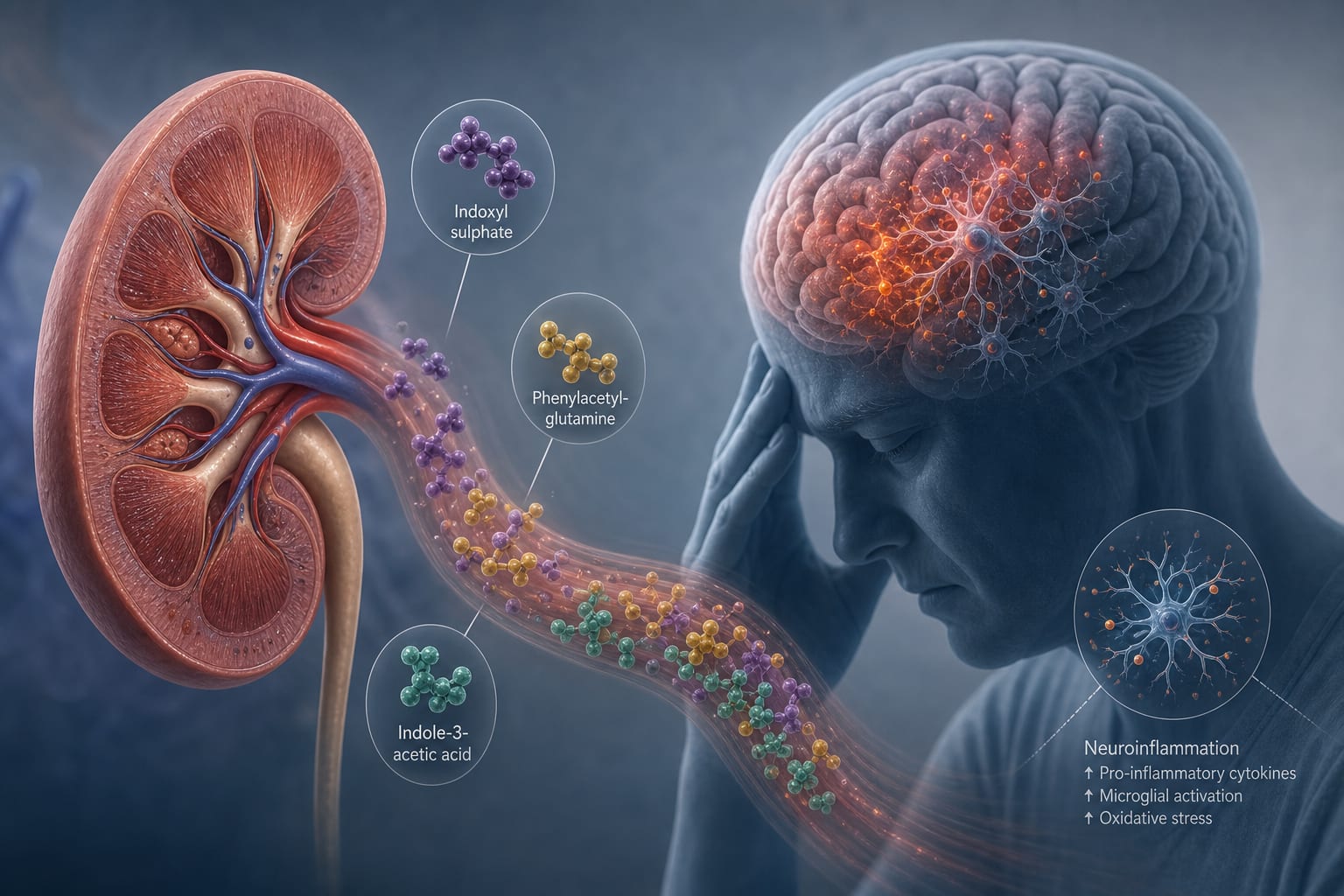
Depression is prevalent in chronic kidney disease (CKD) patients, with rates significantly higher than the general population. The accumulation of uremic toxins (UTs) in CKD may contribute to neuroinflammation and depressive symptoms.

Data Highlights

ParameterValue
Median Age68 years
Mean eGFR35 mL/min/1.73 m²
Median Baseline CESD Score7
Mean Follow-Up Time4.0 years
CESD Score Increase per Year0.11 (0.04 to 0.18)
PAG Score Increase per Doubling0.06 (0.01 to 0.18)
IS Score Increase per Doubling0.20 (0.01 to 0.39)
IAA Score Increase per Doubling0.28 (0.05 to 0.50)

Key Findings

  • 2165 patients were included in the study with a median age of 68 years.
  • The CESD score increased by 0.11 points per year after adjusting for confounders.
  • A doubling in phenylacetylglutamine (PAG) levels was associated with an additional increase of 0.06 points in the CESD score per year.
  • Higher levels of indoxyl sulfate (IS) and indole-3-acetic acid (IAA) were linked to higher mean CESD scores.
  • PAG was significantly associated with changes in CESD scores over time.

Clinical Implications

Further research is needed to clarify the role of uremic toxins in relation to depressive symptoms in CKD patients.

Conclusion

Further studies are needed to confirm these results and to determine whether lowering serum uremic toxin levels would help manage depressive symptoms in patients with CKD.

Related Resources & Content

  1. Frontiers in Immunology, 2026 -- The gut-kidney axis in chronic kidney disease: a vicious cycle of microbial dysbiosis and uremic toxin accumulation
  2. Frontiers in Endocrinology, 2026 -- The role of gut dysbiosis in endocrine and metabolic derangements of chronic kidney disease: mechanisms, controversies, and future perspectives
  3. BMC Psychiatry, 2025 -- Tele-based continuous care and treatment compliance in dialysis patients with and without depression: the serial mediating effect of nurse-patient relationship and health belief
  4. Nature Reviews Nephrology, 2026 -- Mental health and kidney disease
  5. Frontiers in Psychiatry — The trajectories of Demoralization Syndrome and its related factors among elderly patients with end-stage kidney disease: a longitudinal study
  6. KDIGO 2024 CKD Guideline
  7. VA/DoD CKD Guideline 2025
  8. Mental health and kidney disease | Nature Reviews Nephrology
  9. Depression in chronic kidney disease: Particularities, specific mechanisms and therapeutic considerations, a narrative review - ScienceDirect
  10. Uremic Toxins, CKD, and Cognitive Dysfunction - PubMed
  11. Frontiers | Vascular inflammation in chronic kidney disease: the role of uremic toxins in macrophage activation
  12. Effect of the Gut Microbiome on the reduction of uremic toxins in patients with chronic kidney disease: A systematic review & Network meta-analysis
  13. Enhanced sleep quality and reduced indoxyl sulfate levels following probiotic supplementation were linked to gut microbiota modulation in hemodialysis patients - ScienceDirect
  14. Relationship between the clinical efficacy of probiotics and the intestinal microbiota in patients on maintenance dialysis: a prospective, randomized, double-blind, placebo-controlled study | Renal Replacement Therapy | Springer Nature Link
  15. Targeting Protein-Bound Uremic Toxins: A Dual Approach with Medium Cut-Off Membrane Dialysis and a Dietary Intervention—A Randomized Controlled Study - PMC
  16. Impact of Psychosocial Interventions on Depression in Chronic Kidney Disease: A Systematic Review and Meta-Analysis - Jivitesh Singh Chahal, Sumit Saini, Priyanka Bansal, Jivesh Arora, Pir Dutt Bansal, Bhavneesh Saini, 2025
  17. Role of Melatonin as an Adjunctive Treatment for Depression and Cognitive Impairment in Hemodialysis Patients: A Randomized, Double-Blind Clinical Trial - PubMed

Original Source(s)

Related Content