From Engel's Bio-Psycho-Social model to the personalized health determinants model: a comprehensive framework and illustrative operationalization for precision health - Report - MDSpire

From Engel's Bio-Psycho-Social model to the personalized health determinants model: a comprehensive framework and illustrative operationalization for precision health

  • By

  • Nazanin Abbaspour

  • Mory Ghomshei

  • Ario Saeid Vaghefi

  • Karim Abbaspour

  • June 10, 2026

  • 0 min

Share

Clinical Report: Transitioning to the Personalized Health Determinants Model

Overview

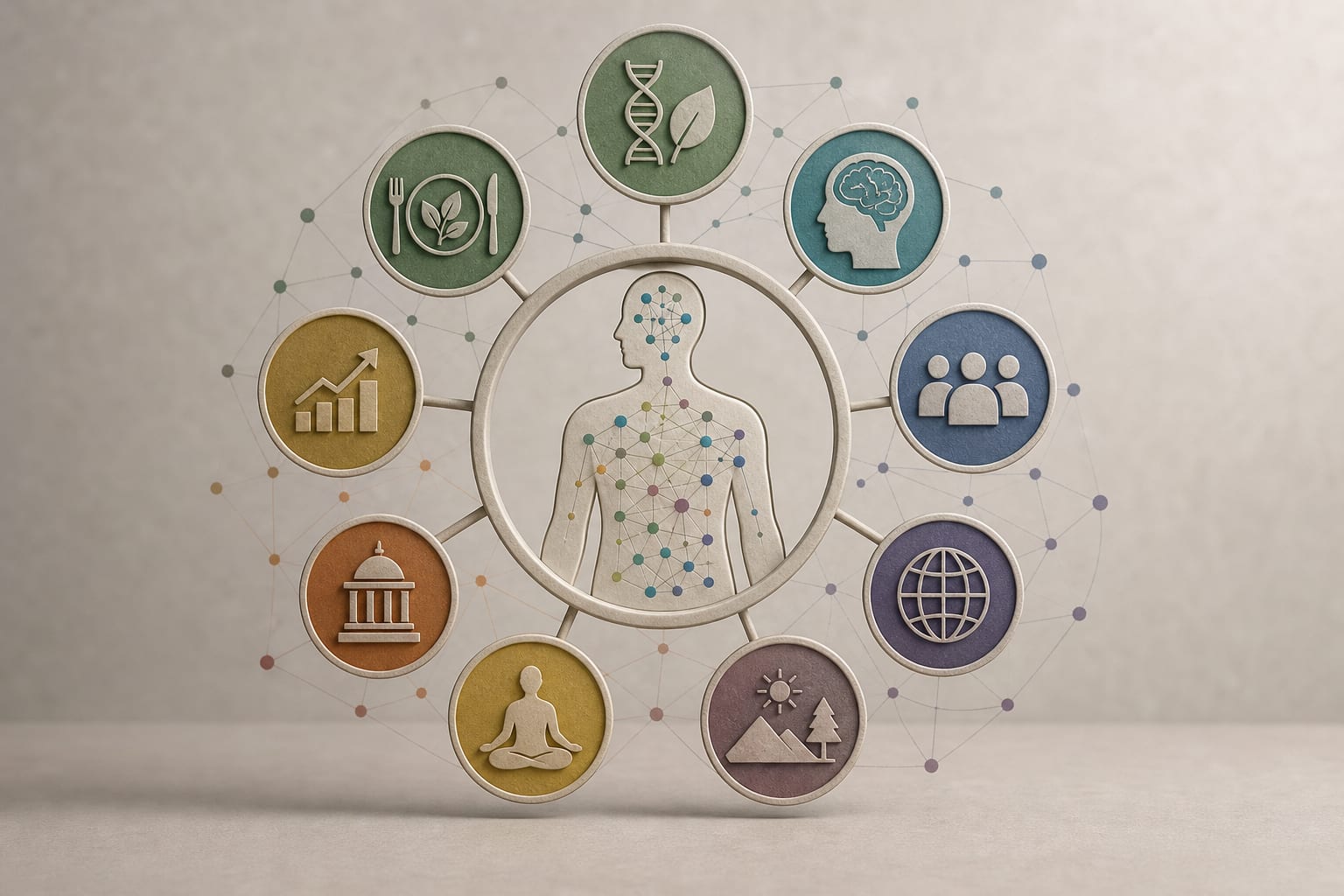
The Personalized Health Determinants Model (PHDm) expands Engel's Bio-Psycho-Social framework into a comprehensive nine-dimension model, addressing critical gaps in precision health.

Background

Engel's Bio-Psycho-Social model has significantly influenced healthcare by integrating biological, psychological, and social perspectives. However, it has been criticized for lacking specificity in areas essential for precision health, such as nutrition and lifestyle factors.

Data Highlights

No numerical data available.

Key Findings

  • The PHDm includes nine dimensions: Biological, Psychological, Social, Cultural, Environmental, Economic, Political, Spiritual, and Lifestyle.
  • Operationalization of the PHDm is illustrated through a case study on obesity using Bayesian Networks and rule-based scoring.
  • Preliminary evaluation on NHANES data showed predictive accuracy for the Bayesian Network.
  • The rule-based system demonstrated concordance in obesity risk quantification.
  • The current model is a proof-of-concept and requires further validation before clinical use.
  • Interdisciplinary collaboration is encouraged to advance the PHDm framework.

Clinical Implications

The PHDm provides a structured approach for clinicians to consider a broader range of health determinants in patient care.

Conclusion

The PHDm represents a new framework for integrating diverse health determinants into clinical practice, although further validation and development are necessary for clinical implementation.
Related Resources & Content

  1. Journal of Medical Internet Research (JMIR), 2026 -- Using Ultra-Abridged Individual Difference Scales for Personalization in Digital Mental Health
  2. Frontiers in Digital Health, 2026 -- Developing a Modular Framework for Digital Health Innovation
  3. npj Digital Medicine, 2025 -- A Systems Dynamics Approach to Tailored Psychiatry
  4. American Diabetes Association, 2026 -- Improving Care and Promoting Health in Populations: Standards of Care in Diabetes
  5. JACC, 2025 -- 2025 AHA/ACC Guideline for the Prevention, Detection, Evaluation, and Management of High Blood Pressure
  6. Journal of Medical Internet Research (JMIR) — Toward Participatory Precision Health With Co-Designed Recommendations: Systematic Review of Just-in-Time Adaptive Interventions in Adolescents and Young Adults
  7. United States Core Data
  8. Risk-Based vs Annual Breast Cancer Screening
  9. 1. Improving Care and Promoting Health in Populations: Standards of Care in Diabetes—2026 | Diabetes Care | American Diabetes Association
  10. 2025 AHA/ACC/AANP/AAPA/ABC/ACCP/ACPM/AGS/AMA/ASPC/NMA/PCNA/SGIM Guideline for the Prevention, Detection, Evaluation, and Management of High Blood Pressure in Adults: A Report of the American College of Cardiology/American Heart Association Joint Committee on Clinical Practice Guidelines | JACC
  11. Low-Intensity Social Care and Child Acute Health Care Utilization: A Randomized Clinical Trial | Trials | JAMA Pediatrics | JAMA Network
  12. Long-term exposure to elemental carbon and disease incidence: a systematic review and meta-analysis | Environmental Health | Full Text
  13. Current Dietary Guidelines | odphp.health.gov
  14. Nutritional Priorities to Support GLP-1 Therapy for Obesity - American Society for Nutrition

Original Source(s)

Related Content