Conexiant’s news site is now MDSpire News. Learn more
Advertisement
Elevation of Cytokeratin-18 as an Early Indicator of Hepatic Cellular Alterations in Obesity Induced by High-Fat Diet Prior to the Development of Steatohepatitis
Elevation of Cytokeratin-18 as an Early Indicator of Hepatic Cellular Alterations
Overview
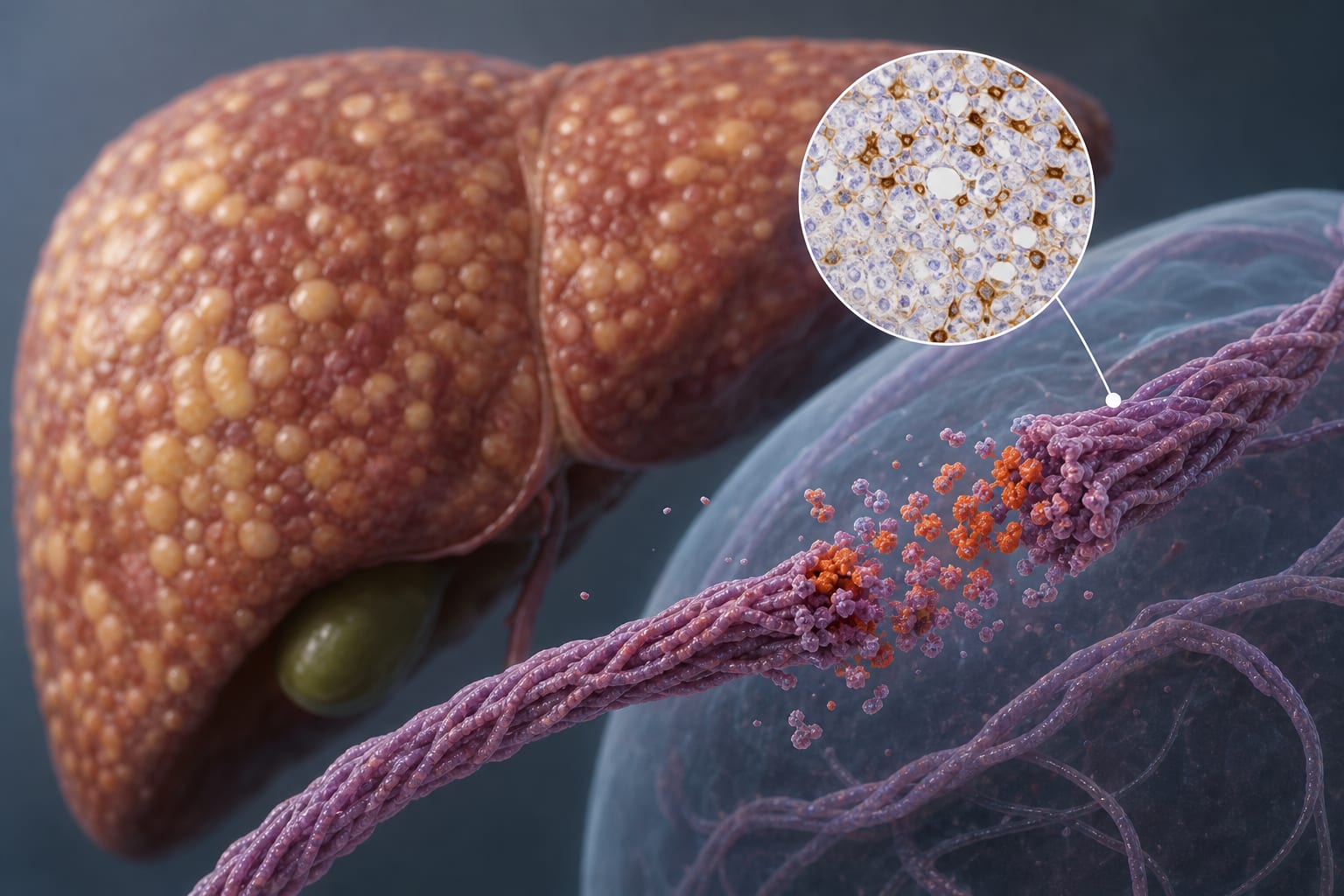
This study demonstrates that high-fat diet-induced obesity in rats leads to increased levels of cytokeratin-18 (CK-18). The findings indicate a relationship between CK-18 levels and liver histopathological changes, particularly ballooning, prior to the development of steatohepatitis.
Background
Obesity is a significant risk factor for non-alcoholic fatty liver disease (NAFLD), which has been redefined as metabolic dysfunction-associated steatotic liver disease (MASLD). The prevalence of NAFLD is increasing globally, closely linked with obesity and metabolic syndrome. Understanding early indicators of liver injury, such as CK-18, is important.
Data Highlights
Parameter
High-Fat Diet (HFD)
Normal-Fat Diet (NFD)
p-value
Final Body Weight (g)
335.8 ± 20.2
291.5 ± 6.25
<0.001
Glucose (mg/dL)
186.4 ± 46.9
130.0 ± 16.2
0.011
Insulin (IU/L)
4.30 ± 0.70
2.23 ± 0.82
<0.001
HOMA-IR
2.03 ± 0.79
0.73 ± 0.34
0.003
ALT (U/L)
72.34 ± 12.35
55.43 ± 5.75
0.009
CK-18 (ng/mL)
1.46 ± 0.18
0.88 ± 0.18
<0.001
AST/ALT Ratio
1.16 ± 0.09
1.32 ± 0.14
0.020
Key Findings
High-fat diet (HFD) led to significant increases in body weight, glucose, insulin, HOMA-IR, ALT, and CK-18 levels compared to normal-fat diet (NFD).
All HFD specimens exhibited ballooning, with half showing steatosis.
CK-18 levels correlated with higher ALT levels and ballooning formation in the HFD group.
NAFLD activity score remained ≤3 in all specimens despite the observed changes.
CK-18 is noted as an indicator of hepatocellular injury in obesity.
Clinical Implications
The elevation of CK-18 in the context of obesity may serve as a biomarker for hepatic cellular alterations.
Conclusion
The study highlights CK-18 as a biomarker for hepatic injury associated with obesity.