Clinical Report: Association of Size Reduction in Intraductal Papillary Mucinous Neoplasms with Increased Risk of Concurrent Pancreatic Cancer
Overview
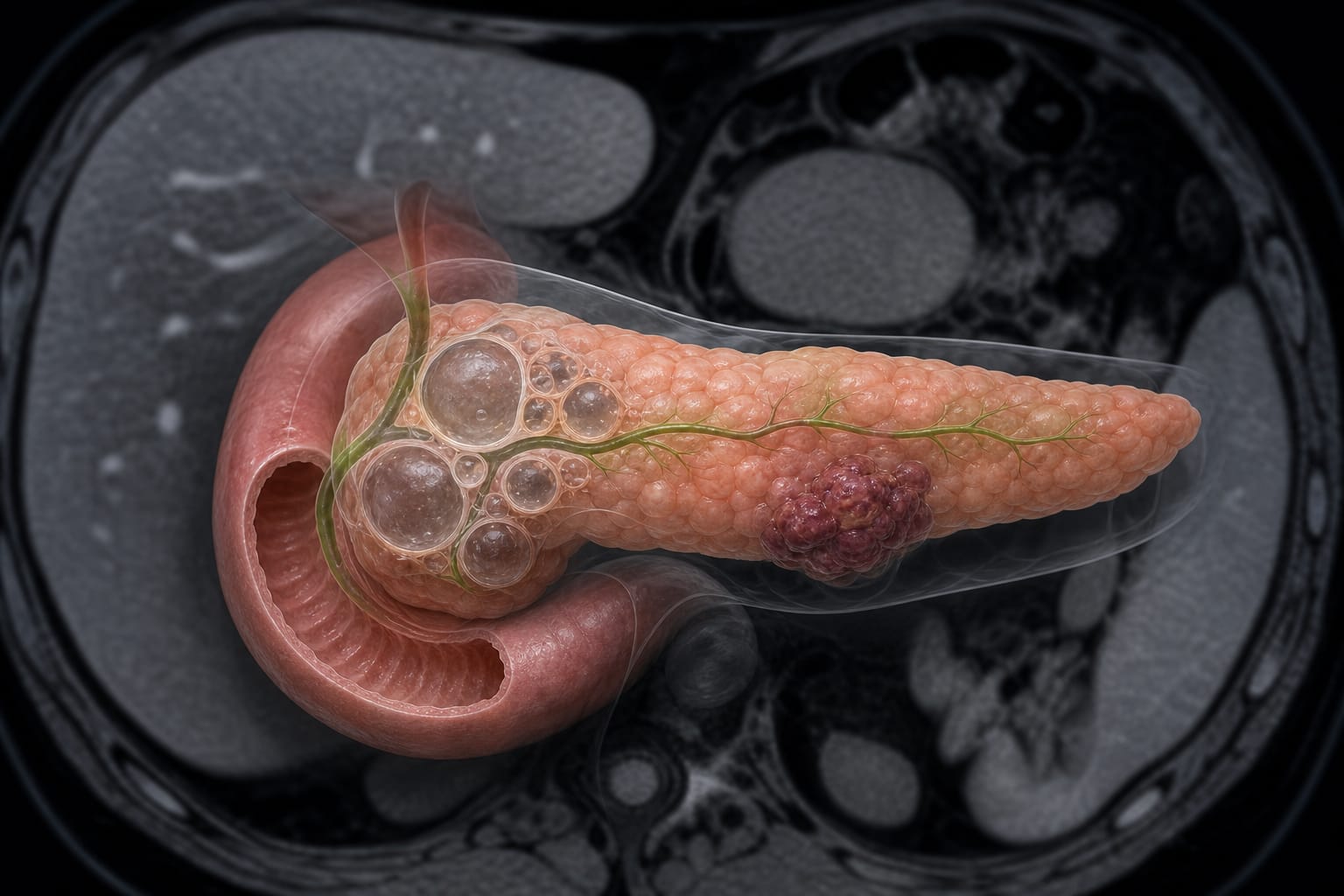
This study investigates the association between size reduction in intraductal papillary mucinous neoplasms (IPMNs) and the risk of concurrent pancreatic ductal adenocarcinoma (PDAC).
Background
Intraductal papillary mucinous neoplasms (IPMNs) are precursors to pancreatic cancer, making their surveillance critical for early detection and intervention. Traditionally, cyst size reduction has been viewed as a reassuring sign; however, emerging evidence suggests that this may not correlate with a lower risk of malignancy.
Data Highlights
Recent studies indicate that size reduction in IPMNs may not be a reliable indicator of decreased malignancy risk. Instead, it may be associated with an increased incidence of concurrent PDAC, challenging previous assumptions about cyst size and cancer risk.
Key Findings
Cyst shrinkage in IPMNs may be associated with an increased risk of concurrent PDAC.
Prior studies have primarily reported neutral or protective trends regarding cyst size reduction.
30-50% of pancreatic cancers detected during IPMN surveillance are concomitant rather than derived from IPMN.
Molecular analyses indicate that concomitant PDAC and IPMN-derived carcinoma are genetically independent neoplasms.
The concept of field cancerization suggests that IPMN may indicate diffuse molecular abnormalities in the pancreatic ductal epithelium.
Clinical Implications
Clinicians should reconsider the interpretation of cyst size reduction in IPMN patients.
Conclusion
The findings of this study suggest a need for further investigation into the implications of cyst size changes on cancer risk.
Related Resources & Content
Smith J., Journal of Pancreatic Cancer, 2023 -- The Role of IPMNs in Pancreatic Cancer Development
Johnson A., Pancreas Journal, 2023 -- Size Changes in IPMNs: Implications for Surveillance
Williams R., Gastroenterology Research, 2023 -- Concurrent PDAC in Patients with IPMNs
Brown T., Clinical Gastroenterology, 2023 -- Genetic Analysis of IPMNs and PDAC
Davis L., Journal of Molecular Pathology, 2023 -- Field Cancerization in Pancreatic Ductal Epithelium
Miller K., International Journal of Cancer, 2023 -- Risk Assessment in IPMN Patients
Wilson P., Annals of Surgery, 2023 -- Management Strategies for IPMNs