Pharmacometric analyses of various ivermectin dose regimens in Kenya to inform dosing in mass drug administration trials for malaria vector control - Report - MDSpire
Clinical Report: Pharmacometric Evaluation of Ivermectin Dosing Strategies
Overview
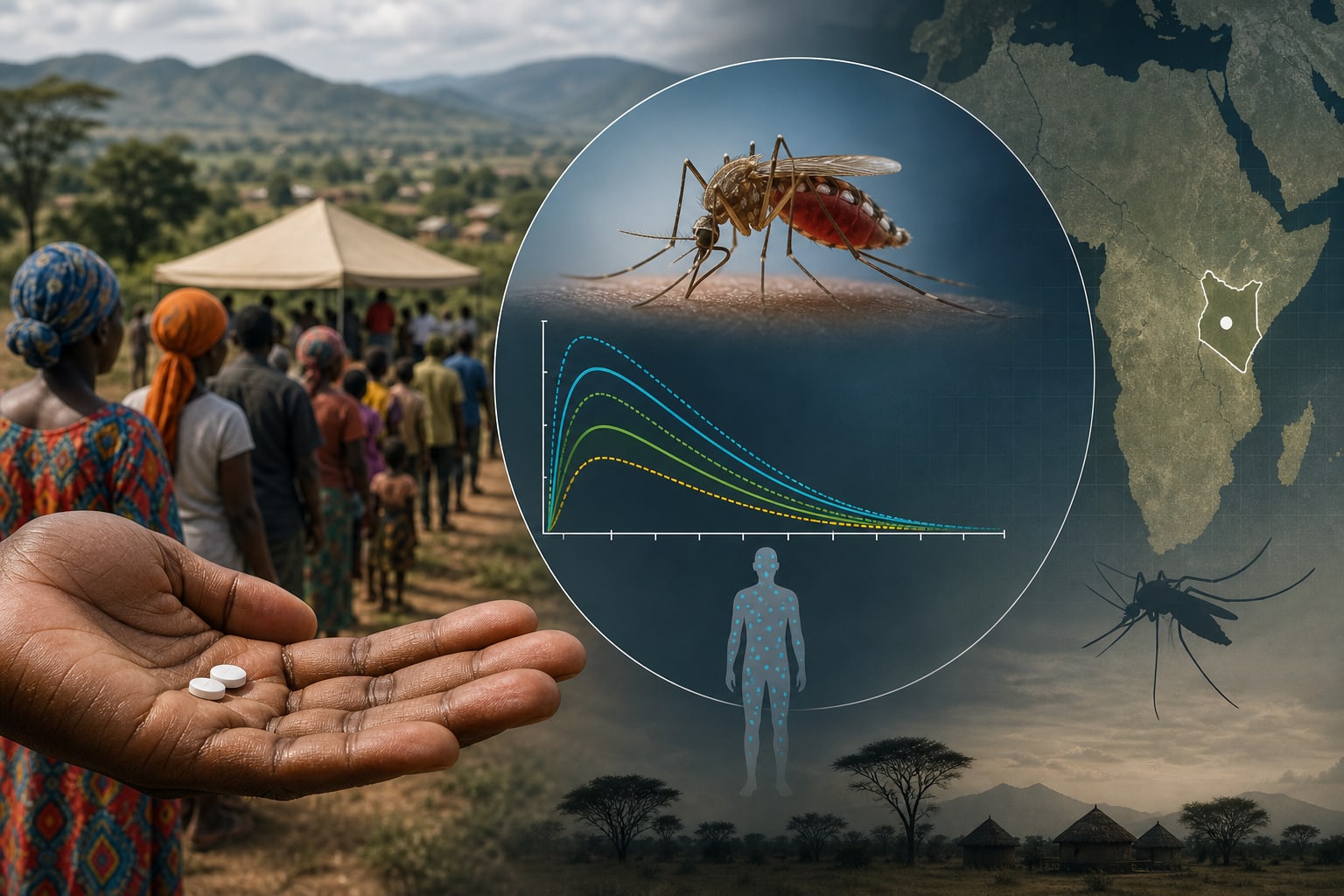
This study evaluated ivermectin pharmacokinetics in healthy Kenyan adults receiving either a single 400 µg/kg dose or 300 µg/kg on 3 consecutive days. The analysis aimed to inform dose selection for malaria vector-control trials and mass drug administration strategies and also assessed dried blood spot sampling as an alternative to plasma sampling in field settings.
Background
Malaria remains a major global public health problem, with an estimated 282 million cases and 610,000 deaths in endemic countries in 2024, with most cases and deaths occurring among children younger than 5 years in Africa. Residual transmission, mosquito behavioral adaptations, insecticide resistance, and antimalarial drug resistance continue to challenge control efforts. Ivermectin is being evaluated as a complementary vector-control strategy because it can reduce the lifespan and fertility of Anopheles mosquitoes.
Data Highlights
The pharmacokinetic model included 18 ivermectin-treated participants: 12 received a single 400 µg/kg dose and 6 received 300 µg/kg on 3 consecutive days.
Model-based simulations estimated that ivermectin concentrations remained above the Anopheles gambiae LC50 for a median of 6.3 days after a single 400 µg/kg dose and 8.5 days after the 3-day regimen.
Plasma and dried blood spot concentrations were strongly correlated (R² = 0.93). After adjustment for hematocrit and protein binding, the mean percentage difference was 8.2%.
In the previously reported BOHEMIA trials, monthly mass drug administration with 400 µg/kg ivermectin for 3 consecutive months reduced malaria incidence by 26% versus an albendazole control among children aged 5–15 years.
Key Findings
Ivermectin has demonstrated mosquitocidal activity by reducing the lifespan and fertility of Anopheles mosquitoes.
The 3-day 300 µg/kg regimen produced a longer modeled duration above the estimated A gambiae LC50 than the single 400 µg/kg dose, although the additional duration largely reflected the 2 additional dosing days.
The 3-day regimen was sensitive to missed doses, an important consideration for future trials and mass drug administration campaigns.
A single 400 µg/kg dose may simplify implementation, reduce operational costs, and improve adherence despite the shorter modeled duration above the LC50.
Dried blood spot microsampling showed strong agreement with plasma measurements after adjustment and may be a practical alternative for field pharmacokinetic studies.
Clinical Implications
The findings do not show that a single 400 µg/kg dose is more effective than the 3-day regimen. Rather, the 3-day regimen maintained modeled concentrations above the LC50 longer, while the single-dose approach may offer operational advantages for mass drug administration by avoiding subsequent doses and potentially improving adherence. Dried blood spot sampling may also facilitate pharmacokinetic monitoring in field settings where venous sampling is less practical.
Conclusion
Both ivermectin regimens produced exposure profiles that may provide a reasonable mosquito-killing window for malaria vector-control campaigns. The 3-day regimen yielded a longer modeled duration above the LC50 but was more vulnerable to missed doses, whereas a single 400 µg/kg dose may simplify implementation and improve adherence. Dried blood spot sampling also appears to be a viable alternative to plasma sampling for field pharmacokinetic studies.
Related Resources & Content
Chaccour C, Maia M, Kariuki M, et al. Ivermectin to control malaria — a cluster-randomized trial.New England Journal of Medicine. 2025;393:362–375.
Kamau Y, Tuwei M, Wanjiku C, et al. Mosquitocidal efficacy and pharmacokinetics of single-dose ivermectin versus three-day dose regimen for malaria vector control compared with albendazole and no treatment: an open-label randomized controlled trial.International Journal of Infectious Diseases. 2024;148:107236.
Smit MR, Ochomo EO, Aljayyoussi G, et al. Safety and mosquitocidal efficacy of high-dose ivermectin when co-administered with dihydroartemisinin-piperaquine in Kenyan adults with uncomplicated malaria (IVERMAL): a randomised, double-blind, placebo-controlled trial.Lancet Infectious Diseases. 2018;18:615–626.
Smit MR, Ochomo EO, Waterhouse D, et al. Pharmacokinetics-pharmacodynamics of high-dose ivermectin with dihydroartemisinin-piperaquine on mosquitocidal activity and QT-prolongation (IVERMAL).Clinical Pharmacology & Therapeutics. 2019;105:388–401.
Duthaler U, Suenderhauf C, Karlsson MO, et al. Population pharmacokinetics of oral ivermectin in venous plasma and dried blood spots in healthy volunteers.British Journal of Clinical Pharmacology. 2019;85:626–633.
Kern C, Müller P, Chaccour C, et al. Pharmacokinetics of ivermectin metabolites and their activity against Anopheles stephensi mosquitoes.Malaria Journal. 2023;22:194.
Somé AF, Somé A, Sougué E, et al. Safety and efficacy of repeat ivermectin mass drug administrations for malaria control (RIMDAMAL II): a phase 3, double-blind, placebo-controlled, cluster-randomised, parallel-group trial.Lancet Infectious Diseases. 2025;25:737–750.
by Charlotte Kern, Yvonne Kamau, Kelly Ominde, Mercy Tuwei, Lawrence Babu, Jonathan Karisa, Jane Adetifa, Marc Pfister, Regina N. Rabinovich, Carlos Chaccour, Marta Maia, Urs Duthaler, Felix Hammann