Quantitative multi-slice spiral CT perfusion parameters as predictors of collateral status and 90-day functional outcome in acute ischemic stroke - Report - MDSpire

Quantitative multi-slice spiral CT perfusion parameters as predictors of collateral status and 90-day functional outcome in acute ischemic stroke

  • By

  • Dan Zhu

  • Xiaozhou Ma

  • Yingzhi Jiao

  • Shuai Liu

  • Jinzhu Yan

  • Lixin Zhang

  • July 6, 2026

  • 0 min

Share

Clinical Report: Assessment of CT Perfusion Metrics in Acute Ischemic Stroke

Overview

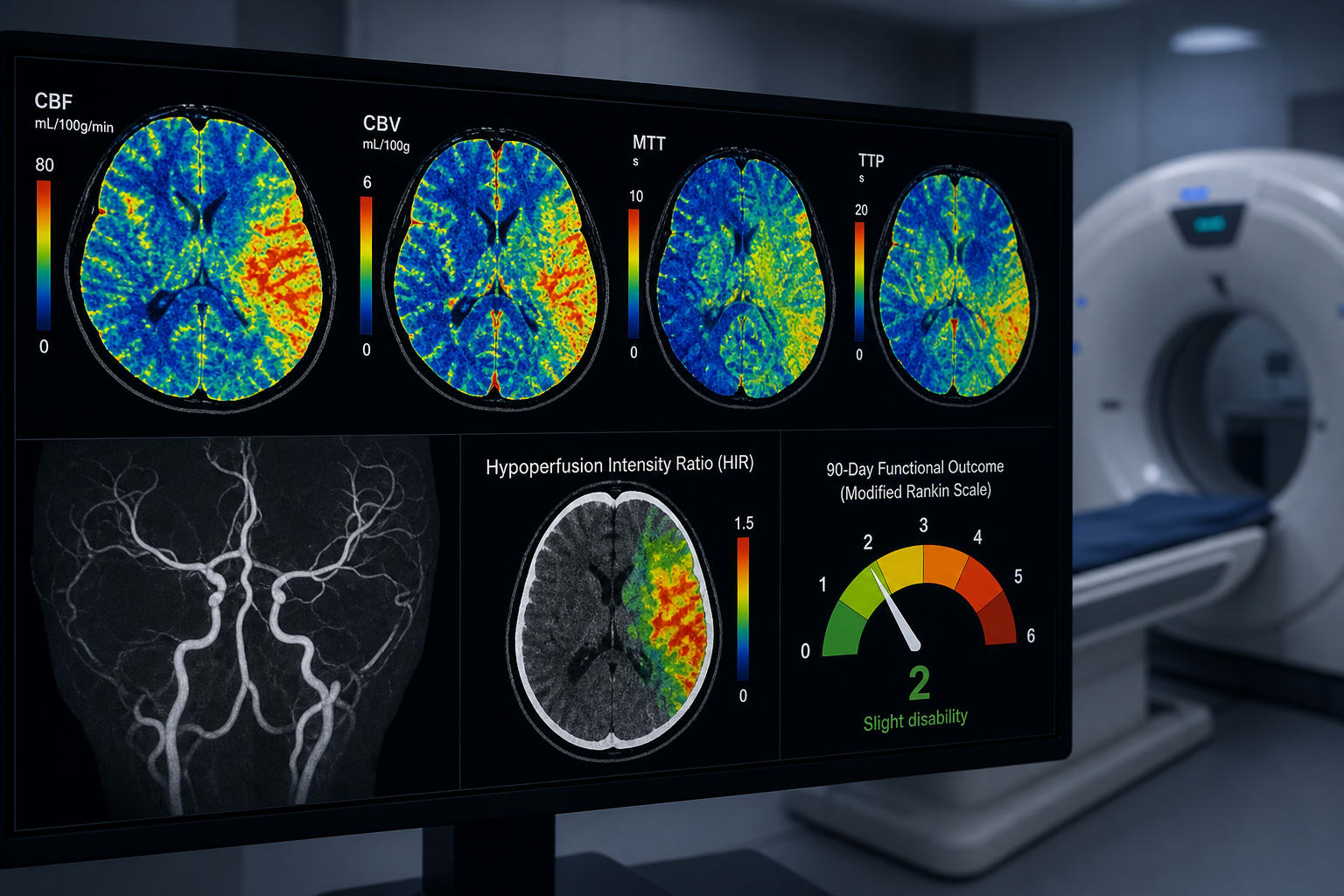
This study evaluates the role of quantitative CT perfusion parameters in assessing collateral circulation and predicting 90-day functional outcomes in acute ischemic stroke.

Background

Acute ischemic stroke (AIS) is a leading cause of mortality and disability worldwide. Understanding collateral circulation is crucial for managing AIS, as it influences tissue viability and treatment outcomes. Recent advancements in CT perfusion imaging provide valuable insights into collateral function.

Data Highlights

ParameterFindings
Hypoperfusion Intensity Ratio (HIR)AUC of 0.925 for diagnostic performance
Combined Model (HIR–rCBF–Tmax)AUC of 0.938 for predicting outcomes
Relative Cerebral Blood Flow (rCBF)Correlated negatively with infarct volume
Favorable OutcomesMore frequent in patients with robust collaterals

Key Findings

  • Patients with robust collateral circulation had higher relative cerebral blood flow and volume.
  • Hypoperfusion intensity ratio (HIR) demonstrated strong diagnostic performance with an AUC of 0.925.
  • HIR achieved an AUC of 0.912 for predicting unfavorable 90-day outcomes.
  • The combined HIR–rCBF–Tmax model achieved an AUC of 0.938.
  • Favorable outcomes were more frequent in patients with robust collaterals.

Clinical Implications

Quantitative CT perfusion parameters can assess collateral circulation and predict functional outcomes in acute ischemic stroke patients.

Conclusion

The study highlights the utility of quantitative CT perfusion metrics in assessing collateral circulation in acute ischemic stroke.

Related Resources & Content

  1. European Radiology, 2023 -- Collateral Mapping: Forecasting Lesion Expansion and Penumbral Area Following Acute Anterior Circulation Ischemic Stroke
  2. conexiant -- CT Perfusion Detects Tissue at Risk in Mild Stroke
  3. European Radiology, 2024 -- Clinical Outcomes and Imaging Metrics in Extensive Ischemic Stroke: A Comparison of Cerebral Edema Assessments
  4. American Stroke Association -- Acute Ischemic Stroke Resources
  5. Assessment of Hyperperfusion Occurrence After Carotid Artery Stenting Utilizing Preoperative CT Perfusion Imaging
  6. Acute Ischemic Stroke Resources | American Stroke Association
  7. Collateral status contributes to differences between observed and predicted 24-h infarct volumes in DEFUSE 3 - PMC
  8. The Role of CT Perfusion in the Evaluation and Management of Acute Ischemic Stroke—A Systematic Review - PMC

Original Source(s)

Related Content