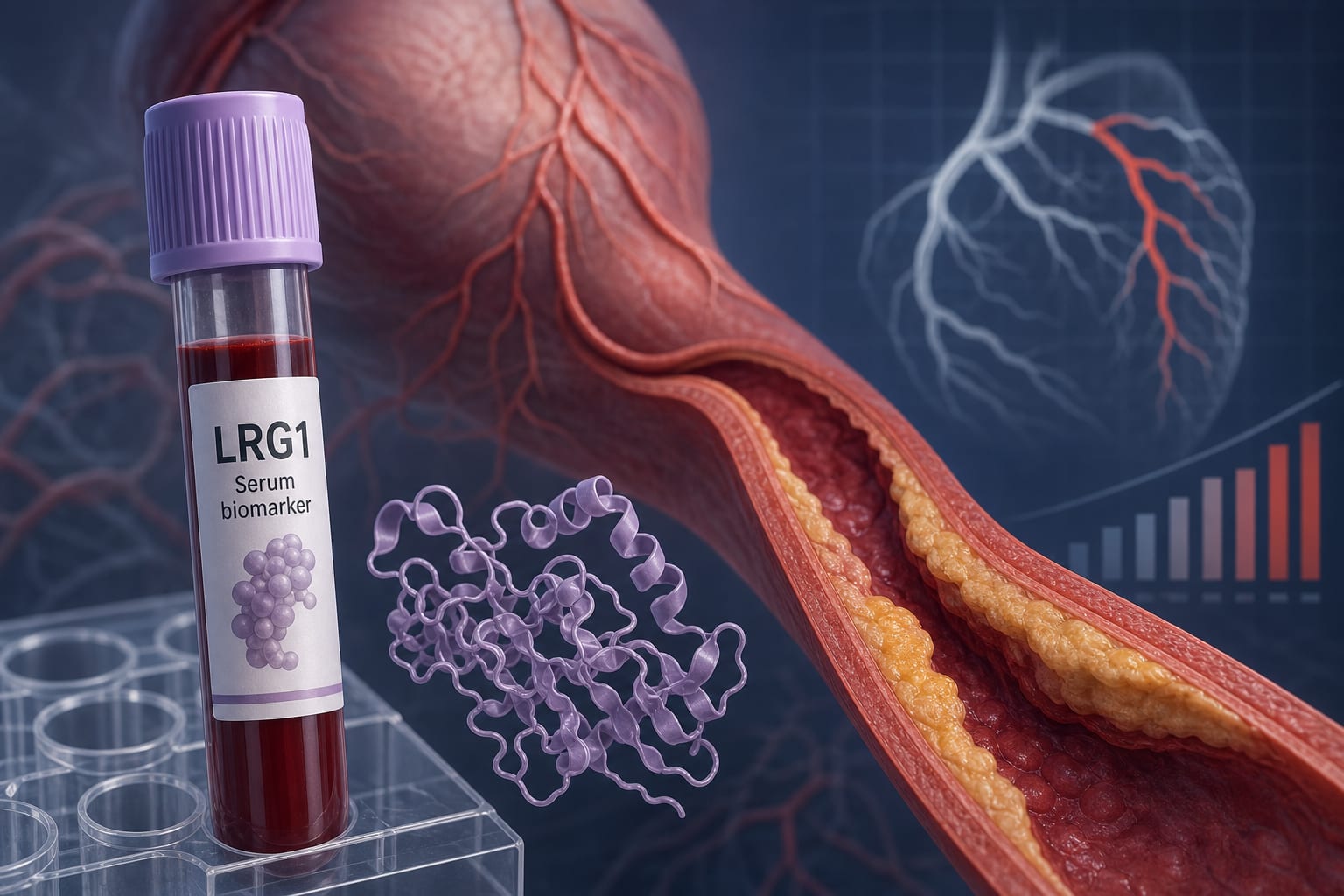
Serum LRG1 as a non-invasive biomarker for identifying complex coronary anatomy in pre-angiography risk stratification - Report - MDSpire

Serum LRG1 as a non-invasive biomarker for identifying complex coronary anatomy in pre-angiography risk stratification

  • By

  • Zhengkai Yang

  • Zirui Liu

  • Ying Xu

  • Haocheng Wang

  • Yu Lu

  • Cao Zou

  • June 4, 2026

  • 0 min

Share

Clinical Report: Serum Levels of LRG1 as a Non-Invasive Indicator for Assessing Complex Coronary Anatomy

Overview

This study investigates the potential of serum LRG1 levels as a non-invasive biomarker for assessing complex coronary anatomy prior to angiography. It finds that LRG1, in conjunction with LDL-C, may serve as an independent predictor of elevated SYNTAX Scores in patients with coronary artery disease.

Background

The SYNTAX Score is a critical tool for evaluating coronary anatomy complexity, guiding revascularization strategies. However, its dependence on invasive angiography limits early risk assessment. Identifying non-invasive biomarkers like LRG1 could enhance the ability to predict complex coronary lesions and improve patient management.

Data Highlights

ParameterAMI PatientsNon-AMI Patients
Serum LRG1 Levels (μg/mL)277.2 (122.8–393.6)113.4 (65.8–248.9)

Key Findings

  • Serum LRG1 levels were significantly elevated in AMI patients compared to non-AMI patients.
  • Patients with SYNTAX Scores ≥ 23 had higher serum LRG1 concentrations than those with Scores < 23.
  • LRG1 and LDL-C were identified as independent predictors of elevated SYNTAX Score ≥ 23.
  • The logistic regression model demonstrated moderate discriminatory ability (AUC = 0.771).
  • The model showed excellent calibration with a Hosmer-Lemeshow test result of P = 0.416.

Clinical Implications

The findings suggest that serum LRG1 could be utilized as a non-invasive adjunct in the risk stratification of patients with complex coronary anatomy. This may facilitate earlier identification of patients requiring more intensive management prior to invasive procedures.

Conclusion

Serum LRG1 levels may serve as a valuable non-invasive biomarker for assessing complex coronary anatomy, potentially aiding in the early identification of patients at risk for adverse cardiovascular events.

Related Resources & Content

  1. Clinical Research in Cardiology, 2025 -- Improved Risk Assessment in Chronic Coronary Syndrome Through the Left Atrioventricular Coupling Index
  2. Frontiers in Cardiovascular Medicine, 2026 -- The serum ANGPTL4 level and severe coronary artery calcification: from association to risk prediction using a nomogram
  3. Clinical Research in Cardiology, 2021 -- Enhancing Risk Evaluation Post-ST-Segment Elevation Myocardial Infarction Through Global Longitudinal Strain: A Comparative Analysis of Left Ventricular Functional Metrics
  4. Clinical Research in Cardiology, 2025 -- Gender-specific effects of Lipoprotein(a) concentrations on coronary plaque features: Insights from the COPRODUCTION Registry
  5. 2024 ESC Guidelines for Chronic Coronary Syndromes
  6. Frontiers | Coronary angiography: a review of the state of the art and the evolution of angiography in cardio therapeutics
  7. Serum leucine-rich α-2 glycoprotein 1 predicts 10-year mortality and vascular events in coronary angiography patients
  8. https://www.escardio.org/static-file/Escardio/Guidelines/Products/Essential%20Messages/2024%20EM/Essential%20Messages_2024%20CCS.pdf

Original Source(s)

Related Content