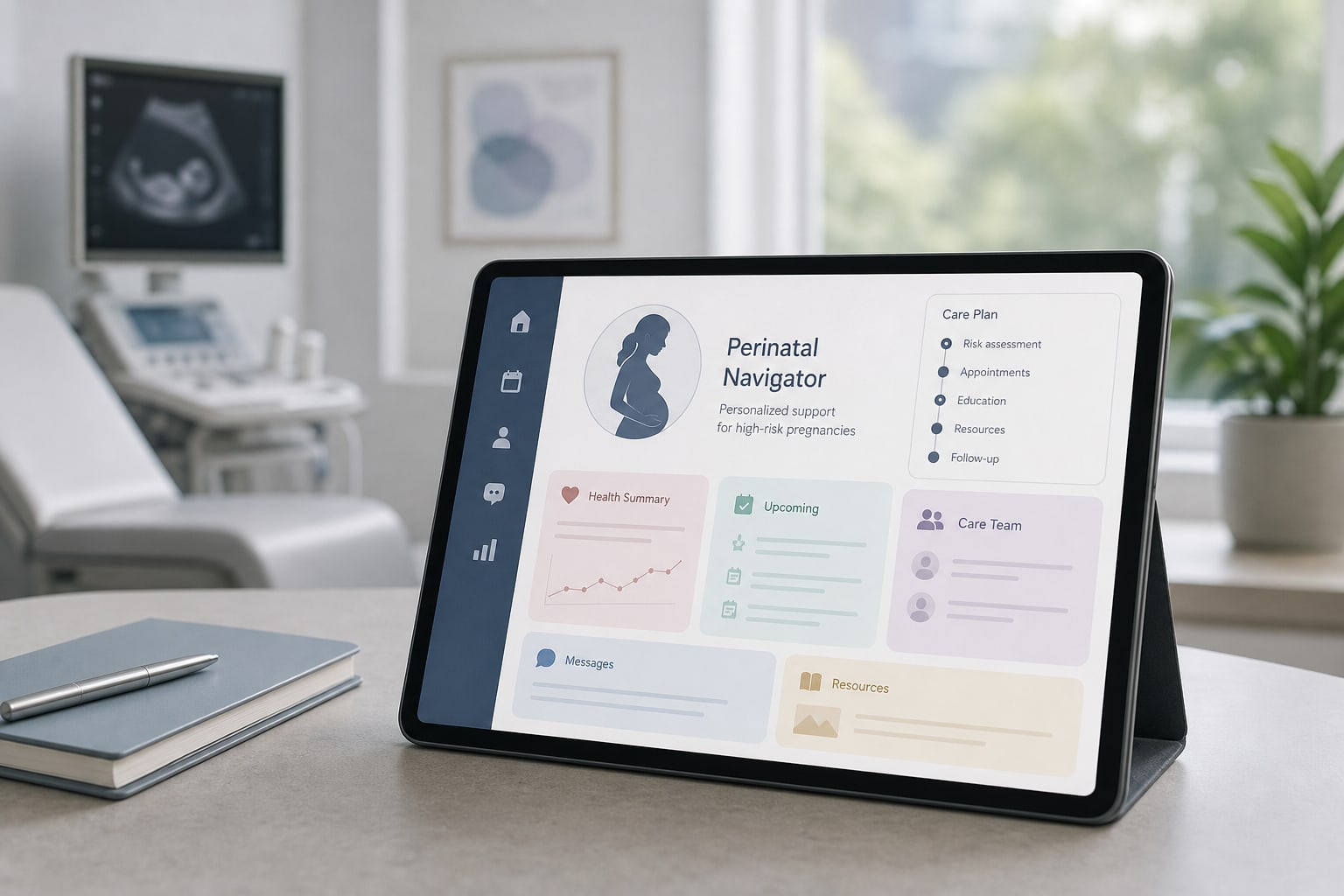
Clinical Report: Digital Perinatal Navigation for High-Risk Pregnancies
Overview
The supplied article context describes the rationale for a mixed-methods study assessing the feasibility and usability of a digital perinatal navigation tool for high-risk pregnancies, but it does not provide the study methods or results. The background identifies perinatal mental health conditions and obstetric complications as concerns associated with maternal, fetal, and child outcomes; no tool-specific findings can be reported from the available material.
Background
Pregnancy and the postpartum period involve physical, emotional, and psychosocial changes, and quality of life may be affected by mental health symptoms, obstetric complications, and pregnancy-related symptoms. The supplied context reports estimates of depression in 9.3% of pregnant individuals, anxiety in 16.9%, and at least one mental health disorder in up to 43.6%. Antenatal depression has been associated with preterm birth, low birth weight, and intrauterine growth restriction, while prenatal depression and anxiety have been associated with child socioemotional development. These concerns provide context for evaluating navigation support in high-risk pregnancy, although the supplied material does not describe the digital tool’s performance or outcomes.
Data Highlights
Measure
Reported estimate or association
Source in supplied context
Depression during pregnancy
Approximately 9.3%
Wallwiener et al., 2019
Anxiety during pregnancy
Approximately 16.9%
Wallwiener et al., 2019
At least one mental health disorder during pregnancy
Up to 43.6%
Wallwiener et al., 2019
Antenatal depression
Associated with preterm birth, low birth weight, and intrauterine growth restriction
Grote et al., 2010
Prenatal depression and anxiety
Associated with child socioemotional development
Madigan et al., 2018
Key Findings
The article title identifies a mixed-methods study focused on feasibility and usability of a digital perinatal navigation tool for high-risk pregnancies; the supplied material contains no study-specific methods or results.
The context reports that depression affects approximately 9.3% of pregnant individuals and anxiety 16.9%; up to 43.6% experience at least one mental health disorder during pregnancy (Wallwiener et al., 2019).
Pregnancy-related mental health symptoms, obstetric complications, and symptoms such as nausea are described as factors associated with reduced quality of life (Lagadec et al., 2018).
Antenatal depression is associated with increased risks of preterm birth, low birth weight, and intrauterine growth restriction (Grote et al., 2010).
Prenatal depression and anxiety have been associated with children’s socioemotional development, and maternal psychological distress has been linked to poorer developmental outcomes during school years (Madigan et al., 2018; Kingston and Tough, 2014).
A related perspective describes maternal mHealth as connective infrastructure and argues that usability depends not only on user-centered design but also on health-system compatibility, governance, trust, navigation assistance, and traversable care pathways; this is a perspective, not a finding from the titled study.
Clinical Implications
The supplied context supports attention to mental health and obstetric risks when considering care for high-risk pregnancies, but it does not establish whether the digital navigation tool is feasible, usable, or clinically effective. The related perspective identifies system compatibility, governance, trust, and navigable care pathways as considerations for maternal mHealth; these are contextual considerations rather than evaluated outcomes of the titled study.
Conclusion
The provided material establishes a clinical rationale for studying digital navigation in high-risk pregnancy but does not include the study’s results. Conclusions about feasibility, usability, or effects on care cannot be drawn from the supplied information.
Related Resources & Content
Lagadec N, et al., BMC Pregnancy and Childbirth, 2018 — Factors influencing the quality of life of pregnant women: a systematic review
Wallwiener S, et al., Archives of Gynecology and Obstetrics, 2019 — Epidemiology of mental disorders during pregnancy and link to birth outcome
Grote NK, et al., Archives of General Psychiatry, 2010 — A meta-analysis of depression during pregnancy and the risk of preterm birth, low birth weight, and intrauterine growth restriction
Madigan S, et al., Journal of the American Academy of Child & Adolescent Psychiatry, 2018 — A meta-analysis of maternal prenatal depression and anxiety on child socioemotional development
Kingston D, Tough S., Maternal and Child Health Journal, 2014 — Prenatal and postnatal maternal mental health and school-age child development: a systematic review
by Michelle Foerstel, Kristina Killinger, Mitho Mueller, Verena Engel, Katrin Schlobohm, Anna Sophie Scholz, Maren Goetz, Armin Bauer, Markus Wallwiener, Michael Abou-Dakn, Dorothea Scholle, Ekkehard Schleussner, Stephanie Wallwiener