Reevaluating Hypoabsorptive Bariatric Surgery: An In-Depth Analysis of Long-Term Results and Clinical Considerations
-
By
-
Francesco Saverio Papadia
-
May 28, 2026
Clinical Report: Reevaluating Hypoabsorptive Bariatric Surgery
Overview
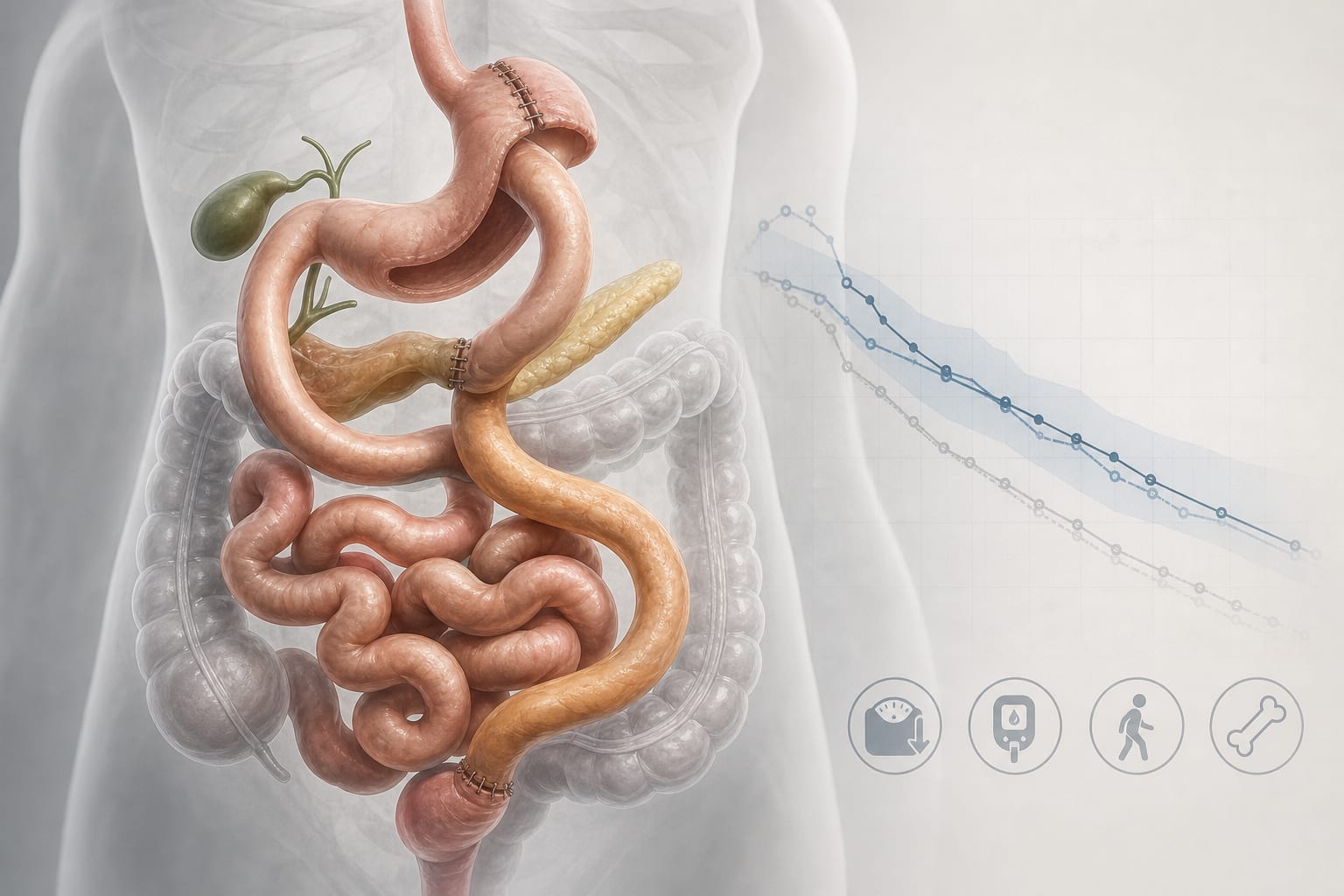
This report examines the long-term outcomes and clinical considerations of hypoabsorptive bariatric surgery, highlighting its efficacy in weight loss and metabolic comorbidity resolution. Despite its benefits, adoption remains low due to perceived risks and complications.
Background
Hypoabsorptive bariatric surgery, including procedures like biliopancreatic diversion and duodenal switch, offers significant weight loss and resolution of metabolic comorbidities. However, these procedures represent a small fraction of bariatric surgeries performed, primarily due to concerns over long-term complications and a lack of training among surgeons. Understanding the long-term outcomes and safety profiles of these surgeries is essential for informed clinical decision-making.
Data Highlights
| Procedure | %TWL at 24 months | Leak Rate (30 days) |
|---|---|---|
| BPD/DS | 40.6% | 0.8% |
| RYGB | 33.8% | 0.4% |
| SADI-S | 36.0% | N/A |
| OAGB | N/A | N/A |
Key Findings
- Hypoabsorptive procedures account for less than 3% of bariatric surgeries in the US.
- 30-day leak rates for BPD/DS are 0.8%, higher than RYGB at 0.4%.
- Weight loss outcomes at 24 months show BPD/DS achieving 40.6% total weight loss (TWL).
- Long-term studies indicate sustained weight loss with BPD/DS, with %EWL of 65.1% at 2 years and 67.9% at 10-15 years.
- Complications are more prevalent in older, frailer patients, emphasizing the need for careful patient selection.
Clinical Implications
Surgeons should consider hypoabsorptive bariatric surgery for select patients, particularly those with higher BMI or previous surgical failures. Ongoing nutritional surveillance and patient education about potential complications are critical for successful outcomes.
Conclusion
Hypoabsorptive bariatric surgery presents a viable option for effective long-term weight management and metabolic improvement, though it requires careful patient selection and management of potential complications.
Related Resources & Content
- Obesity Surgery, 2018 -- Long-Term Weight Loss Results Following Bariatric Surgery
- Obesity Surgery, 2021 -- Evaluating the Long-term Effectiveness of Roux-en-Y Gastric Bypass
- Surgical Endoscopy, 2024 -- The Short-term Rates of Protein-Energy Malnutrition Do Not Adequately Reflect Long-term Outcomes Following Hyposorptive Bariatric Surgery
- Obesity Surgery, 2025 -- Long-Term Results of Single versus Dual Anastomosis in Duodenal Switch Procedures
- Single Anastomosis Duodeno-Ileostomy with Sleeve Gastrectomy/Single Anastomosis Duodenal Switch (SADI-S/SADS) IFSO Position Statement-Update 2023
- Long-term 10-year outcomes of biliopancreatic diversion with duodenal switch (BPD/DS) and single anastomosis duodeno-ileal bypass with sleeve gastrectomy (SADI-S)
- Single Anastomosis Duodeno-Ileostomy with Sleeve Gastrectomy/Single Anastomosis Duodenal Switch (SADI-S/SADS) IFSO Position Statement-Update 2023 - PubMed
- Long-term 10-year outcomes of biliopancreatic diversion with duodenal switch (BPD/DS) and single anastomosis duodeno-ileal bypass with sleeve gastrectomy (SADI-S): a comparative multicenter cohort study - PubMed
- The Nutritional Challenges Following Revisional Bariatric Surgery After Sleeve Gastrectomy: A Systematic Review and Meta Analysis | Obesity Surgery | Springer Nature Link
Based on findings from:
The Heresy of Hypoabsorptive Bariatric Surgery: A Critical Reappraisal of Long-Term Outcomes and Clinical Trade-Offs
Francesco Saverio Papadia. Obesity Surgery, 2026.
https://link.springer.com/article/10.1007/s11695-026-08749-4
This content is an AI-generated, fully rewritten summary based on a published scholarly article. It does not reproduce the original text and is not a substitute for the original publication. Readers are encouraged to consult the source for full context, data, and methodology.