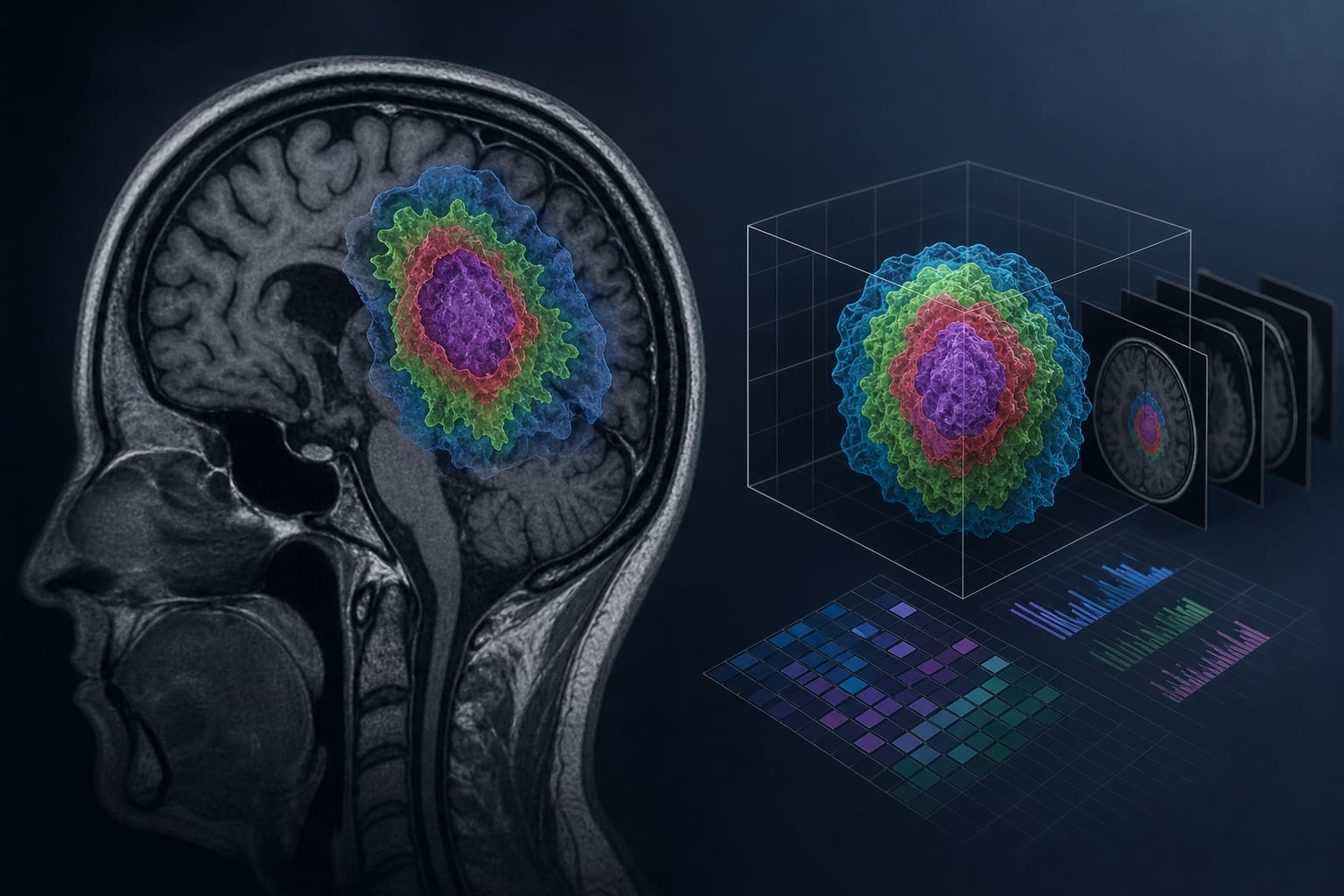
Creation of a volumetric MRI-based framework for glioma complexity assessment: Introducing the glioma imaging complexity score (GICS)
-
By
-
Alex Ofori
-
Guozhu Sun
-
June 29, 2026
Clinical Report: Creation of a volumetric MRI-based framework for glioma complexity assessment
Overview
This study introduces the Glioma Imaging Complexity Score (GICS), a quantitative framework for assessing glioma complexity using MRI data. The framework categorizes gliomas into low, moderate, and high complexity groups based on standardized imaging features derived from a large dataset.
Background
Gliomas present challenges in neurosurgery due to their infiltrative nature and variability in morphology. Accurate preoperative assessment is important for surgical planning, yet existing qualitative methods can be subjective. The development of a standardized quantitative framework like GICS aims to provide a method for glioma complexity assessment.
Data Highlights
| GICS Category | Mean Total Tumor Volume (cm³) | Edema Volume Correlation |
|---|---|---|
| GICS-1 | 35.40 ± 15.84 | Positive (Pearson r = 0.861; p < 0.001) |
| GICS-2 | Data not specified | Data not specified |
| GICS-3 | 162.62 ± 34.96 | Data not specified |
Key Findings
- The GICS framework stratifies gliomas into three complexity categories based on total tumor volume.
- Mean total tumor volume significantly increased from GICS-1 to GICS-3 (p < 0.001).
- Higher GICS categories correlated with increased edema burden and maximum tumor diameter.
- Robust positive correlations were found between total tumor volume and maximum tumor diameter (Pearson r = 0.764; p < 0.001).
- Segmentation-derived MRI variables demonstrated consistent quantitative differences across GICS categories.
Clinical Implications
The GICS framework provides a standardized method for assessing glioma complexity using quantitative MRI data.
Conclusion
The establishment of the GICS framework represents a quantitative assessment of glioma complexity.
Related Resources & Content
- Journal of Neuro-Oncology, 2024 -- Enhanced malignancy in glioblastomas associated with the subventricular zone identified through advanced imaging: indications of increased infiltrative growth and perfusion
- European Radiology, 2023 -- Diffusion Histogram Analysis Reveals Molecular Characteristics of Grade 4 in Histologically Lower-Grade Adult Diffuse Gliomas According to WHO 2021 Classification
- Journal of Neuro-Oncology, 2023 -- Hippocampal Volume Alterations in Glioblastoma: Potential Indicators of Neuroplasticity?
- European Radiology, 2024 -- Preoperative Assessment of Diffuse Glioma Classification and Grading in Adults Using a Gadolinium-Free MRI Decision Tree
- RANO 2.0: Update to the Response Assessment in Neuro-Oncology Criteria for High- and Low-Grade Gliomas in Adults - PMC
- Volumetric MRI-based response assessment and prognostic value in newly diagnosed glioblastoma: RANO 2.0 versus mRANO versus RANO - PMC
- RANO 2.0: Update to the Response Assessment in Neuro-Oncology Criteria for High- and Low-Grade Gliomas in Adults - PMC
- Volumetric MRI-based response assessment and prognostic value in newly diagnosed glioblastoma: RANO 2.0 versus mRANO versus RANO - PMC
- https://academic.oup.com/neuro-oncology/article/28/1/38/8256732
- Frontiers | Predicting IDH and ATRX mutations in gliomas from radiomic features with machine learning: a systematic review and meta-analysis
Based on findings from:
Development of the glioma imaging complexity score (GICS): a volumetric MRI-based stratification framework
Alex Ofori, Guozhu Sun. Frontiers In Surgery, 2026.
https://www.frontiersin.org/journals/surgery/articles/10.3389/fsurg.2026.1872271/full
This content is an AI-generated, fully rewritten summary based on a published scholarly article. It does not reproduce the original text and is not a substitute for the original publication. Readers are encouraged to consult the source for full context, data, and methodology.