Safety and Effectiveness of Direct Oral Anticoagulants Versus Low-Molecular-Weight Heparin for Cancer-Associated Thrombosis: A Systematic Review and Meta-analysis - Report - MDSpire
Advertisement
Safety and Effectiveness of Direct Oral Anticoagulants Versus Low-Molecular-Weight Heparin for Cancer-Associated Thrombosis: A Systematic Review and Meta-analysis
Clinical Report: Comparative Analysis of Direct Oral Anticoagulants and Low-Molecular-Weight Heparin for Thrombosis Related to Cancer
Overview
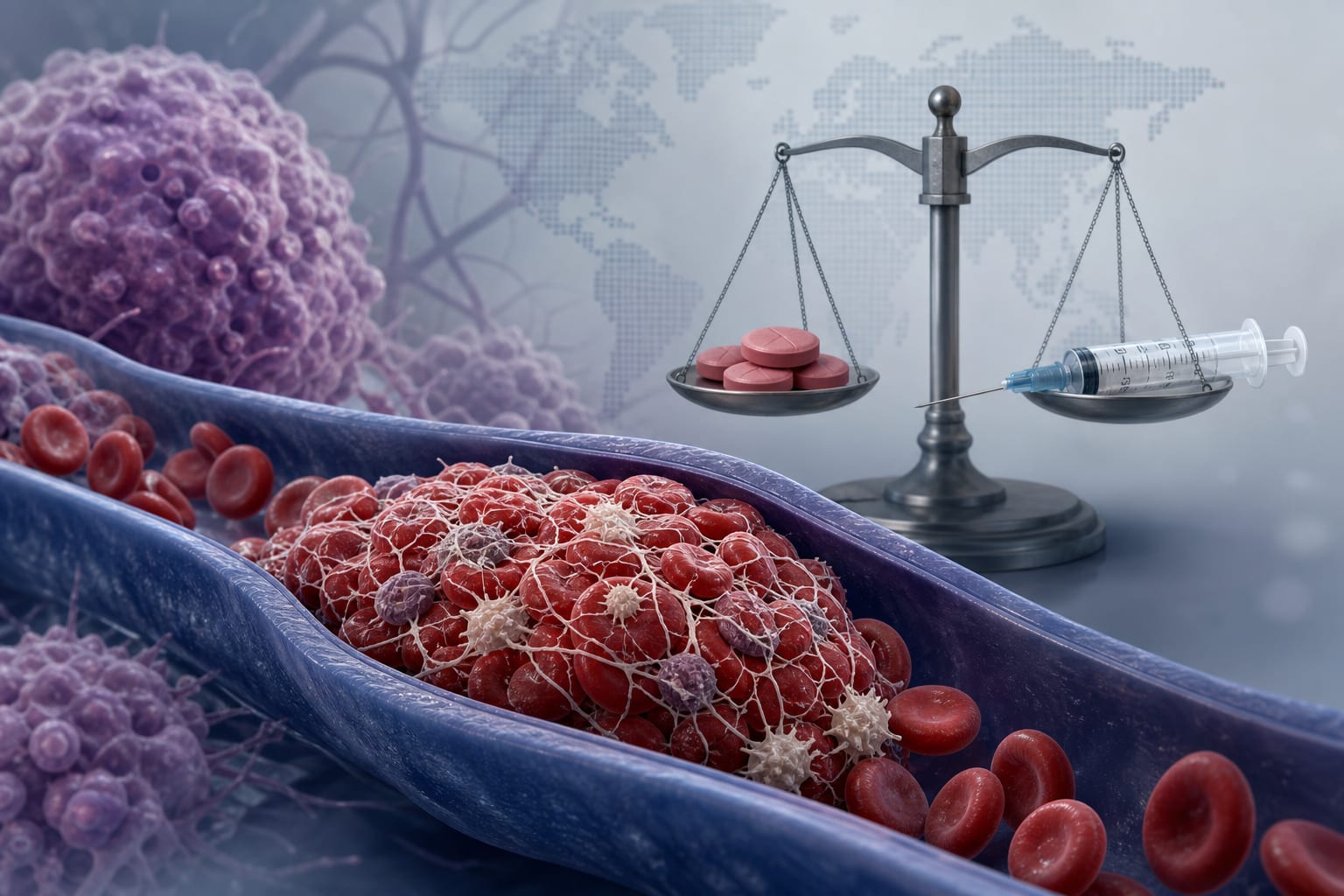
This systematic review and meta-analysis found that direct oral anticoagulants (DOACs) are associated with a significantly lower risk of recurrent venous thromboembolism compared to low-molecular-weight heparin (LMWH) in patients with cancer-associated thrombosis. Additionally, DOACs showed a lower risk of all-cause mortality in cohort studies, with comparable safety profiles.
Background
Cancer-associated thrombosis (CAT) significantly increases the risk of venous thromboembolism (VTE) in cancer patients, who face a nine-fold higher risk compared to the general population. The management of CAT is critical, as it can lead to severe complications and high mortality rates. Anticoagulants, including LMWH and DOACs, are essential in preventing and treating VTE in this population.
Data Highlights
No specific numerical data provided in the source material.
Key Findings
DOACs are associated with a significantly lower risk of recurrent VTE compared to LMWH.
In cohort studies, DOACs are linked to a significantly lower risk of all-cause mortality compared to LMWH.
DOACs and LMWH have comparable safety profiles regarding major bleeding risks.
Current clinical guidelines recommend both DOACs and LMWH as first-line treatments for CAT.
Variability in study designs may affect the outcomes and interpretations of safety and efficacy between DOACs and LMWH.
Clinical Implications
Clinicians should consider the use of DOACs for managing cancer-associated thrombosis, particularly in patients who may prefer oral administration over injections. The findings suggest that DOACs may offer effective management with a lower risk of recurrent thromboembolic events.
Conclusion
The analysis indicates that DOACs may provide a more effective option for treating cancer-associated thrombosis compared to LMWH, with similar safety outcomes. Further research is needed to confirm these findings across diverse patient populations.
by Wei Kang, Bowie P. Y. Lam, Rinko Tsz Lam Lau, Silvia T. H. Li, Kangrui Wu, Yue Wei, Yu Yang, Kyung Jin Lee, Caige Huang, Vincent K. C. Yan, Hei Hang Edmund Yiu, Shing Fung Lee, Aya El Helali, Victor H. F. Lee, Stephen L. Chan, Rina Y. M. Hui, Ka On Lam, Esther W. Chan