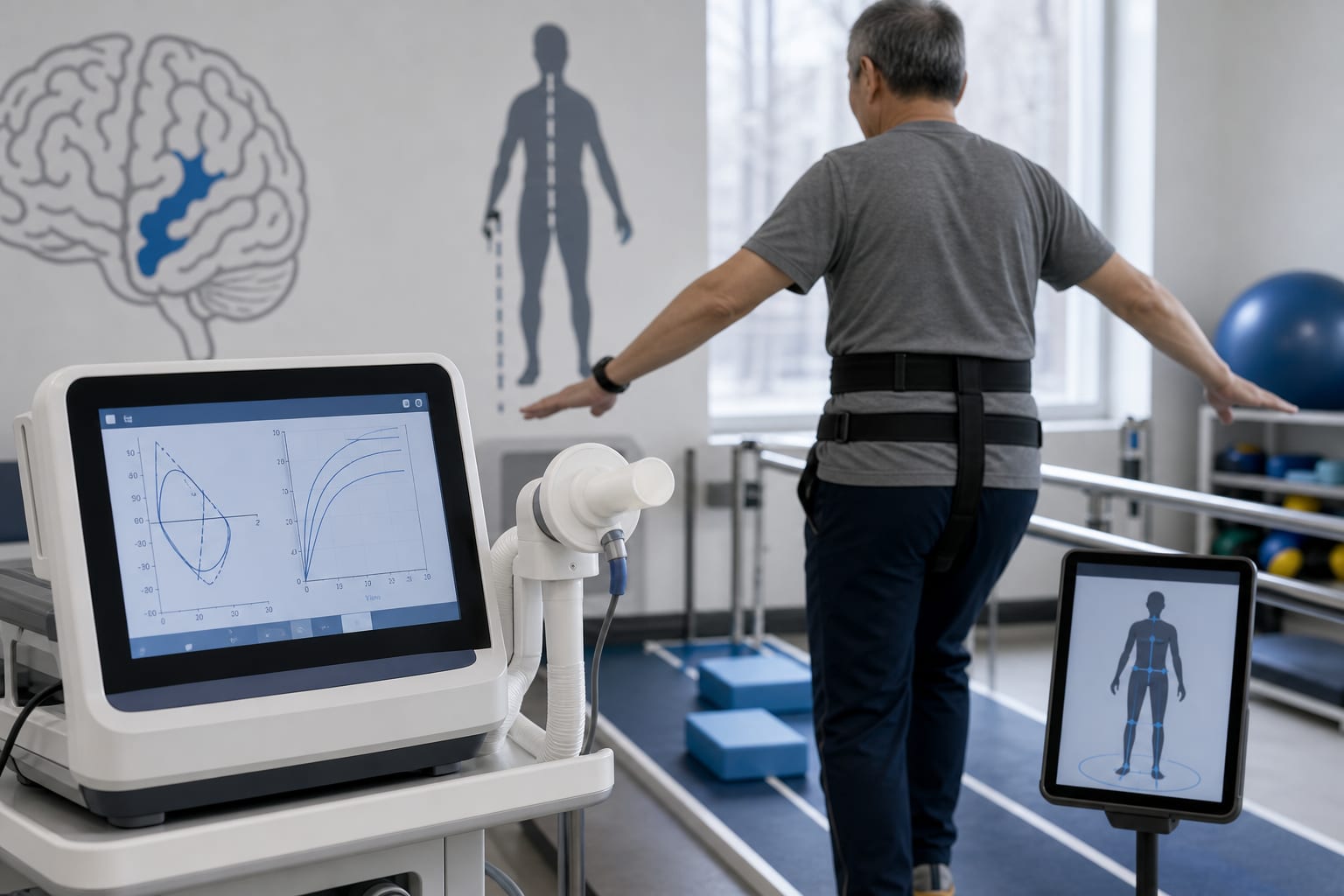
Association between pulmonary function and balance, motor function, and trunk stability in stroke survivors
-
By
-
Shuai Guo
-
Anming Hu
-
Yumei Zhang
-
June 18, 2026
-
0 min
Clinical Report: Relationship of Lung Function with Balance and Motor Skills Post-Stroke
Overview
This study highlights the significant correlations between pulmonary function parameters and key functional domains such as balance and motor skills in stroke survivors. Findings suggest that integrating pulmonary assessments into stroke rehabilitation could enhance functional recovery.
Background
Stroke is a leading cause of disability, with many survivors facing persistent impairments that affect daily living. Respiratory function is often overlooked in rehabilitation, despite its potential impact on recovery. Understanding the relationship between lung function and physical capabilities is crucial for developing comprehensive rehabilitation strategies.
Data Highlights
{'table': {'Parameter': ['Berg Balance Scale (BBS)', 'Fugl-Meyer Assessment for Lower Extremity (FMA-LE)', 'Trunk Impairment Scale (TIS)', 'Peak Expiratory Flow (PEF)', 'COP Path Length', '95% Confidence Ellipse Area'], 'Correlation Coefficient (r)': ['0.30–0.48', '0.30–0.48', '0.31–0.54', '0.54', '-0.30 to -0.33', '-0.40'], 'p-value': ['<0.05', '<0.05', '<0.05', '<0.001', '<0.05', '<0.01']}}Key Findings
- Positive correlations exist between BBS and FMA-LE scores with pulmonary function parameters (VC%, FEV1%, PEF%).
- TIS scores correlate positively with multiple pulmonary parameters, particularly PEF%.
- PEF% is negatively correlated with COP path length and velocity, indicating better balance.
- Integration of pulmonary assessments can enhance multidisciplinary collaboration in stroke rehabilitation.
- Simple pulmonary screenings can serve as triggers for timely interventions in stroke care.
Clinical Implications
Incorporating pulmonary function assessments into stroke rehabilitation can improve patient outcomes by addressing respiratory issues that affect balance and motor skills. Clinicians should consider routine pulmonary evaluations to foster a more integrated approach to stroke recovery.
Conclusion
The study underscores the importance of pulmonary function in the rehabilitation of stroke survivors, advocating for its integration into standard care practices to optimize recovery outcomes.
Related Resources & Content
- Brain, Motor learning after stroke: what we’ve learned and what lies ahead, 2026 -- https://academic.oup.com/brain/article/149/2/386/8285389
- Frontiers in Neurology, Effects of Tai Chi Cloud Hands on balance and resting-state functional connectivity after stroke: an fNIRS study, 2026 -- https://www.frontiersin.org/journals/neurology/articles/10.3389/fneur.2026.1791157/full
- Frontiers in Neurology, Association of upper limb motor function with muscle tone changes and quality of life in the subacute phase after stroke: a prospective cohort study, 2026 -- https://www.frontiersin.org/journals/neurology/articles/10.3389/fneur.2026.1857094/full
- 2026 Guideline for the Early Management of Patients With Acute Ischemic Stroke: A Guideline From the American Heart Association/American Stroke Association -- https://apps.asha.org/EvidenceMaps/Articles/ArticleSummary/efe13a17-2009-f111-9a71-000d3a149d5a
- Frontiers | Effect of respiratory muscle training on diaphragm function in stroke patients: a systematic review and meta-analysis -- https://www.frontiersin.org/journals/medicine/articles/10.3389/fmed.2025.1694356/full
- Brain — Motor learning after stroke: what we’ve learned and what lies ahead
- Frontiers in Neurology — Effects of Tai Chi Cloud Hands on balance and resting-state functional connectivity after stroke: an fNIRS study
- Frontiers in Neurology — Association of upper limb motor function with muscle tone changes and quality of life in the subacute phase after stroke: a prospective cohort study
- Frontiers in Neurology — Impaired pendulum-like mechanics during post-stroke walking: a biomechanical comparison with healthy individuals
- 2026 Guideline for the Early Management of Patients With Acute Ischemic Stroke: A Guideline From the American Heart Association/American Stroke Association
- Frontiers | Effect of respiratory muscle training on diaphragm function in stroke patients: a systematic review and meta-analysis
- Inspiratory muscle training with balance challenge improves diaphragmatic thickness, respiratory function, balance, exercise capacity and quality of life in people after stroke: a randomised trial - ScienceDirect
This content is an AI-generated, fully rewritten summary based on a published scholarly article. It does not reproduce the original text and is not a substitute for the original publication. Readers are encouraged to consult the source for full context, data, and methodology.