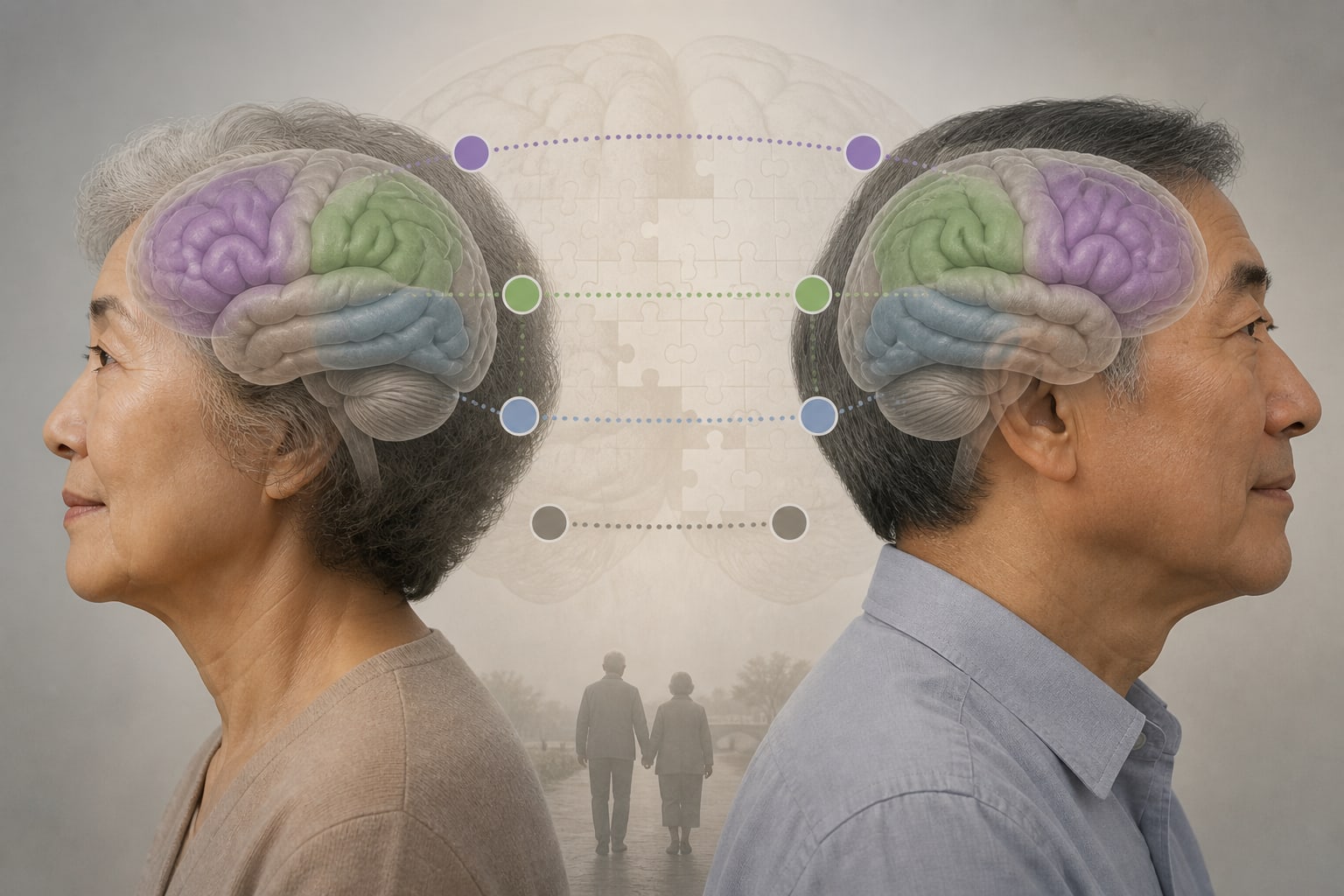
Exploring Domain-Specific Cognitive Concordance Among Older Married Couples
-
By
-
Jianhua Hou
-
August 26, 2026
Clinical Report: Exploring Domain-Specific Cognitive Concordance Among Older Couples
Overview
This study investigates cognitive concordance among older married couples, revealing that spousal similarity varies by cognitive domain. Language and visuospatial abilities show greater concordance, while global cognition and verbal memory demonstrate less.
Background
Cognitive aging is often viewed as an individual process; however, understanding it within the couple context is crucial. This study highlights the importance of examining specific cognitive domains rather than relying solely on global assessments.
Data Highlights
No numerical data or trial data provided in the source material.
Key Findings
- Spousal cognitive concordance varies by cognitive domain.
- Language and visuospatial abilities demonstrate the greatest similarity among couples.
- Global cognition and verbal memory show little evidence of excess concordance.
- Shared environments and routines may influence cognitive abilities selectively.
Clinical Implications
Clinicians should consider domain-specific cognitive changes in one partner as potential indicators of risk for both individuals in a couple.
Conclusion
Future research should explore these patterns across diverse cultural contexts.
Related Resources & Content
- Yang et al, Source, Year -- Exploring Domain-Specific Cognitive Concordance Among Older Married Couples
- JAMA Network Open — Spousal Dementia Exposure and Risk of Dementia
- DIGITAL HEALTH — Beyond the individual: A dyadic longitudinal study of internet use, social participation, and depressive symptoms in older couples
- Frontiers in Cardiovascular Medicine — Dyadic coping experiences of young and middle-aged patients undergoing PCI for coronary heart disease and their spouses during the perioperative period: a qualitative study
- Frontiers in Pain Research — Pain differences in cognitive impairment appear only during active motor tasks
- Clinical Summary: Cognitive Impairment in Older Adults: Screening | United States Preventive Services Taskforce
- Alzheimer's Association clinical practice guideline for the Diagnostic Evaluation, Testing, Counseling, and Disclosure of Suspected Alzheimer's Disease and Related Disorders (DETeCD‐ADRD)
- Revised criteria for diagnosis and staging of Alzheimer's disease: Alzheimer's Association Workgroup - PMC
- Spousal Dementia Exposure and Risk of Dementia | Neurology | JAMA Network Open | JAMA Network
- Exploration of Cognitive Outcomes and Risk Factors for Cognitive Decline Shared by Couples | Geriatrics | JAMA Network Open | JAMA Network
- Occurrence and Risk Factors for Cognitive Decline Shared by Couples: A Systematic Review and Meta-Analysis.
- Dyadic contagion in cognitive function: A nationally-representative longitudinal study of older U.S. couples | Health and Retirement Study
- Structured vs Self-Guided Multidomain Lifestyle Interventions for Global Cognitive Function: The US POINTER Randomized Clinical Trial | Trials | JAMA | JAMA Network
- Trial of the MIND Diet for Prevention of Cognitive Decline in Older Persons | New England Journal of Medicine
Based on findings from:
Beyond Global Cognition—Understanding Domain-Specific Concordance in Older Couples
Jianhua Hou. Jama Network Open, 2026.
https://jamanetwork.com/journals/jamanetworkopen/fullarticle/2853302
This content is an AI-generated, fully rewritten summary based on a published scholarly article. It does not reproduce the original text and is not a substitute for the original publication. Readers are encouraged to consult the source for full context, data, and methodology.