Integrating Multifocal Scleral Lenses for Discontented GP Users - Report - MDSpire
Advertisement
Integrating Multifocal Scleral Lenses for Discontented GP Users
Explore a transformative case where multifocal scleral lenses enhance comfort and vision for a long-term GP lens user, as discussed by Dr. Daniel Helin.
Integrating Multifocal Scleral Lenses for Discontented GP Users
Overview
This case report describes a 53-year-old male with keratoconus and dry eye disease who transitioned from long-term gas permeable lenses to multifocal scleral lenses. The multifocal scleral lenses provided improved comfort, stability, and near vision, addressing the patient's dissatisfaction with corneal GP lenses.
Background
Long-term gas permeable (GP) lens wearers often face challenges such as discomfort, lens dislodgement, and poor near vision as their ocular conditions evolve. Keratoconus and dry eye disease can exacerbate these issues, leading to decreased lens tolerance and visual dissatisfaction. Multifocal scleral lenses offer an alternative by providing enhanced comfort and stable vision correction, potentially reducing the need for additional reading glasses. This case highlights the clinical approach and outcomes of integrating multifocal scleral lenses for a patient dissatisfied with corneal GP lenses.
Data Highlights
Parameter
Right Eye (OD)
Left Eye (OS)
Manifest Refraction
-2.25 -5.25 @ 084
0.00 -1.75 @ 090
Visual Acuity with GP
20/40 with glare
20/30 with glare
Reading Addition (Over-refraction)
+1.50
+1.50
Visual Acuity with Multifocal Scleral Lens at 2 months
20/20-2 (distance), J3 (intermediate), J1 (near)
20/20-2 (distance), J3 (intermediate), J1 (near)
Key Findings
The patient experienced frequent lens dislodgement and discomfort with long-term corneal GP lenses, especially during dry eye spells and sports activities.
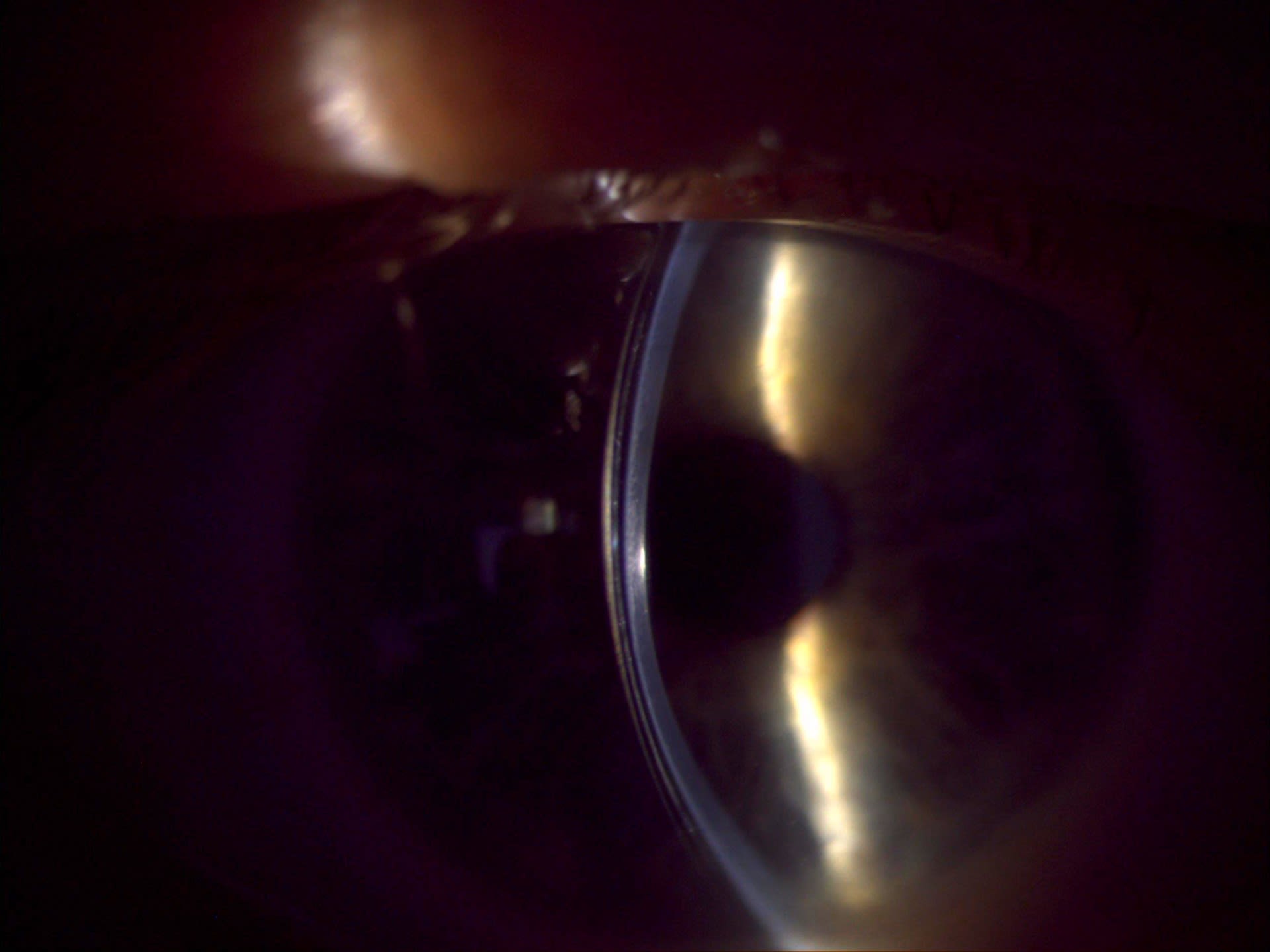
Initial scleral lens trial demonstrated immediate improvements in comfort and stability, though minor lens decentration caused posterior tear film debris.
Quadrant-specific haptics in the scleral lens design were adjusted to improve comfort and reduce fogging.
Multifocal scleral lenses (SmartFocus design) were successfully fitted, providing improved intermediate and near vision after adaptation and optical zone adjustments.
At 2-month follow-up, the patient achieved 20/20-2 distance visual acuity and J1 near vision with comfortable, stable lens wear.
Clinical Implications
Multifocal scleral lenses can be an effective solution for patients dissatisfied with corneal GP lenses due to discomfort, instability, and poor near vision. Careful fitting with quadrant-specific haptics and patient education about neuroadaptation are essential to optimize comfort and visual outcomes. Adjustments to the near optical zone within the multifocal design can enhance near vision without compromising distance acuity.
Conclusion
Integrating multifocal scleral lenses offers a promising approach to improve comfort, stability, and functional vision in long-term GP lens wearers experiencing dissatisfaction. Tailored fitting and patient counseling facilitate successful adaptation and visual rehabilitation.
Related Resources & Content
Helin OD -- Integrating Multifocal Scleral Lenses for Discontented GP Users