Characteristics in the uterine cavity microbiota of infertile women with hydrosalpinx or endometrial polyps revealed by shotgun metagenomics - Report - MDSpire

Characteristics in the uterine cavity microbiota of infertile women with hydrosalpinx or endometrial polyps revealed by shotgun metagenomics

  • By

  • ShuZhen Li

  • Huifeng Zeng

  • Xiulin Wan

  • Zhiruo Chen

  • Xia Nong

  • Lisi Peng

  • Qingyang Li

  • Yuxia Wang

  • July 2, 2026

  • 0 min

Share

Clinical Report: Analysis of Uterine Cavity Microbiota in Infertile Women

Overview

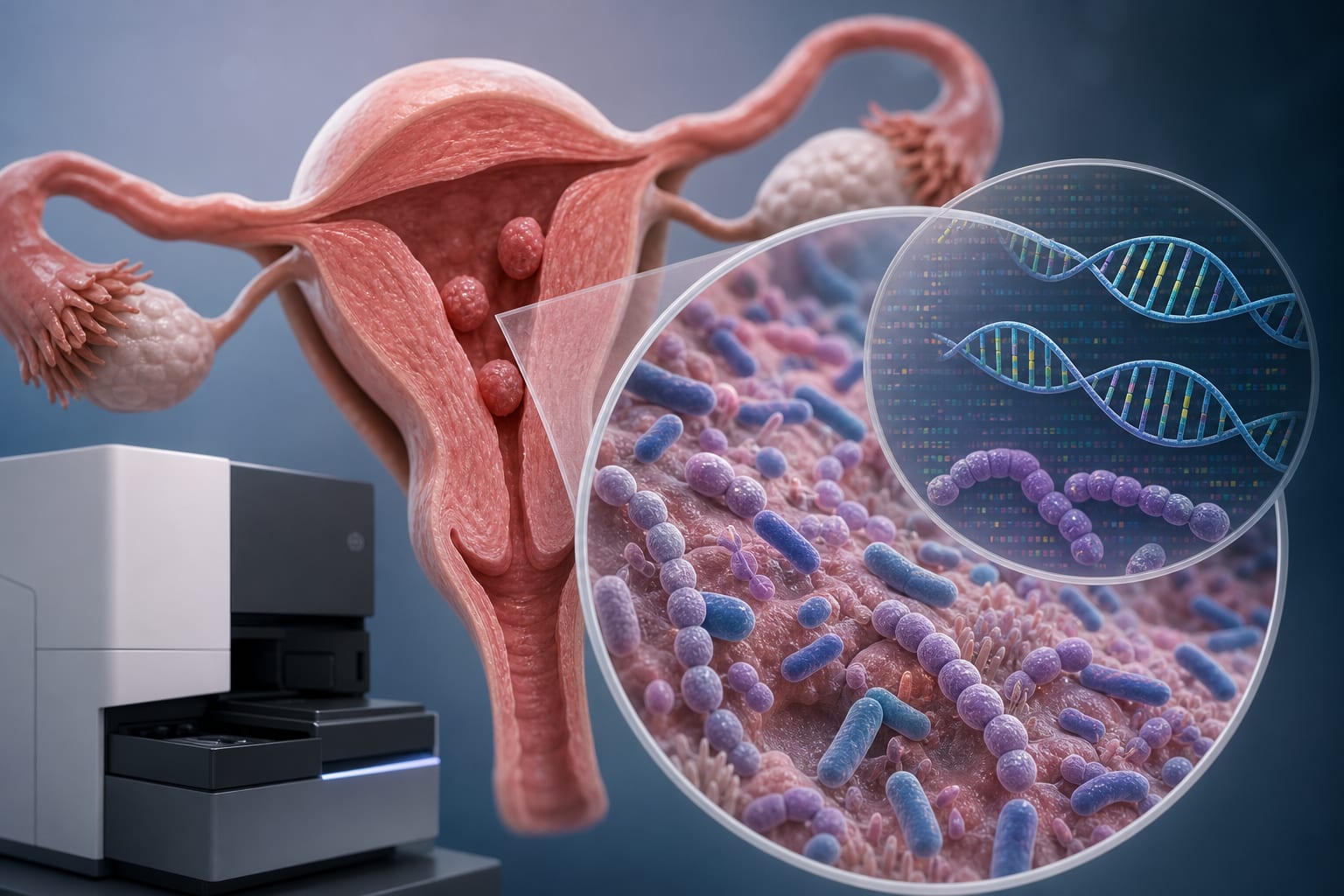
This study investigates the uterine cavity microbiota in infertile women with hydrosalpinx and endometrial polyps using shotgun metagenomics. It identifies distinct microbial profiles associated with these conditions.

Background

Infertility affects a significant portion of reproductive-aged couples globally, with endometrial polyps and hydrosalpinx being common contributors. Understanding the role of uterine microbiota in these conditions is important, as dysbiosis may impact reproductive outcomes.

Data Highlights

GroupMicrobial Alpha DiversityPathogenic Bacteria
Fertile ControlsHigherLower
Endometrial PolypsLowerElevated Streptococcus, Streptococcus pneumoniae
HydrosalpinxLowerIncreased Streptococcus, Streptococcus pneumoniae

Key Findings

  • The fertile control group exhibited significantly higher microbial alpha diversity compared to the EM and HD groups.
  • Endometrial polyps were associated with marked dysbiosis and elevated pathogenic bacteria.
  • Hydrosalpinx showed a reduction in overall microbial load and core beneficial bacteria.
  • Both EM and HD groups had increased relative abundance of Streptococcus and Streptococcus pneumoniae.
  • Distinct microbial profiles were identified for EM and HD, suggesting different mechanisms of infertility.

Clinical Implications

The findings indicate that endometrial microbiota may be associated with infertility, which could have implications for future research.

Conclusion

This study provides novel insights into the endometrial microbiota's role in infertility associated with endometrial polyps and hydrosalpinx, highlighting the need for further research in this area.
Related Resources & Content

  1. Frontiers in Immunology, 2026 -- From gut-reproductive microbiota to ferroptosis: a comprehensive insight into the molecular-pathogenicity of endometriosis
  2. Journal of Gastroenterology, 2017 -- Endoscopic Brush Sample Analysis Reveals Mucosal Dysbiosis in Patients with Inflammatory Bowel Disease
  3. The Journal of Infectious Diseases, 2023 -- Role of Atopobiaceae Family in Modulating Immunometabolic Factors During Human Papillomavirus Infection and Cervical Cancer Development
  4. Guideline for the prevention, diagnosis and treatment of infertility, WHO, 2025
  5. American Society for Reproductive Medicine recurrent implantation failure: a committee opinion, ASRM, 2026
  6. Computational Approaches in the Metagenomic Analysis of Chronic Prostatitis
  7. American Society for Reproductive Medicine recurrent implantation failure: a committee opinion
  8. Management of endometrial polyps in fertility: British fertility Society policy and practice guideline
  9. Guideline for the prevention, diagnosis and treatment of infertility
  10. Recurrent pregnancy loss: a committee opinion (2026) | American Society for Reproductive Medicine | ASRM
  11. Effect of the timing of surgical treatment of hydrosalpinx on in vitro fertilization/intracytoplasmic single-sperm injection pregnancy outcomes in patients with tubal factor infertility | Contraception and Reproductive Medicine | Springer Nature Link
  12. Tubal occlusion in patients with hydrosalpinx modifies the uterine environment and improves in vitro fertilization outcomes within 7 months | Journal of Ovarian Research | Springer Nature Link
  13. Vaginal Microbiome and Its Relationship with Assisted Reproduction: A Systematic Review and Meta-Analysis - PMC
  14. The impact of CD138 plasma cell severity on IVF-ET outcomes in women with untreated chronic endometritis: a systematic review and meta-analysis | BMC Pregnancy and Childbirth | Springer Nature Link

Original Source(s)

Related Content