Clinical Report: Timely Detection of Non-Response to Neoadjuvant Therapy
Overview
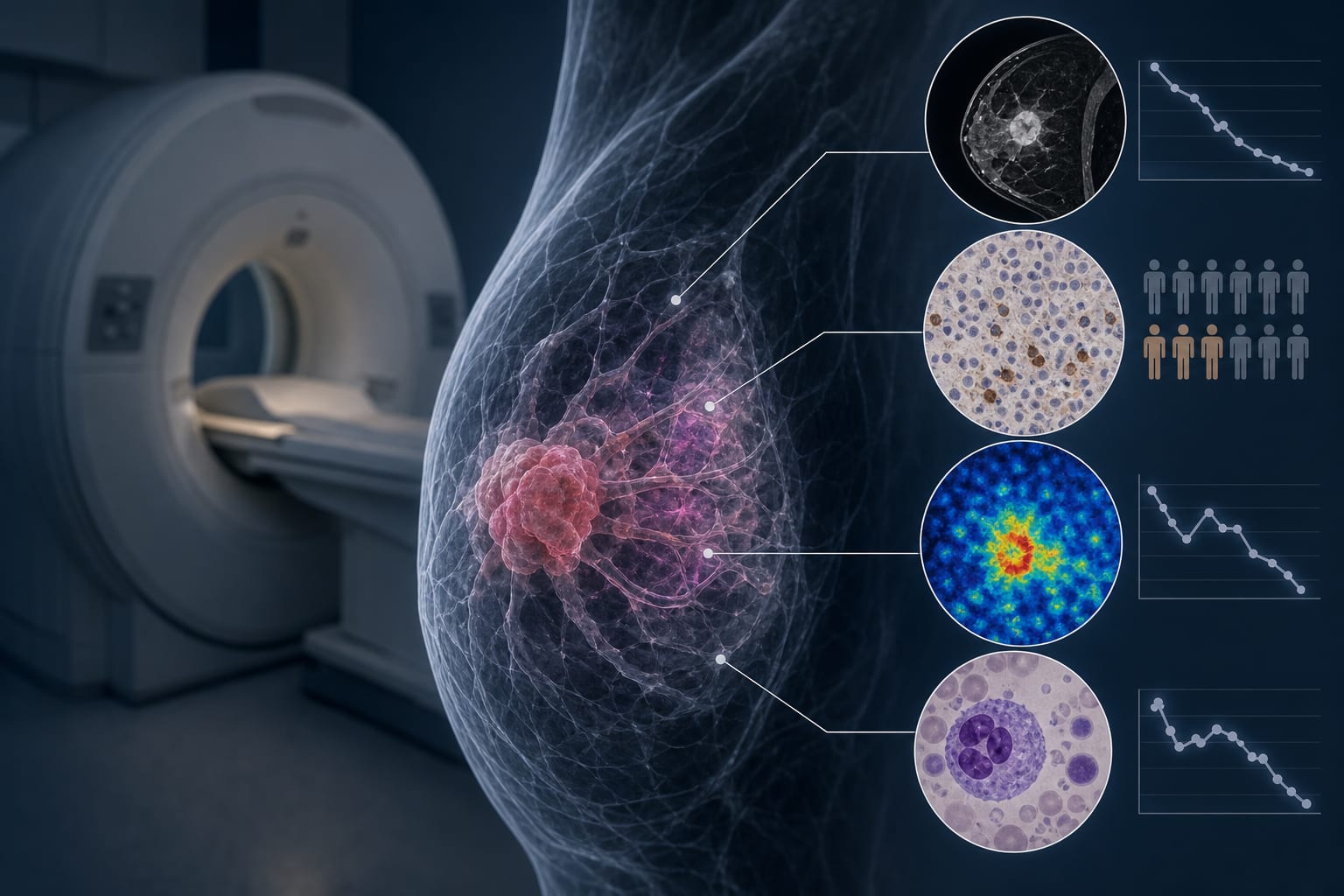
{'text': 'This study developed a multimodal prediction model to identify breast cancer patients unlikely to respond to neoadjuvant therapy (NAT). The model integrates clinicopathological, imaging, tumor microenvironment, and systemic inflammatory features, achieving a high observed AUC of 0.933.'}
Background
Identifying breast cancer patients who are unlikely to benefit from neoadjuvant therapy is crucial for optimizing treatment strategies and minimizing unnecessary toxicity. Neoadjuvant therapy is commonly used in high-risk breast cancer cases to reduce tumor size and assess treatment sensitivity. However, a significant subset of patients may not achieve substantial tumor regression, highlighting the need for effective predictive models.
Data Highlights
{'text': '
Model Type: Clinical, AUC: 0.844
Model Type: Imaging, AUC: 0.786
Model Type: Tumor Microenvironment, AUC: 0.828
Model Type: Inflammatory, AUC: 0.706
Model Type: Multimodal Model, AUC: 0.933
'}
Key Findings
{'text': '
38 patients (33.9%) were identified as non-responders to NAT.
The multimodal model achieved an apparent AUC of 0.933, indicating strong predictive capability.
Independent predictors included TILs, TSR, PIV2, and Ki-67, which are critical for understanding treatment response.
The model demonstrated acceptable calibration and net clinical benefit across various thresholds.
Internal validation included five-fold cross-validation and bootstrap methods.
'}
Clinical Implications
{'text': 'The multimodal prediction model may assist clinicians in identifying patients who are unlikely to benefit from neoadjuvant therapy, allowing for timely treatment adjustments. This approach could enhance personalized treatment strategies by tailoring interventions based on individual patient profiles and reducing exposure to ineffective therapies.'}
Conclusion
{'text': 'The study presents a promising multimodal model for predicting non-response to neoadjuvant therapy in breast cancer patients. However, further external validation is necessary to confirm its clinical utility and address the limitations of the current study.'}