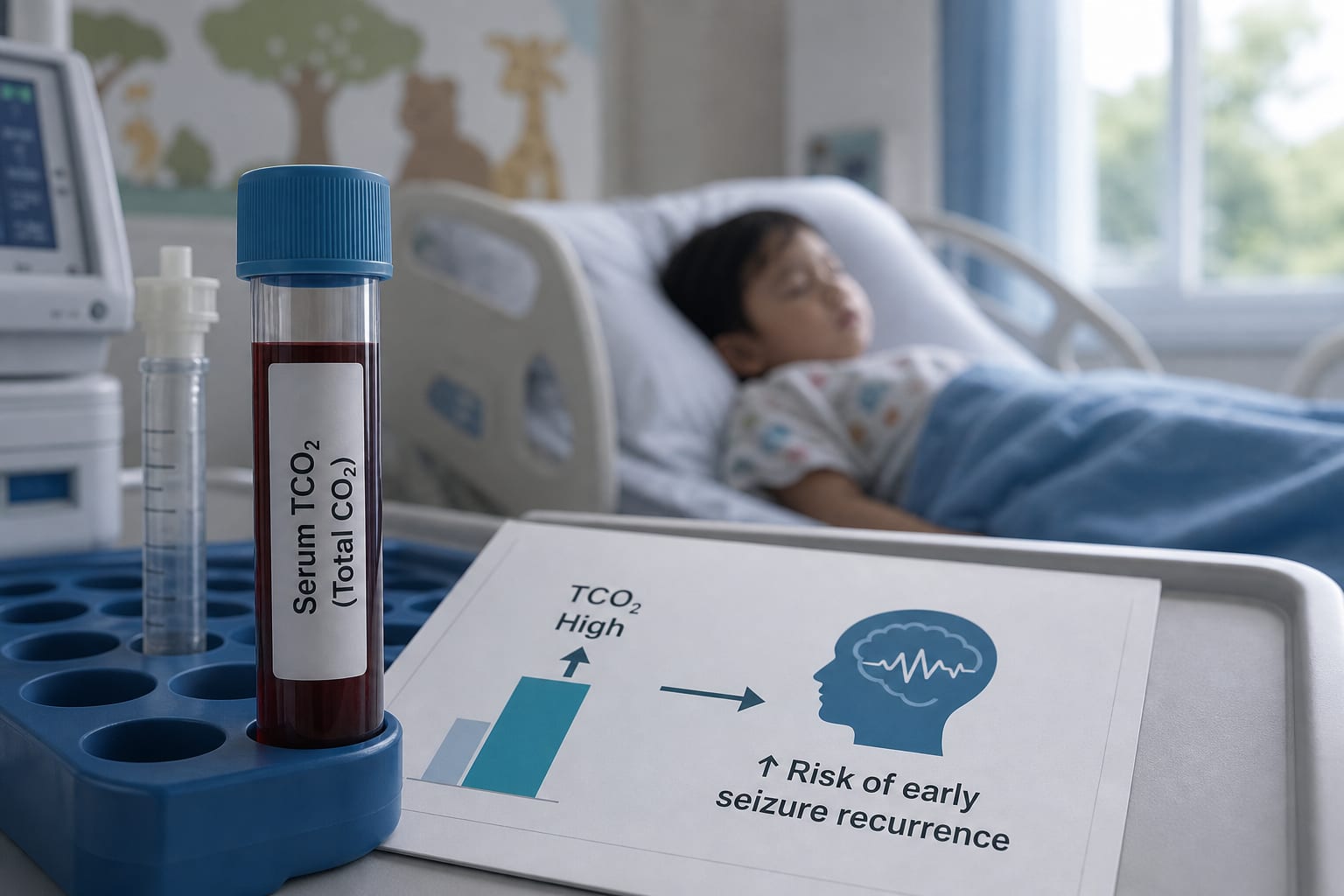
Elevated serum total carbon dioxide levels at admission are linked to increased risk of early seizure recurrence in pediatric patients with benign convulsions associated with mild gastroenteritis
-
By
-
Ling Zou
-
Feng Li
-
Hongyu Li
-
Zhihong Su
-
June 16, 2026
Clinical Report: Elevated Serum Total Carbon Dioxide Levels and Seizure Recurrence
Overview
This study identifies elevated serum total carbon dioxide (TCO2) levels at admission as a significant predictor of early seizure recurrence in pediatric patients with benign convulsions associated with mild gastroenteritis. The findings suggest that TCO2 may serve as a useful biomarker for risk stratification in clinical settings.
Background
Benign convulsions with mild gastroenteritis (CwG) are common in young children and can lead to significant parental anxiety and healthcare resource utilization due to potential seizure recurrence. Identifying reliable biomarkers for early recurrence is crucial for optimizing patient management and improving outcomes. This study explores the association between admission serum TCO2 levels and the likelihood of seizure recurrence within 48 hours.
Data Highlights
| Measure | Recurrence Group | No Recurrence Group |
|---|---|---|
| Median TCO2 (mmol/L) | 17.4 | 15.1 |
| Odds Ratio for TCO2 | 1.235 (95% CI 1.053–1.448; P = 0.009) | |
| Cutoff TCO2 for Sensitivity | 16.25 mmol/L | |
| Sensitivity | 78.3% | |
| Specificity | 61.9% | |
| Negative Predictive Value | 88.7% | |
Key Findings
- 26.7% of children with CwG experienced seizure recurrence within 48 hours.
- Higher admission serum TCO2 levels were significantly associated with increased risk of recurrence.
- The median TCO2 level was 17.4 mmol/L in the recurrence group compared to 15.1 mmol/L in the non-recurrence group (P = 0.007).
- A TCO2 cutoff of 16.25 mmol/L provided 78.3% sensitivity for predicting recurrence.
- There was a strong correlation between venous TCO2 and arterial bicarbonate (r = 0.966, P < 0.001).
Clinical Implications
Clinicians should consider measuring serum TCO2 levels in pediatric patients presenting with benign convulsions associated with mild gastroenteritis to assess the risk of early seizure recurrence. This biomarker may aid in decision-making regarding observation and management strategies in the emergency department.
Conclusion
Elevated serum TCO2 levels at admission are linked to an increased risk of early seizure recurrence in children with CwG. Further validation in prospective studies is necessary to confirm these findings and establish TCO2 as a standard biomarker in clinical practice.
Related Resources & Content
- Author(s)/Org, Source, Year -- Title
- Intensive Care Medicine — Incidence and Outcomes of Seizures in 204 Unconscious Pediatric Patients
- Frontiers in Pediatrics — Overreliance on EEG Normalization: A Case Report of DEE-SWAS Treated as Presumed NCSE Leading to Avoidable Escalation
- Intensive Care Medicine — Unexpected carbon dioxide embolism during laparoscopic kidney removal surgery
- Frontiers in Pediatrics — Cumulative secondary systemic metabolic cerebral insults are associated with disease severity and mortality in neonatal hypoxic–ischaemic encephalopathy: a retrospective study
- Benign convulsions with mild gastroenteritis in children: An emerging acute symptomatic seizures
- Laboratory Findings of Benign Convulsions With Mild Gastroenteritis: A Meta-Analysis
- Frontiers | Febrile seizures and convulsions with mild gastroenteritis: age-dependent acute symptomatic seizures
- Updated classification of epileptic seizures (2025) // International League Against Epilepsy
- Clinical characteristics, treatment, and long-term outcomes in children suffering from benign convulsions with mild gastroenteritis: a retrospective study | BMC Pediatrics | Full Text
- Changes in frequency of benign convulsions with mild gastroenteritis and their viral causes before and during the COVID-19 pandemic: a single-center study - PubMed
- Efficacy of phenobarbital for benign convulsions with mild gastroenteritis: A randomized, placebo-controlled trial - PubMed
- Efficacy and safety of phenobarbital for benign convulsions with mild gastroenteritis: A prospective randomized controlled study - PMC
- Clinical Characteristics, Treatment, and Outcomes in Children with Benign Convulsions with Mild Gastroenteritis in the Philippine General Hospital: A Retrospective Cohort Study - PMC
- Prognostic factors for the recurrence of afebrile seizures after benign convulsions associated with mild gastroenteritis - PubMed
- Risk factors for recurrence of benign convulsions with mild gastroenteritis in children: A prospective cohort study - Zaki - 2023 - Journal of Paediatrics and Child Health - Wiley Online Library
Based on findings from:
Higher admission serum total carbon dioxide is independently associated with early seizure recurrence in children with benign convulsions with mild gastroenteritis
Ling Zou, Feng Li, Hongyu Li, Zhihong Su. Frontiers In Pediatrics, 2026.
https://www.frontiersin.org/journals/pediatrics/articles/10.3389/fped.2026.1884706/full
This content is an AI-generated, fully rewritten summary based on a published scholarly article. It does not reproduce the original text and is not a substitute for the original publication. Readers are encouraged to consult the source for full context, data, and methodology.