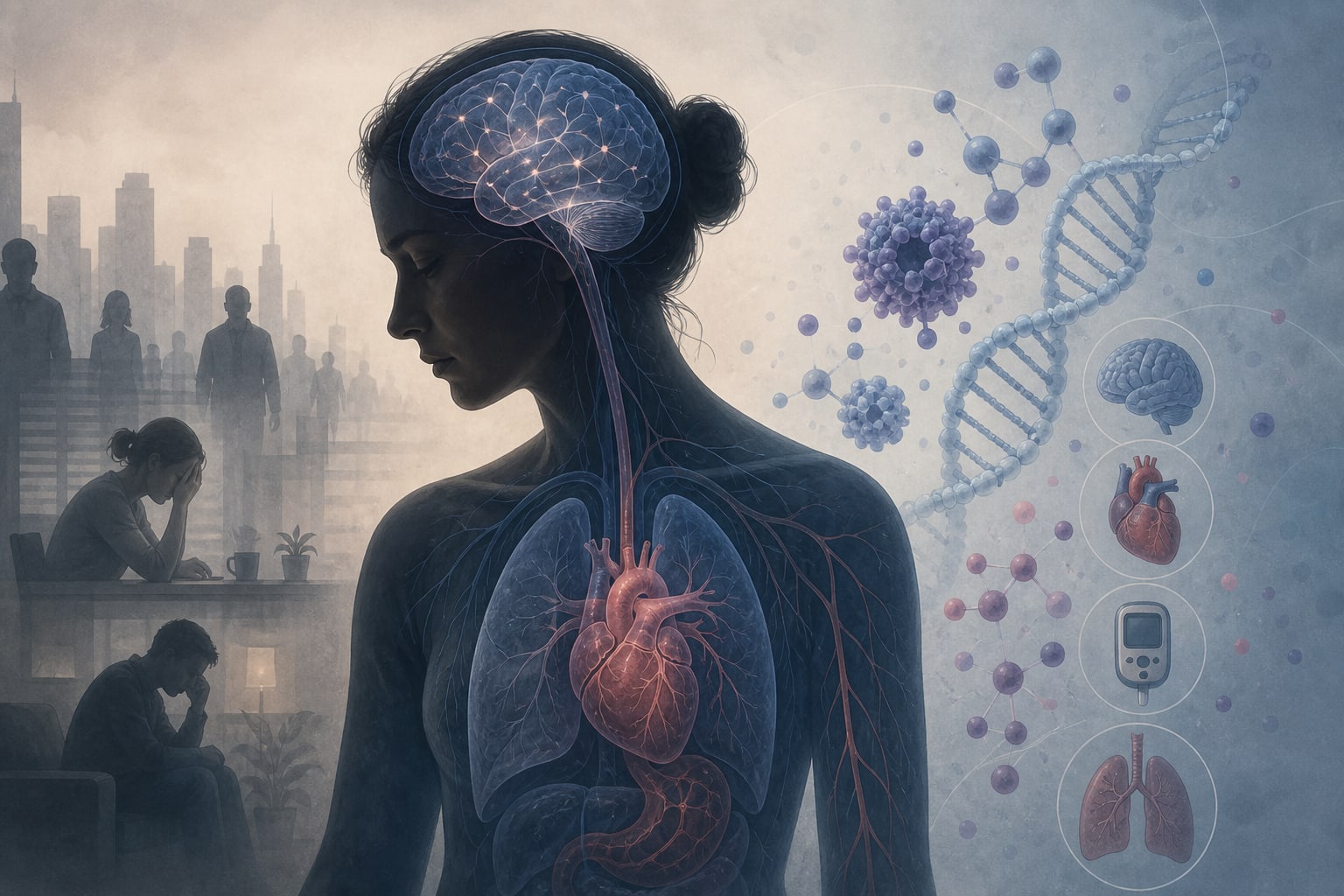
Editorial: The Interplay of Psychosocial Elements, Mental Health Comorbidities, and Associated Biomarkers in the Development and Progression of Physical Illnesses
-
By
-
Gloria-Beatrice Wintermann
-
Michael Noll-Hussong
-
September 15, 2026
Clinical Report: The Interplay of Psychosocial Elements and Physical Illnesses
Overview
This editorial discusses the influence of psychosocial factors and mental health comorbidities on the development and progression of physical illnesses.
Background
The increasing prevalence of chronic somatic diseases and mental disorders necessitates a comprehensive understanding of their interrelationship. Mental disorders contribute significantly to global health burdens, complicating the management of physical illnesses.
Data Highlights
No specific numerical data or trial data were provided in the source material.
Key Findings
- Comorbid mental disorders can complicate help-seeking behaviors and worsen somatic disease outcomes.
- Psychosocial factors such as lifestyle behavior and emotional awareness significantly influence the course of chronic illnesses.
- Major depressive disorder is associated with increased susceptibility to severe infections, including sepsis.
- Psychological support is essential for patients with chronic conditions, such as those with implantable cardioverter defibrillators.
- Alcohol consumption has a notable impact on both mental health and gastrointestinal symptoms.
Clinical Implications
Healthcare providers should consider psychosocial assessments in the care of patients with chronic diseases.
Conclusion
The editorial highlights the critical need for integrated care models that address both psychosocial and somatic health factors in managing chronic diseases.
Related Resources & Content
- Frontiers in Psychiatry, 2026 -- The heterogeneity of psychiatric symptoms and disorders
- Frontiers in Medicine, 2026 -- Improving Health Outcomes for At-Risk Groups via Comprehensive Biosocial Strategies
- Frontiers in Psychiatry, 2026 -- From molecular changes to behaviour: exploring neuropsychiatric disorders
- 2025 ESC Clinical Consensus Statement on mental health and cardiovascular disease, European Heart Journal
- Post–Myocardial Infarction Psychological Distress: A Scientific Statement From the American Heart Association - PMC
- Frontiers in Medicine — Editorial: The Intricate Relationship Between Pulmonary Conditions and Multisystem Disorders: Mechanisms, Treatment Approaches, and Prognosis
- Comprehensive Medical Evaluation and Assessment of Comorbidities: Standards of Care in Diabetes—2026
- NCCN Guidelines® Insights: Distress Management, Version 1.2026
- Finalized PD on NCDs and Mental Health - REV4 - 3 September 2025
- 2025 ESC Clinical Consensus Statement on mental health and cardiovascular disease: developed under the auspices of the ESC Clinical Practice Guidelines Committee | European Heart Journal | Oxford Academic
- Post–Myocardial Infarction Psychological Distress: A Scientific Statement From the American Heart Association - PMC
- Depression increases cancer mortality by 23–83%: a meta-analysis of 65 studies across five major cancer types - PMC
- Cardiovascular diseases and depression: A meta-analysis and Mendelian randomization analysis
- Frontiers | The impact of depression on mortality among older adult patients with hypertension: a systematic review and meta-analysis
- Sex-specific associations of depression with inflammatory markers: a systematic review and meta-analysis - PMC
- JCI - The role of suPAR and related proteins in kidney, heart diseases, and diabetes
- Heart rate variability in mental disorders: an umbrella review of meta-analyses | Translational Psychiatry
Based on findings from:
Editorial: Psychosocial factors, mental comorbidities and related biomarkers interacting with the onset and course of somatic diseases
Gloria-Beatrice Wintermann, Michael Noll-Hussong. Frontiers In Psychiatry, 2026.
https://www.frontiersin.org/journals/psychiatry/articles/10.3389/fpsyt.2026.1927855/full
This content is an AI-generated, fully rewritten summary based on a published scholarly article. It does not reproduce the original text and is not a substitute for the original publication. Readers are encouraged to consult the source for full context, data, and methodology.