Gut–lung axis in radiation-induced lung injury: mechanisms and interventions - Report - MDSpire

Gut–lung axis in radiation-induced lung injury: mechanisms and interventions

  • By

  • Ping Zhou

  • Xiao Jiang

  • Haiyan Zhang

  • Shizheng Jiang

  • Xiaotao Zhang

  • Chengtai Ma

  • Xiaoshuai Bai

  • July 2, 2026

  • 0 min

Share

Clinical Report: The Role of the Gut–Lung Microbiota Axis in Lung Injury Caused by Radiation

Overview

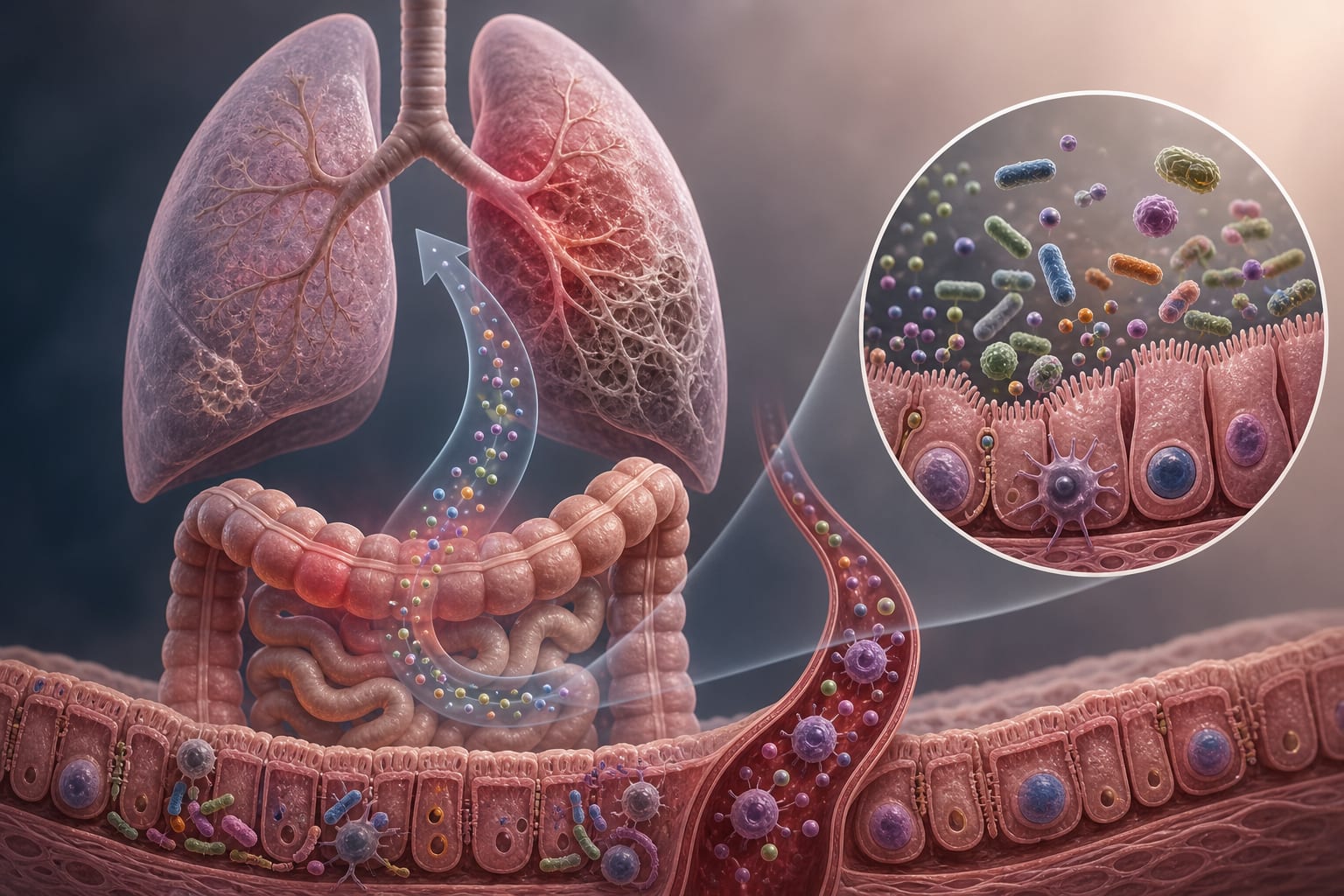
This narrative review examines the gut-lung microbiota axis in radiation-induced lung injury (RILI), highlighting mechanisms. Key findings include associations between gut microbiota stability and radiation pneumonitis risk.

Background

Radiation-induced lung injury (RILI) is a significant complication of thoracic radiotherapy, impacting treatment efficacy. It encompasses acute radiation pneumonitis (RP) and chronic radiation-induced pulmonary fibrosis (RPF), which can lead to severe respiratory complications.

Data Highlights

No specific numerical data or trial results were provided in the source material.

Key Findings

  • Radiotherapy induces gut dysbiosis and barrier breakdown, contributing to inflammation and fibrosis.
  • Lower gut microbiota stability is associated with an increased risk of grade ≥2 RP in non-small cell lung cancer cohorts.
  • Higher baseline abundance of Faecalibacterium may confer protection against RP.
  • Mechanisms involve lipopolysaccharide translocation and regulatory T cell/T helper 17 cell imbalance.
  • Artificial intelligence models can predict RP with 75% accuracy.
  • Preliminary studies suggest fecal microbiota transplantation may improve pulmonary function.

Clinical Implications

Future clinical trials should account for confounding factors like antibiotic use to establish causality.

Conclusion

Further studies are needed to validate these findings.
Related Resources & Content

  1. Frontiers in Immunology, 2026 -- Mechanism of blueberry anthocyanins in ameliorating radiation-induced intestinal injury through gut microbiota modulation
  2. Frontiers in Oncology, 2026 -- Persistent dysbiosis of intestinal and oral microbiota after neoadjuvant radiotherapy for rectal cancer: Implications for surgery and microbiome intervention
  3. Frontiers in Immunology, 2026 -- Lactylation-driven PDLIM1/PDAP1 axis remodels the inflammatory landscape of acute lung injury: mechanistic insights and precision intervention
  4. Frontiers in Medicine, 2026 -- Editorial: Deciphering the microbiome's role in the progression of interstitial lung diseases
  5. Diagnosis and treatment of radiation induced pneumonitis in patients with lung cancer: An ESTRO clinical practice guideline - ScienceDirect
  6. Pirfenidone in the Treatment of Radiation-Induced Lung Injury: A Randomized, Controlled, Multicenter Clinical Trial - ScienceDirect
  7. Stability of gut microbiota in non-small cell lung cancer patients during chemoradiotherapy and its association with radiation pneumonitis - ScienceDirect
  8. Diagnosis and treatment of radiation induced pneumonitis in patients with lung cancer: An ESTRO clinical practice guideline - ScienceDirect
  9. Pirfenidone in the Treatment of Radiation-Induced Lung Injury: A Randomized, Controlled, Multicenter Clinical Trial - ScienceDirect
  10. Stability of gut microbiota in non-small cell lung cancer patients during chemoradiotherapy and its association with radiation pneumonitis - ScienceDirect

Original Source(s)

Related Content