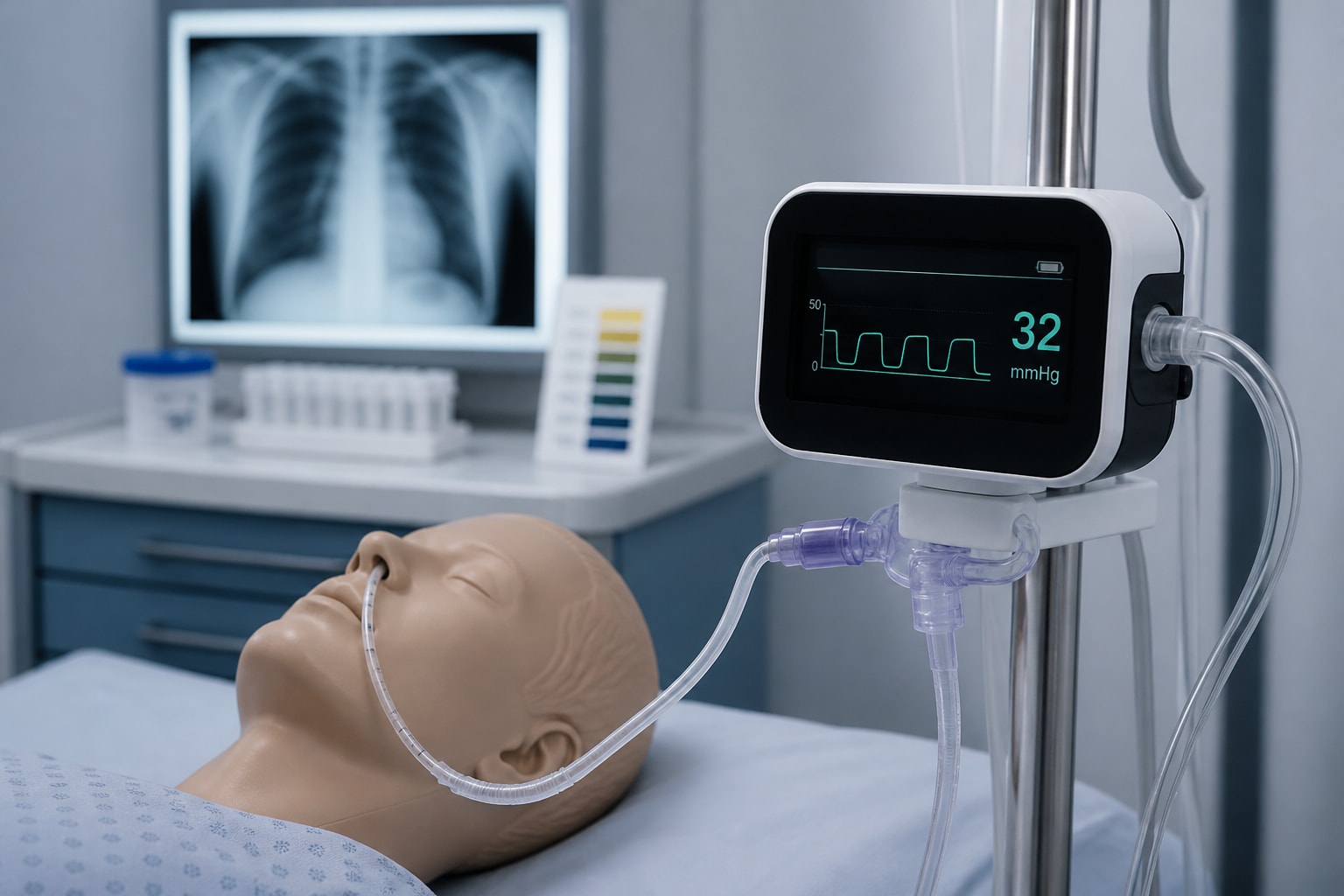
Assessing capnography costs as part of a comprehensive nasogastric tube verification pathway
-
By
-
Peng Zhao
-
Ying Liu
-
Fengya Zhu
-
Shao Yin
-
November 6, 2026
Clinical Report: Assessing capnography costs in nasogastric tube verification
Overview
A 21-hospital study of 508 patients evaluated capnography for identifying airway placement of nasogastric tubes and modeled savings when radiography was reserved for ETCO₂ above a selected threshold. The correspondence argues that these estimates do not establish the costs of a complete pathway combining capnography with aspirate pH testing, because many patients with negative capnography results lacked aspirate or had pH above 5.5 and may still require radiography.
Background
Nasogastric tube verification must distinguish exclusion of airway placement from confirmation of appropriate tube position. The study assessed capnography alongside aspirate pH testing, but the cost model compared radiography for all patients with radiography only for those exceeding an ETCO₂ threshold. Adult guidance cited in the correspondence describes radiography as a second-line step when aspirate is unavailable or pH exceeds 5.5. The practical and economic implications therefore depend on the subsequent verification steps and the intended use of the tube.
Data Highlights
| Measure | Reported value | Context |
|---|---|---|
| Hospitals and patients | 21 hospitals; 508 patients | Multicentre capnography assessment |
| ETCO₂ threshold | >5 mmHg | 23 patients positive; 485 negative |
| Modeled cost saving | HK$210.3 per patient | Compared with radiography for all patients; radiography costs for capnography-negative patients were excluded |
| Aspirate unavailable | 241 patients | Reported in the original article’s Table 1 |
| Aspirate pH >5.5 | 61 patients | Combined with unavailable aspirate, 302 patients had either finding |
| Minimum capnography-negative patients with either aspirate finding | 279 of 485 | Derived from marginal counts; exact overlap requires joint-result data |
Key Findings
- The study assessed capnography in 508 patients across 21 hospitals to identify airway placement of nasogastric tubes.
- At an ETCO₂ threshold above 5 mmHg, 23 patients were positive and 485 were negative.
- The reported hypothetical saving of HK$210.3 per patient compared with radiography for all patients excluded radiography costs for the capnography-negative group; the authors distinguished this estimate from a cost-effectiveness analysis.
- Aspirate was unavailable in 241 patients and pH exceeded 5.5 in 61; based on the reported marginal counts, at least 279 capnography-negative patients had one of these findings, although their exact overlap is not reported.
- The correspondence notes that the original table reports aspirate availability by radiographic location but does not provide the joint capnography, aspirate availability, pH, and radiographic-position results needed to calculate costs for a combined pathway.
- The cited adult National Nurses Nutrition Group guidance describes radiography as a second-line confirmation step; the correspondence states that local practice and intended tube use should be considered when specifying the pathway.
Clinical Implications
The correspondence calls for a clearly specified combined verification pathway that defines what follows a negative capnography result when aspirate is unavailable or pH exceeds 5.5, and includes the associated checks, imaging, and repositioning costs. It also proposes comparison with the locally used pathway and clarification of when tube use is permissible, particularly in relation to the proposed reduction in emergency department transfers from care homes.
Conclusion
The reported capnography cost estimate is a hypothetical comparison rather than an evaluation of the full verification pathway. Joint-result data and explicit accounting for subsequent confirmation procedures are needed to assess the resource implications of adding capnography.
Related Resources & Content
- Chau et al., Critical Care, 2026 — Using capnography to differentiate airway from gastrointestinal placement of nasogastric tubes: a prospective multicentre diagnostic accuracy study
- National Nurses Nutrition Group, 2023 — Good Practice Guideline: Safe Insertion and Ongoing Care of Nasogastric (NG) Feeding Tubes in Adults
- Guidelines for Verification of Gastric Tube Location in Adult Hospitalised Patients, 2026 — A Systematic Review
- AHRQ Patient Safety Network — Misplaced Nasogastric Tube Resulting in Aspiration
- Critical Care — Real-Time Visualization Techniques for Nasoenteral Tube Insertion in Critically Ill Patients: Insights from a Multicenter Study
- Critical Care (Springer) — Continuous non-invasive measurement of tidal volume and minute ventilation using a smart nasal cannula
- Frontiers in Medicine — Respiratory safety and resource utilization in ERCP: a comparative study of high-flow nasal oxygen, conventional mask, and general anesthesia in high-risk populations
- Frontiers in Medicine — Bronchoscopy-Guided Non-Capping Decannulation Pathway Versus Conventional Capping Trial in Patients with Prolonged Tracheostomy: A Retrospective Comparative Cohort Study
- Using capnography to differentiate airway from gastrointestinal placement of nasogastric tubes: a prospective multicentre diagnostic accuracy study
- Good Practice Guideline: Safe Insertion and Ongoing Care of Nasogastric (NG) Feeding Tubes in Adults
- Guidelines for Verification of Gastric Tube Location in Adult Hospitalised Patients: A Systematic Review
- Misplaced Nasogastric Tube Resulting in Aspiration
- Guidelines for Verification of Gastric Tube Location in Adult Hospitalised Patients: A Systematic Review - PMC
- Misplaced Nasogastric Tube Resulting in Aspiration | PSNet
- ASPEN Safe Practices for Enteral Nutrition Therapy - Boullata - 2017 - Journal of Parenteral and Enteral Nutrition - Wiley Online Library
- Ultrasonography to confirm gastric tube placement in critical care and emergency: From diagnostic accuracy to an actionable safety pathway - PMC
Based on findings from:
Estimating the costs of capnography within a complete nasogastric tube verification pathway
Peng Zhao, Ying Liu, Fengya Zhu, Shao Yin. Critical Care, 2026.
https://link.springer.com/article/10.1186/s13054-026-06439-2
This content is an AI-generated, fully rewritten summary based on a published scholarly article. It does not reproduce the original text and is not a substitute for the original publication. Readers are encouraged to consult the source for full context, data, and methodology.