Diagnostic value of cardiovascular biomarkers for cerebral–cardiac syndrome risk in acute ischemic stroke - Report - MDSpire

Diagnostic value of cardiovascular biomarkers for cerebral–cardiac syndrome risk in acute ischemic stroke

  • By

  • Zegang Liu

  • Ying Zhao

  • Mei Wang

  • Chenwei Li

  • Xurong Zhu

  • Peirui Wang

  • Ke Wang

  • July 8, 2026

  • 0 min

Share

Clinical Report: Evaluating Cardiovascular Biomarkers for Assessing CCS Risk

Overview

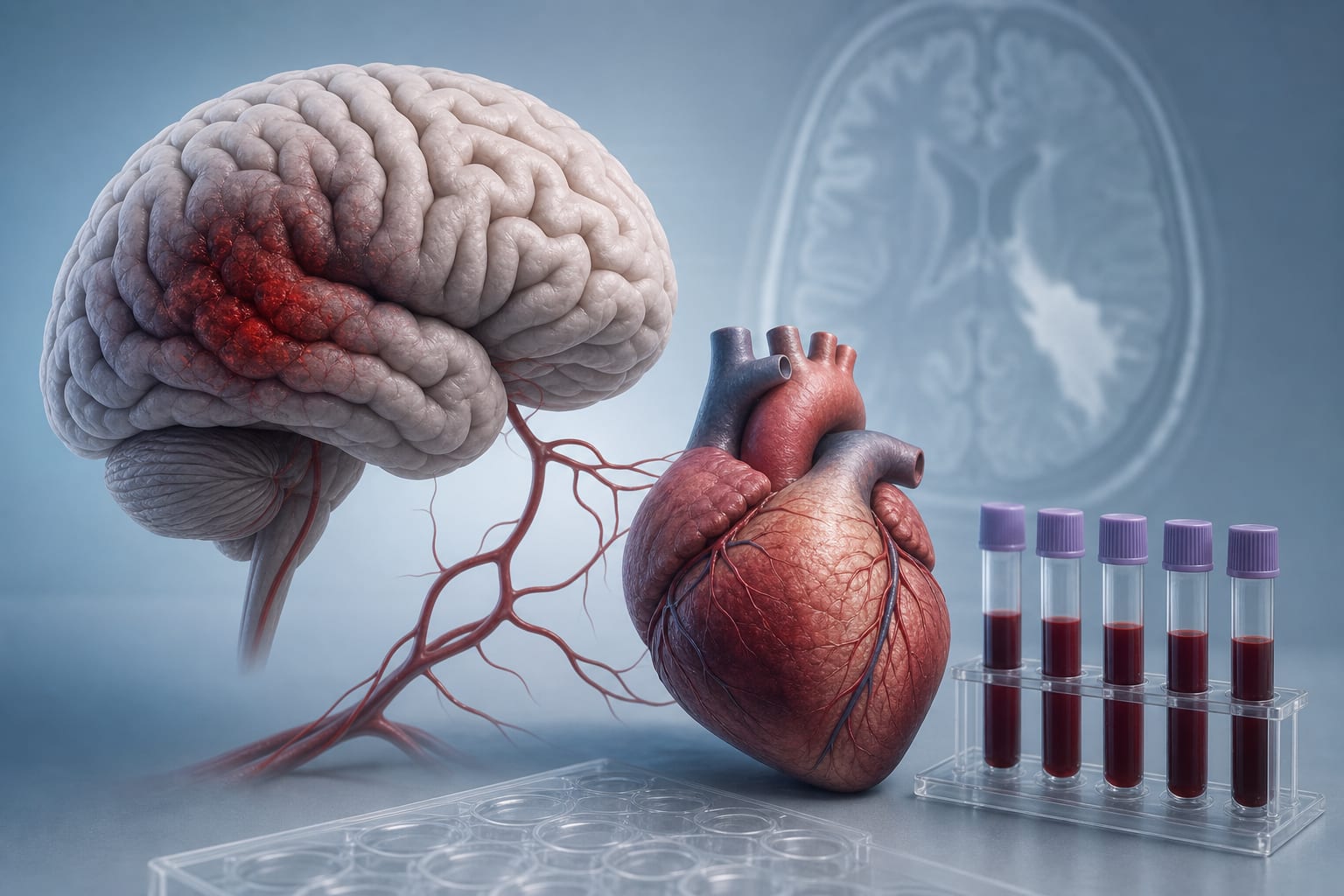
This study investigates the role of cardiovascular biomarkers in identifying cerebral-cardiac syndrome (CCS) risk among acute ischemic stroke (AIS) patients. Key findings indicate that age, BNP, and Myo are significant independent risk factors for CCS.

Background

Cerebral-cardiac syndrome (CCS) is a serious complication following ischemic stroke, leading to increased morbidity and mortality. Early diagnosis of CCS is important. Despite its prevalence, the mechanisms and risk factors associated with CCS remain poorly understood.

Data Highlights

BiomarkerCCS Group (n=97)Non-CCS Group (n=80)p-value
BNPElevatedNormal< 0.001
DDElevatedNormal< 0.001
cTnIElevatedNormal< 0.001
MyoElevatedNormal< 0.001
CK-MBElevatedNormal< 0.001

Key Findings

  • CCS occurred in 54.8% of the studied AIS patients.
  • BNP, DD, cTnI, Myo, and CK-MB levels were significantly higher in the CCS group compared to the non-CCS group.
  • Age, BNP, and Myo were identified as independent risk factors for CCS after adjusting for covariates.
  • The combined model of age, BNP, and Myo demonstrated an AUC of 0.945.
  • CCS significantly increases the risk of mortality in stroke patients, with a 2.7 times higher probability of death compared to non-CCS patients.

Clinical Implications

The identification of age, BNP, and Myo as risk factors for CCS can aid clinicians in early diagnosis and risk stratification of AIS patients.

Conclusion

The study highlights the importance of cardiovascular biomarkers in the early identification of CCS in AIS patients.
Related Resources & Content

  1. Frontiers in Neurology, 2026 -- Cardiometabolic Index: a novel prognostic biomarker for recurrent stroke risk in acute ischemic stroke patients
  2. Frontiers in Neurology, 2026 -- Diagnostic biomarkers of ischemic stroke: strengths and limitations across blood, urine, and saliva
  3. Frontiers in Neurology, 2026 -- Cardiometabolic index and modified cardiometabolic index are associated with early neurological deterioration in patients with acute ischemic stroke
  4. 2026 Guideline for the Early Management of Patients With Acute Ischemic Stroke: A Guideline From the American Heart Association/American Stroke Association | Stroke
  5. Accuracy of NT-proBNP for predicting mortality amongst patients with ischemic stroke: a systematic review and meta-analysis | BMC Medicine
  6. Frontiers in Neurology — Impact of cerebral small vessel disease burden and systemic clinical phenotypes on short-term neurological outcomes after acute ischemic stroke
  7. 2026 Guideline for the Early Management of Patients With Acute Ischemic Stroke: A Guideline From the American Heart Association/American Stroke Association | Stroke
  8. Accuracy of NT-proBNP for predicting mortality amongst patients with ischemic stroke: a systematic review and meta-analysis | BMC Medicine | Springer Nature Link
  9. Prognostic value of cardiac troponin I in acute ischemic stroke patients treated with reperfusion therapy: a multicenter retrospective cohort study - PubMed

Original Source(s)

Related Content