Exploratory characterization of IgG1/IgG4 glycosylation and monocyte-derived dendritic cell responses in esophageal squamous cell carcinoma - Report - MDSpire

Exploratory characterization of IgG1/IgG4 glycosylation and monocyte-derived dendritic cell responses in esophageal squamous cell carcinoma

  • By

  • Hui Wang

  • Jun Li

  • Yinghai Wang

  • Yuebin Shi

  • Peiren Tang

  • Ying Li

  • Jiang Gu

  • Li Wang

  • June 18, 2026

  • 0 min

Share

Clinical Report: Investigation of IgG1/IgG4 Glycosylation Patterns in ESCC

Overview

Revise to include specific effects of IgG4 on moDCs and implications for tumor immunosuppression.

Background

Understanding the immunological roles of IgG subclasses, particularly IgG4, is crucial in the context of esophageal squamous cell carcinoma (ESCC). IgG4's unique properties and its association with immune suppression may influence tumor progression and response to therapies. This study provides insights into the glycosylation patterns of IgG4 and their functional implications on dendritic cells, which are pivotal in orchestrating immune responses.

Data Highlights

FindingDetails
IgG4 DensitySignificantly higher in ESCC tissues than normal tissues.
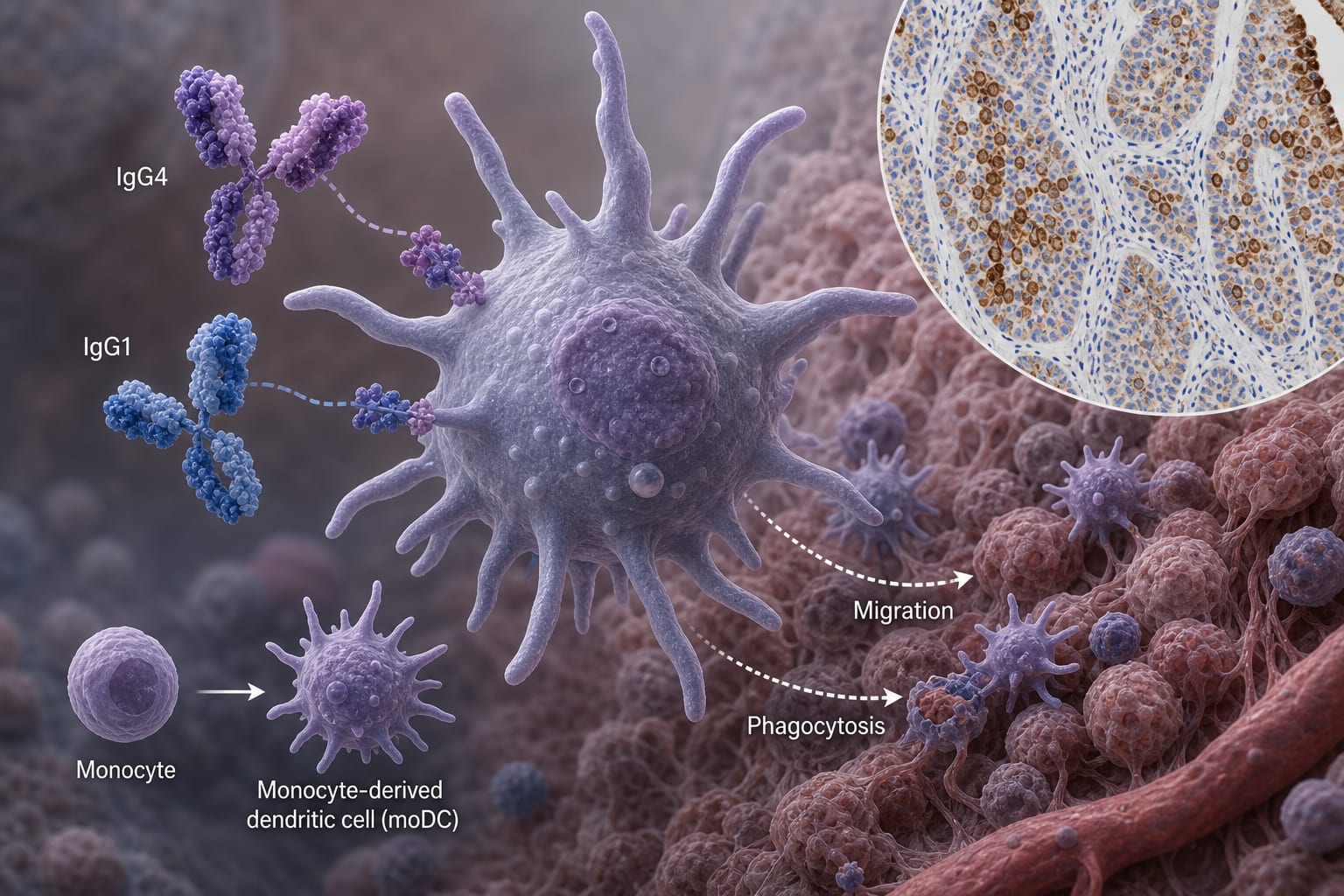
Glycosylation ProfileIgG4 exhibits extensive high-mannose glycosylation compared to IgG1.
moDC ActivityIgG4 significantly promotes moDC migration and phagocytosis relative to IgG1.
Affinity for IgG SubclassesMonocytes showed strong binding to IgG1 but weak to IgG4.

Key Findings

  • IgG4 and CD11c densities are elevated in ESCC tissues.
  • IgG4 has distinct glycosylation profiles compared to IgG1.
  • IgG4 enhances the migratory and phagocytic capacities of moDCs.
  • IgG4 from IVIg and patient serum shows similar effects on moDC differentiation.
  • Monocytes express CD68 and CD206, indicating their differentiation potential.

Clinical Implications

The findings suggest that IgG4 may play a significant role in modulating immune responses in ESCC through its effects on dendritic cells. Understanding these mechanisms could inform therapeutic strategies that target IgG4-related pathways to enhance anti-tumor immunity.

Conclusion

This study highlights the importance of IgG4 glycosylation in influencing dendritic cell function in ESCC, warranting further investigation into its role in tumor immunology and potential therapeutic applications.
Related Resources & Content

  1. Journal of Gastrointestinal Surgery, 2008 -- Dendritic Cell Involvement in Barrett's Esophagus and the Development of Esophageal Adenocarcinoma
  2. Journal of Gastrointestinal Surgery, 2008 -- Immune Inflammation in Cardiac Mucosa Involving Dendritic Cells: A Potential Contributor to Barrett’s Esophagus Development
  3. Gastric Cancer, 2025 -- Exploration of CD66c as a Promising Target for Antibody-Drug Conjugate Therapy in Gastroesophageal Junction Cancer
  4. Journal of Gastroenterology, 2025 -- Evaluating the Role of Tumor-Infiltrating Lymphocytes in Predicting Lymph Node Metastasis in Deep Submucosal Invasive Esophageal Squamous Cell Carcinoma: A Retrospective Analysis
  5. Nivolumab plus chemotherapy or ipilimumab versus chemotherapy in patients with advanced esophageal squamous cell carcinoma (CheckMate 648): 29-month follow-up from a randomized, open-label, phase III trial - PubMed
  6. IgG Glycosylation: Biomarker, Functional Modulator, and Structural Component | The Journal of Immunology | Oxford Academic
  7. Nivolumab plus chemotherapy or ipilimumab versus chemotherapy in patients with advanced esophageal squamous cell carcinoma (CheckMate 648): 29-month follow-up from a randomized, open-label, phase III trial - PubMed
  8. IgG Glycosylation: Biomarker, Functional Modulator, and Structural Component | The Journal of Immunology | Oxford Academic

Original Source(s)

Related Content