Circulating Methylated SEPT9 for Detection of Hepatocellular Carcinoma in Cirrhosis - Report - MDSpire
Coming Soon: Introducing MDSpire News. Learn more
Conexiant’s news site is now MDSpire News. Learn more

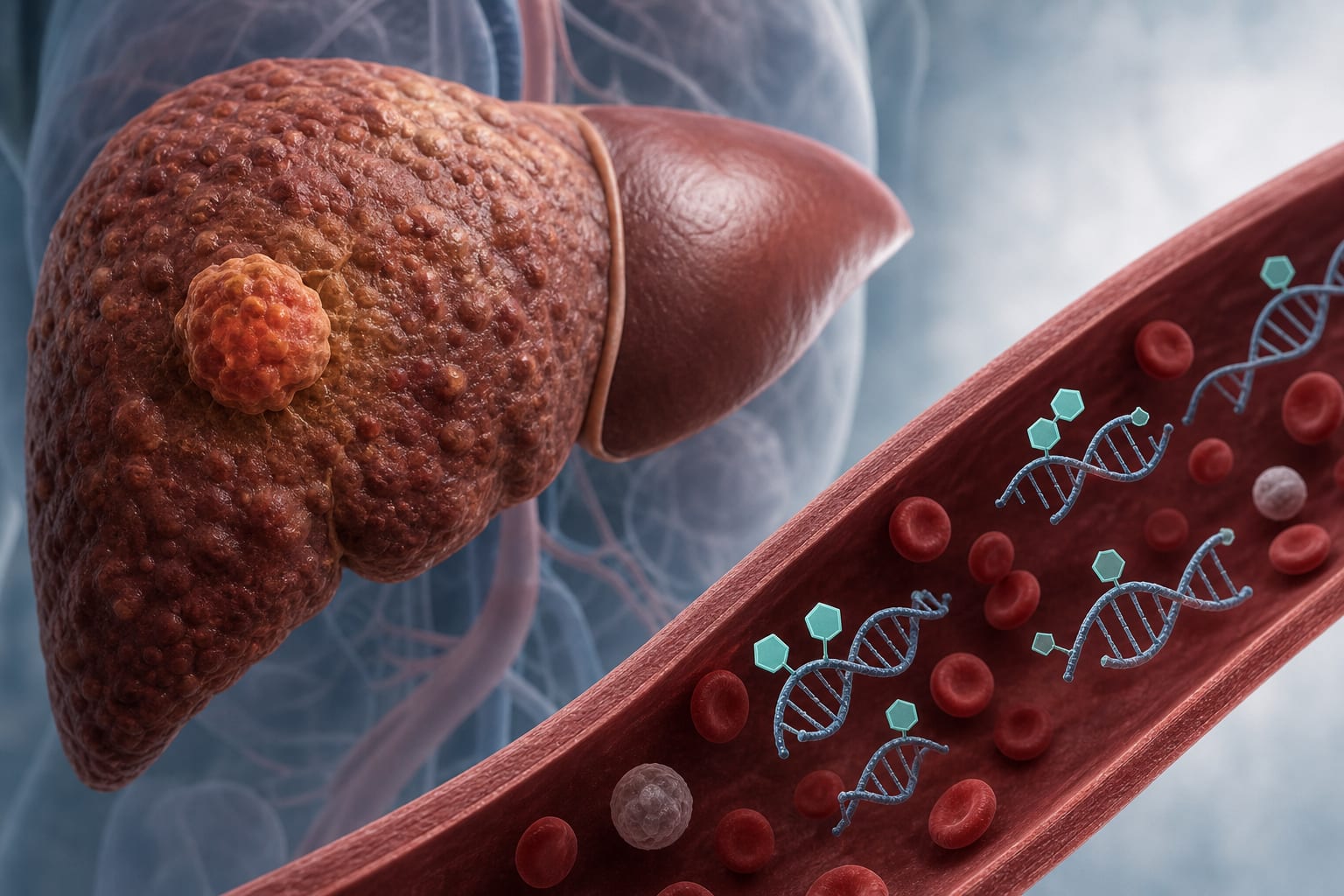
Detection of Hepatocellular Carcinoma in Cirrhotic Patients Using Circulating Methylated SEPT9 Markers

  • By

  • Abderrahim Oussalah

  • Maël Silva Rodriguez

  • Guillaume Conroy

  • Mouni Bensenane

  • Hélène Rousseau

  • Ahmet Ayav

  • Jean-Louis Guéant

  • Houda Camara

  • Cédric Baumann

  • Valérie Laurent

  • Jean-Pierre Bronowicki

  • SEPT9_CROSS Study Group

  • Vincent Haghnejad

  • Claire Geist

  • Raphaelle Riffault

  • Abdelbasset Nani

  • Julien Levy

  • Jonas Callet

  • September 1, 2026

Share

Detection of Hepatocellular Carcinoma in Cirrhotic Patients Using Circulating Methylated SEPT9 Markers

Overview

This study evaluates the diagnostic accuracy of circulating methylated SEPT9 compared to alpha-fetoprotein (AFP) for detecting hepatocellular carcinoma (HCC) in patients with cirrhosis.

Background

Hepatocellular carcinoma (HCC) is a leading cause of cancer-related mortality, with significant incidence among patients with cirrhosis. Current surveillance methods, including ultrasound and AFP, have limitations in sensitivity, particularly for early-stage disease.

Data Highlights

No numerical data available in the source material.

Key Findings

  • Methylated SEPT9 demonstrated higher sensitivity for HCC detection compared to AFP alone.
  • In a prospective study, methylated SEPT9 achieved 87.8% sensitivity for HCC versus 44.3% for AFP.
  • Early-stage HCC detection sensitivity was 74.5% with methylated SEPT9 compared to 23.5% with AFP.
  • The study adhered to the STARD guidelines for reporting diagnostic accuracy.
  • Patients with cirrhosis were enrolled from two French hospitals for the study.

Clinical Implications

The use of methylated SEPT9 as a biomarker may improve the accuracy of HCC surveillance in cirrhotic patients.

Conclusion

Methylated SEPT9 may serve as a complementary biomarker to AFP for HCC detection in patients with cirrhosis.

Related Resources & Content

  1. JAMA Network, Circulating Methylated SEPT9 for Detection of Hepatocellular Carcinoma in Cirrhosis, 2025 -- Study on methylated SEPT9
  2. EASL Clinical Practice Guidelines on the management of hepatocellular carcinoma, 2025 -- Guidelines for HCC management
  3. AASLD Practice Guidance on prevention, diagnosis, and treatment of hepatocellular carcinoma, 2023 -- AASLD guidelines
  4. the pathologist — Finding Markers For Liver Cancer
  5. The New Gastroenterologist — Enhanced Risk Assessment Tool May Optimize HCC Monitoring in Cirrhosis Patients
  6. Journal of Gastroenterology — Early Detection of Hepatocellular Carcinoma Through High-Sensitivity Alpha-Fetoprotein Assay Using Lens culinaris Agglutinin Reactivity
  7. Journal of Gastrointestinal Surgery — A Prospective Study Utilizing Proteomics to Discover Potential Biomarkers for Cholangiocarcinoma Diagnosis
  8. Finding Markers For Liver Cancer
  9. Enhanced Risk Assessment Tool May Optimize HCC Monitoring in Cirrhosis Patients
  10. Early Detection of Hepatocellular Carcinoma Through High-Sensitivity Alpha-Fetoprotein Assay Using Lens culinaris Agglutinin Reactivity
  11. EASL Clinical Practice Guidelines on the management of hepatocellular carcinoma
  12. AASLD Practice Guidance on prevention, diagnosis, and treatment of hepatocellular carcinoma - PMC
  13. LI-RADS US Surveillance Version 2024 for Surveillance of Hepatocellular Carcinoma: An Update to the American College of Radiology US LI-RADS | Radiology
  14. Circulating Methylated SEPT9 for Detection of Hepatocellular Carcinoma in Cirrhosis | Hepatobiliary Disease | JAMA Oncology | JAMA Network
  15. Checking your browser - reCAPTCHA
  16. Sensitive detection of circulating methylated SEPT9 in hepatocellular carcinoma patients using a novel quantitative PCR assay.
  17. Trial design and end points in hepatocellular carcinoma: an EASL–AASLD–ILCA consensus statement | Nature Reviews Clinical Oncology

Original Source(s)

Related Content