Discussion: Evaluating the Efficacy of Treatment, Follow-Up Outcomes, and Recurrence Trends in Pediatric Helicobacter pylori Infections
-
By
-
Toshihiko Kakiuchi
-
September 3, 2026
Clinical Report: Evaluating the Efficacy of Treatment in Pediatric H. pylori Infections
Overview
This commentary discusses the findings of Luo et al. regarding the recurrence of Helicobacter pylori infections in children after eradication therapy, as reported in their study (Luo M, Wei D, Jin L, Wei Y, Frontiers in Pediatrics, 2026). It emphasizes the importance of distinguishing between recurrence, recrudescence, and reinfection in interpreting follow-up outcomes.
Background
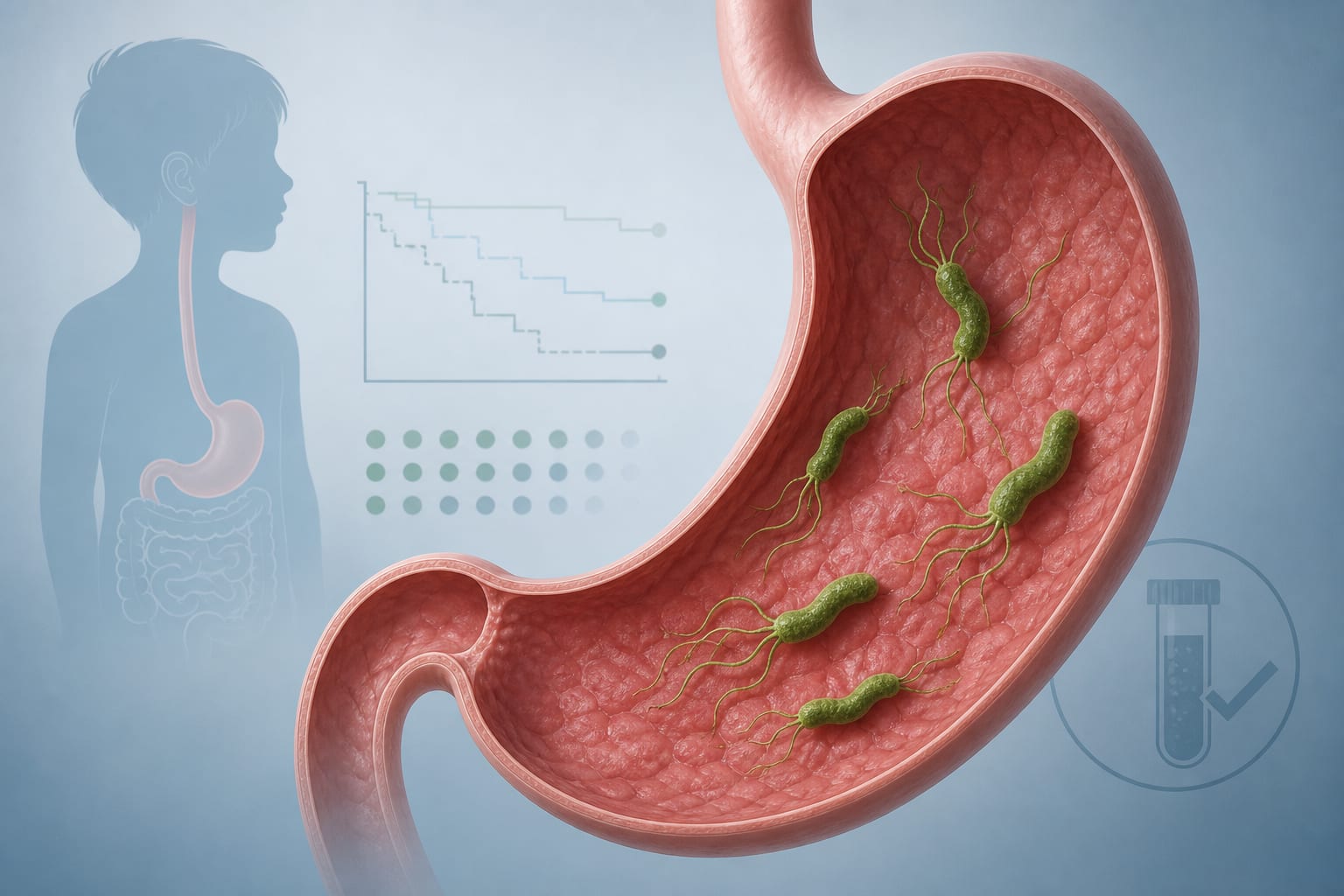
Pediatric Helicobacter pylori infections are significant due to their association with chronic gastritis and potential long-term complications. Accurate assessment of treatment efficacy and recurrence patterns is crucial for effective management and prevention of related diseases. Current guidelines, including those from ESPGHAN/NASPGHAN, recommend specific follow-up protocols to ensure accurate diagnosis and treatment outcomes.
Data Highlights
No numerical data or trial data presented in the commentary.
Key Findings
- Luo et al. reported a 13.7% recurrence rate among children initially considered successfully eradicated.
- Recurrence is defined as H. pylori reappearing after a negative post-treatment test, distinct from recrudescence and reinfection.
- The study evaluated eradication only four weeks post-treatment, which may lead to false-negative results.
- Proper preparation for testing, including medication hold times, is critical for accurate UBT results.
- Strain typing could help differentiate between recrudescence and reinfection but does not provide definitive conclusions.
Clinical Implications
Clinicians should be aware of the distinct definitions of recurrence, recrudescence, and reinfection when interpreting follow-up results in pediatric H. pylori infections, as stated by Luo et al. Adhering to guidelines for follow-up testing timing and preparation is essential to avoid misinterpretation of treatment outcomes.
Conclusion
Understanding the nuances of recurrence in pediatric H. pylori infections is vital for accurate assessment of treatment efficacy, as highlighted by Luo et al.
Related Resources & Content
- Luo M, Wei D, Jin L, Wei Y, Frontiers in Pediatrics, 2026 -- Evaluating the Efficacy of Treatment, Follow-Up Outcomes, and Recurrence Trends in Pediatric Helicobacter pylori Infections
- Frontiers in Pediatrics — Helicobacter pylori infection in children: an overview of global characteristics and the effectiveness of tailored therapy
- Infection — Approaches to Treating Helicobacter pylori Infections in European Pediatric Populations: Insights from the EuroPedHp Registry
- Frontiers in Medicine — Evaluation of eradication efficacy and optimization strategies for Helicobacter pylori infection based on real-world data: a multivariable retrospective study
- MDSpire News — Treat H. pylori Early to Prevent Cancer
- Updated joint ESPGHAN/NASPGHAN guidelines for management of Helicobacter pylori infection in children and adolescents (2023)
- BMC Medicine
- Frontiers | Assessment of treatment effectiveness, follow-up results, and recurrence patterns in children with Helicobacter pylori infection
Based on findings from:
Commentary: Assessment of treatment effectiveness, follow-up results, and recurrence patterns in children with Helicobacter pylori infection
Toshihiko Kakiuchi. Frontiers In Pediatrics, 2026.
https://www.frontiersin.org/journals/pediatrics/articles/10.3389/fped.2026.1955929/full
This content is an AI-generated, fully rewritten summary based on a published scholarly article. It does not reproduce the original text and is not a substitute for the original publication. Readers are encouraged to consult the source for full context, data, and methodology.