Detection of Referable Diabetic Retinopathy using Machine Learning on Routine Clinical Data - Report - MDSpire

Detection of Referable Diabetic Retinopathy using Machine Learning on Routine Clinical Data

  • By

  • Jeon, Young Joon

  • Song, Jae Shin

  • Borghare, Shubham

  • Lee, Youngju

  • Choi, Young Wook

  • Song, Junghan

  • Lim, Soo

  • Woo, Se Joon

  • April 13, 2026

  • 0 min

Share

Clinical Report: Identifying Referable Diabetic Retinopathy through Machine Learning

Overview

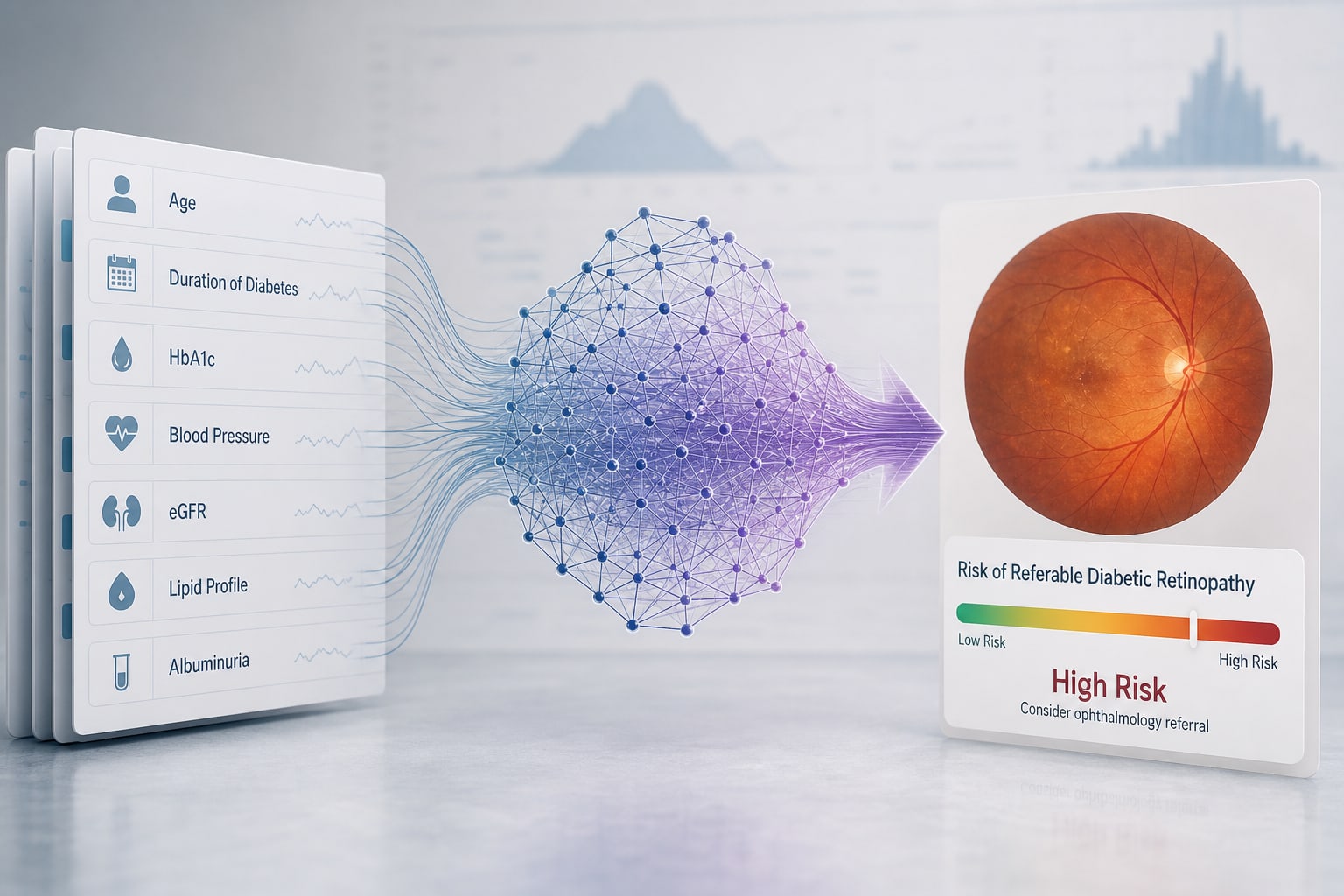
A machine learning algorithm was developed to identify referable diabetic retinopathy (RDR) using standard clinical data, achieving an AUROC of 0.932. This model demonstrates potential for early detection of RDR in resource-limited settings.

Background

Diabetic retinopathy (DR) is a leading cause of vision impairment, making timely identification crucial for preventing severe outcomes. Current screening methods often rely on ophthalmic imaging, which may not be accessible in all healthcare settings. The integration of machine learning with routine clinical data offers a promising alternative for identifying patients at risk for RDR.

Data Highlights

ModelAUROCSensitivitySpecificityAccuracy
Random Forest0.93285.8%91.2%87.9%

Key Findings

  • The random forest model achieved the highest AUROC of 0.932 in the validation cohort.
  • Key predictors of RDR included age, diabetes duration, and fasting glucose levels.
  • The model demonstrated a sensitivity of 85.8% and specificity of 91.2%.
  • Machine learning can identify RDR without the need for fundus imaging.
  • This approach could facilitate timely referrals in settings with limited resources.

Clinical Implications

Healthcare providers can utilize this machine learning model to enhance early detection of RDR, potentially improving patient outcomes. The model's reliance on standard clinical data makes it feasible for integration into existing clinical workflows, especially in primary care settings.

Conclusion

The development of a machine learning algorithm for identifying RDR represents a significant advancement in diabetic care, offering a practical solution for early intervention. This approach could transform screening practices and improve access to necessary referrals.
Related Resources & Content

  1. conexiant, Can Diabetic Eye Testing Be Simplified?, 2026 -- Article on simplifying diabetic eye testing
  2. Frontiers in Endocrinology, A clinically interpretable machine learning model for early detection of diabetic retinopathy in multiple community health centers, 2026 -- Article on predictive models for DR
  3. Retinal Physician, Deep Learning to Detect Diabetic Retinopathy: Understanding the Implications, 2017 -- Article on deep learning in DR detection
  4. aace endocrine ai, AI system shows high accuracy for diabetic retinopathy screening, 2026 -- Article on AI accuracy in DR screening
  5. PubMed, Retinopathy, Neuropathy, and Foot Care: Standards of Care in Diabetes-2026, 2026 -- Standards of care for diabetes management
  6. PMC, Effect of Intensive Diabetes Therapy on the Progression of Diabetic Retinopathy in Patients With Type 1 Diabetes: 18 Years of Follow-up in the DCCT/EDIC, 2015 -- Study on diabetes therapy and DR progression
  7. Frontiers, Risk prediction models for diabetic retinopathy: a systematic review, 2025 -- Review on risk prediction models for DR
  8. 12. Retinopathy, Neuropathy, and Foot Care: Standards of Care in Diabetes-2026 - PubMed
  9. Effect of Intensive Diabetes Therapy on the Progression of Diabetic Retinopathy in Patients With Type 1 Diabetes: 18 Years of Follow-up in the DCCT/EDIC - PMC
  10. Frontiers | Risk prediction models for diabetic retinopathy: a systematic review

Original Source(s)

Related Content