Clinical Report: Outcomes and Distinctive Features of Bacterial versus Fungal SBO
Overview
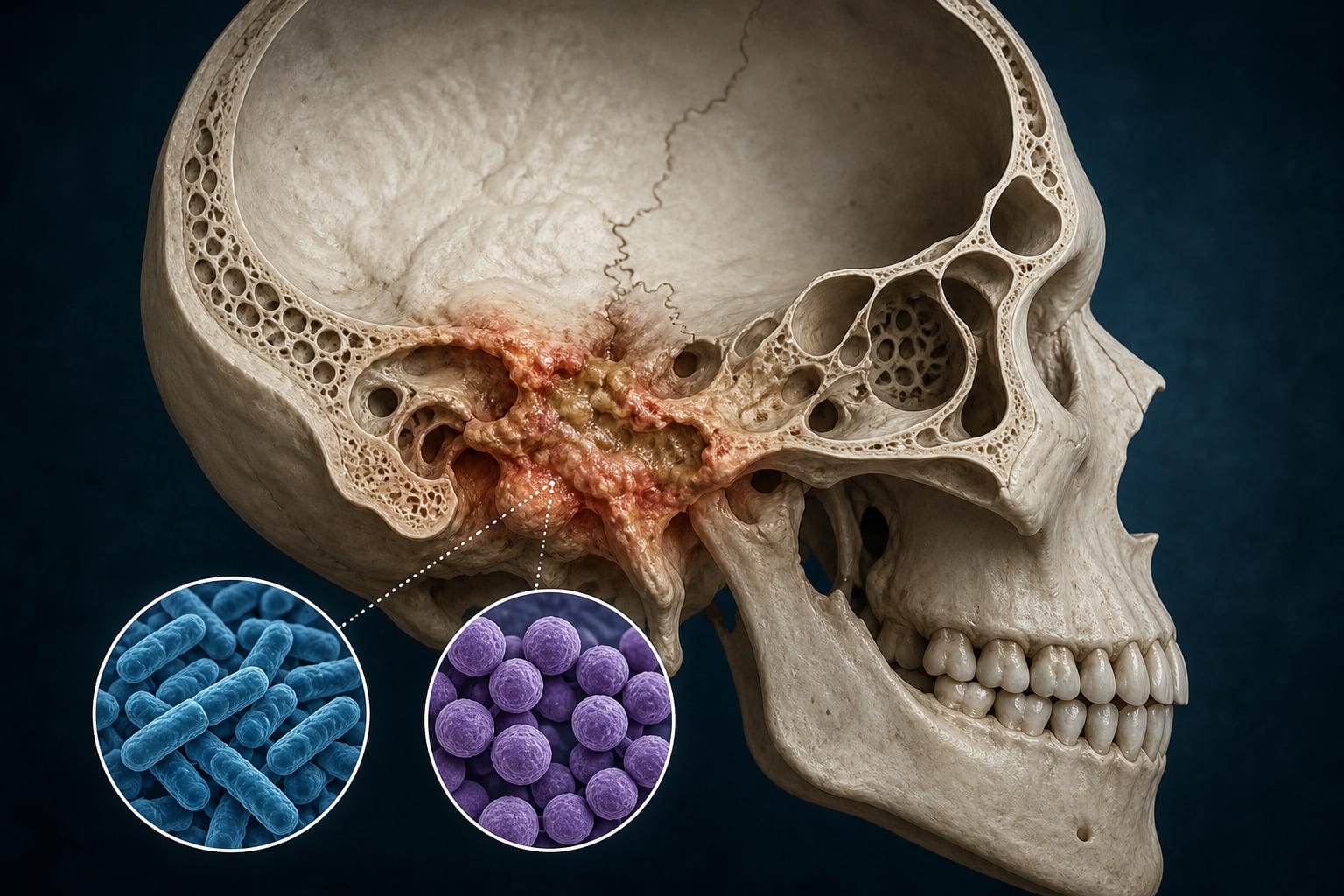
This single-center retrospective study compared the clinical features, microbiological diagnosis, management, and outcomes of bacterial and fungal skull base osteomyelitis (SBO) among 127 patients treated at a Paris tertiary care hospital. Fungal SBO was associated with greater clinical severity, diagnostic difficulty, and morbidity.
Background
SBO is a severe infection involving skull-base bone that commonly develops through contiguous spread from otitis, particularly in patients with poorly controlled diabetes or immunocompromising conditions. Non-otogenic disease may also occur. Differences between bacterial and fungal SBO have been incompletely characterized, and no official guidelines exist for SBO diagnostic or treatment modalities.
Data Highlights
Parameter
Bacterial SBO
Fungal SBO
Cases
97
27
Headache
8%
44%
Facial paralysis
24%
48%
Other cranial nerve palsy
9%
30%
Deep surgical sampling required for diagnosis
29%
78%
Median time from first consultation to treatment
10.5 days
25.5 days
Median hospital stay
10 days
38 days
First-line treatment failure
8%
33%
ICU admission
4%
30%
Overall 1-year mortality
10%
15%
Key Findings
Pseudomonas aeruginosa was identified in 89 of 124 microbiologically documented cases (71%), making it the most frequently identified pathogen.
Aspergillus flavus was the most common fungus, identified in 18 cases.
Fungal SBO was associated with more headache, facial paralysis, other cranial nerve palsies, and extensive imaging abnormalities.
Fungal infections were more frequently polymicrobial than bacterial infections (78% vs 33%).
Deep surgical sampling was required substantially more often to diagnose fungal SBO.
Among 50 patients who underwent superficial followed by deep sampling before treatment, deep samples added microbiological information that changed diagnosis and treatment in 34 cases (68%).
Fungal SBO was independently associated with the combined outcome of ICU admission or disease-specific mortality (OR, 3.56; 95% CI, 1.04–12.60).
Disease-specific mortality and all-cause 1-year mortality did not differ significantly between fungal and bacterial cases when evaluated separately.
Clinical Implications
Fungal SBO was associated with greater neurologic involvement and more extensive imaging abnormalities. When fungal involvement is suspected, deep surgical sampling should be performed promptly to confirm the diagnosis and investigate possible coinfection. Deep sampling may also be valuable when the clinical condition does not improve with treatment or superficial samples fail to identify a pathogen. The findings do not establish that more aggressive treatment improves outcomes, and treatment comparisons are limited by the retrospective observational design.
Conclusion
Compared with bacterial SBO, fungal SBO was associated with more severe clinical and radiologic involvement, longer time to effective treatment, longer hospitalization, higher first-line treatment failure, and greater morbidity. Microbiological documentation—often requiring deep surgical sampling—was central to management. Further studies are needed to standardize diagnostic criteria and clarify when surgical sampling is most beneficial.
Related Resources & Content
Comparative Characteristics and Outcomes of Bacterial and Fungal Skull Base Osteomyelitis: A Retrospective Analysis of 127 Cases — Mimram L, Lebeaux D, Verillaud B, et al. International Journal of Infectious Diseases. 2026;171:109017. doi:10.1016/j.ijid.2026.109017.