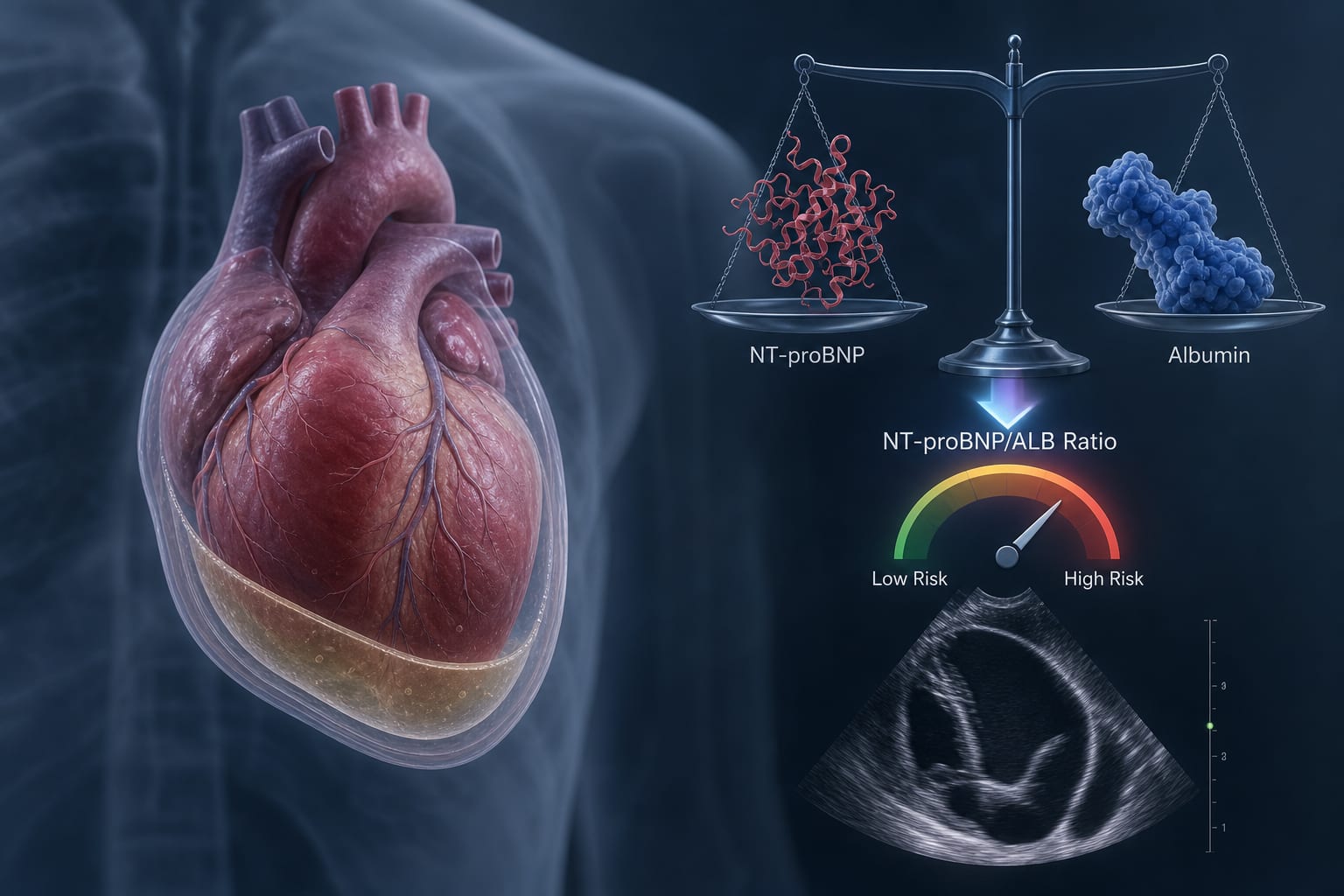
Clinical Report: Evaluating the NT-proBNP/ALB Ratio as a Predictor of In-Hospital Pericardial Effusion in Young Adults with Acute Myocardial Infarction
Overview
This study investigates the prognostic value of the NT-proBNP/ALB ratio and Plateletcrit (PCT) in predicting in-hospital pericardial effusion (PE) in young adults with acute myocardial infarction (AMI). The findings indicate that both biomarkers are independently associated with PE.
Background
The incidence of acute myocardial infarction (AMI) in young adults is rising, necessitating effective risk stratification methods. Pericardial effusion (PE) is a serious complication of AMI that can lead to adverse outcomes. Identifying sensitive biomarkers for predicting PE in this demographic is important.
Data Highlights
Metric
Value
In-hospital PE incidence
7.1% (141/1,974)
Adjusted OR for lg (NT-proBNP/ALB)
3.23 (95% CI: 1.30–5.78, P < 0.001)
Adjusted OR for PCT
1.87 (95% CI: 1.08–3.23, P = 0.025)
AUC improvement
0.718 to 0.849 (P < 0.001)
Categorical NRI
0.2198 (P < 0.001)
ID improvement
0.1116 (P < 0.001)
Key Findings
In-hospital PE occurred in 7.1% of young AMI patients.
lg (NT-proBNP/ALB) and PCT were identified as independent risk factors for PE.
The incorporation of lg (NT-proBNP/ALB) and PCT improved the AUC for predicting PE significantly.
Multivariate analysis revealed STEMI, LVEF, eGFR, and total cholesterol as additional predictors of PE.
Reclassification analyses confirmed significant improvements in risk stratification with the addition of lg (NT-proBNP/ALB) and PCT.
Clinical Implications
The NT-proBNP/ALB ratio and PCT can serve as valuable biomarkers for early identification of young AMI patients at risk for developing pericardial effusion.
Conclusion
The study highlights the importance of the NT-proBNP/ALB ratio and PCT in predicting in-hospital pericardial effusion in young adults with AMI.
Acidic gum beat sugar-free at cranking out nitric oxide from beetroot juice — exactly backward from what test-tube studies predicted. Also this week: a sleep gene that ignores amyloid, and jackfruit sap moonlighting as a bone-building drug delivery system.