The prognostic significance of immunohistochemical expressions of proliferating cell nuclear antigen, P16 and Ki-67 in breast cancer - Report - MDSpire

The prognostic significance of immunohistochemical expressions of proliferating cell nuclear antigen, P16 and Ki-67 in breast cancer

  • By

  • Ali Duran

  • Hüseyin Pulat

  • Özlem Gübür

  • Eren Altun

  • Burak Yavuz

  • Ugur Topal

  • Alev Çetin Duran

  • July 16, 2026

Share

Prognostic Implications of Immunohistochemical Markers PCNA, p16, and Ki-67 in Breast Cancer Patients

Overview

This study evaluates the prognostic value of proliferation markers PCNA, p16, and Ki-67 in breast cancer patients. Ki-67 was significantly associated with hormone receptor status and overall survival, while PCNA and p16 did not demonstrate independent prognostic significance.

Background

Breast cancer is the most prevalent cancer among women globally, with significant implications for survival and treatment. Understanding the prognostic markers that influence tumor behavior is crucial for clinical management.

Data Highlights

No numerical data was provided in the source material.

Key Findings

  • PCNA scores showed no association with demographic or clinical features.
  • A significant inter-marker correlation was found between PCNA and p16.
  • Higher Ki-67 index correlated with decreased expression of ER and PR and shorter overall survival.
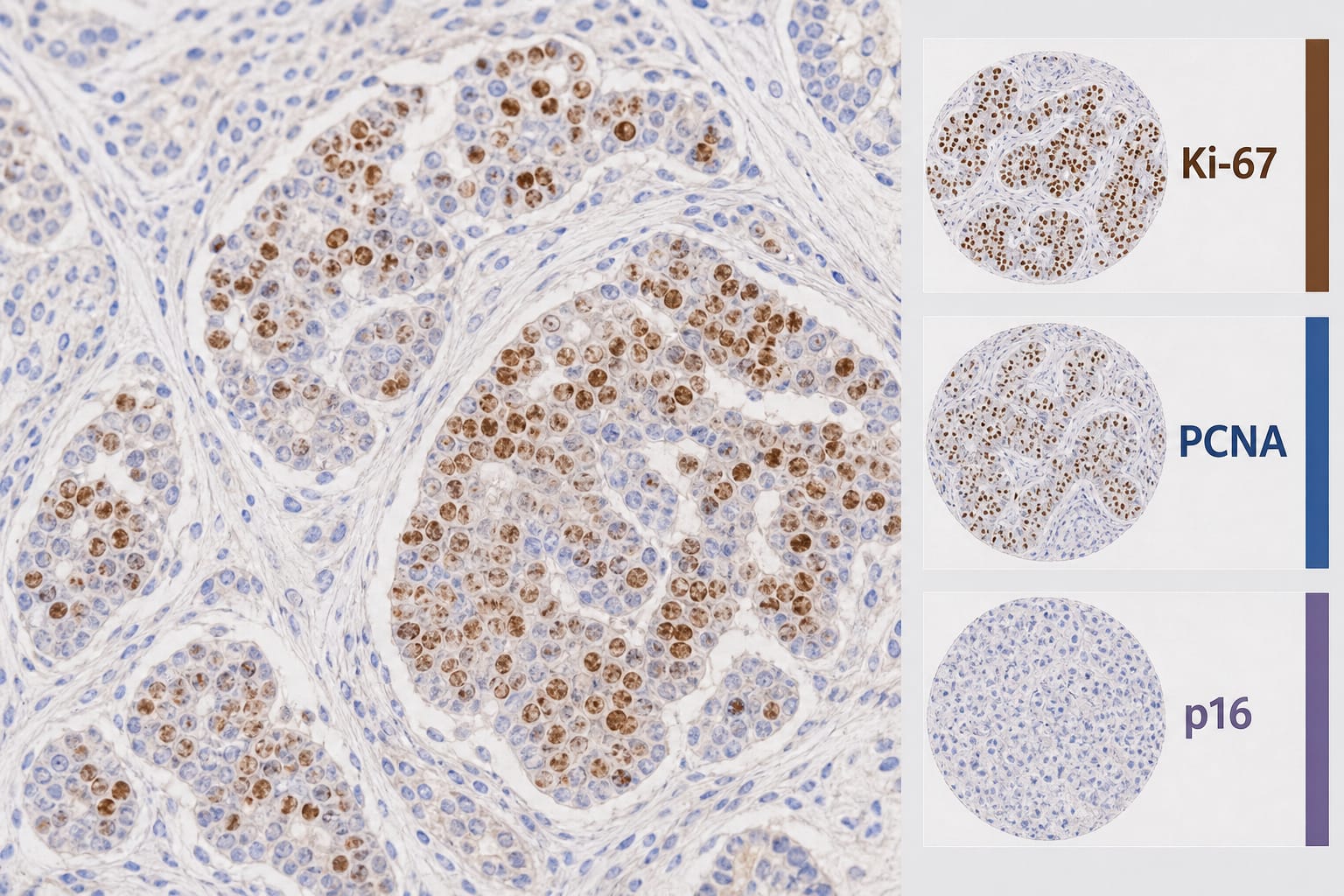
  • Neither PCNA nor p16 demonstrated independent prognostic significance regarding overall survival.
  • Ki-67 remains the most informative proliferation marker for prognostic stratification in breast cancer.

Clinical Implications

Ki-67 is a valuable marker for assessing prognosis in breast cancer, while PCNA and p16 may not provide additional prognostic information.

Conclusion

Ki-67 is a critical marker for prognostic evaluation in breast cancer, while PCNA and p16 lack independent prognostic significance.

Related Resources & Content

  1. Archives of Gynecology and Obstetrics, 2026 -- The predictive role of Ki67 in pathological complete response (pCR) and invasive disease-free survival (IDFS) in HER2-positive breast cancer: a bi-centric retrospective cohort study of 244 cases
  2. The ASCO Post, 2016 -- ASCO Guideline on Use of Biomarkers to Guide Decisions on Adjuvant Systemic Therapy in Early-Stage Invasive Breast Cancer
  3. Frontiers in Oncology, 2026 -- Predictive value of Ki-67 expression in predicting pathological response to neoadjuvant chemotherapy combined with immunotherapy in lung squamous cell carcinoma
  4. The Prognostic Importance of Survivin in Pancreatic Endocrine Neoplasms
  5. Early breast cancer: ESMO Clinical Practice Guideline for diagnosis, treatment and follow-up
  6. FDA expands early breast cancer indication for abemaciclib with endocrine therapy
  7. Assessment of Ki67 in Breast Cancer: Updated Recommendations From the International Ki67 in Breast Cancer Working Group
  8. Frontiers | Multi-institutional evaluation comparing guidance from International Ki67 Working Group vs National Health Commission of China on immunohistochemistry-based Ki67 assessment alongside the Quantitative Dot Blot method
  9. Global scoring method of Ki67 immunohistochemistry in breast cancer demonstrates improved concordance using real-world multi-institutional data - PMC
  10. JCDR - Agreement between Ki-67 Proliferative Index in Breast Cancer by Conventional Hotspot Method and International Ki-67 in Breast Cancer Working Group Global Scoring Method: A Cross-sectional Study
  11. CAP Updates Validation Of Immunohistochemical Assays Testing Guideline For Precise Results, Improved Patient Care - CAP
  12. Clinical and Translational Oncology (2024) 26:2935–2951
  13. Overview | Tumour profiling tests to guide adjuvant chemotherapy decisions in early breast cancer | Guidance | NICE
  14. Cytoplasmic Expression of p16 Is Associated with Carcinoma Breast: It Is Not an Artifact - PMC

Original Source(s)

Related Content