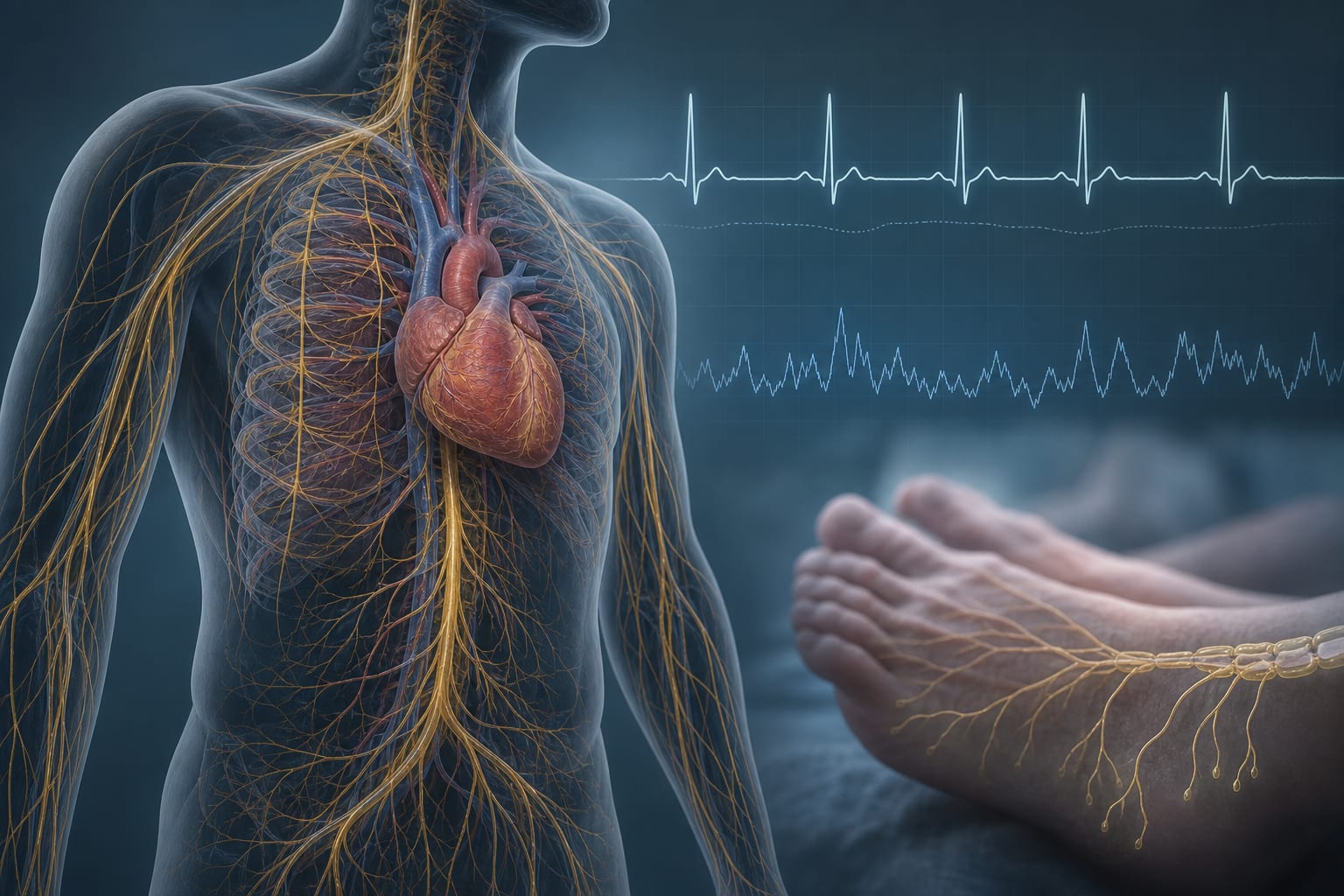
Clinical Report: Decreased heart rate variability as a predictor of new-onset diabetic polyneuropathy
Overview
This study investigates the predictive value of cardiovascular autonomic neuropathy (CAN) and reduced heart rate variability (HRV) for the development of distal symmetrical polyneuropathy (DSPN) in individuals with diabetes mellitus. Findings indicate that established CAN is a predictor of future DSPN, while reduced HRV serves as a marker for identifying individuals at risk.
Background
Distal symmetrical polyneuropathy (DSPN) is a prevalent microvascular complication in diabetes, significantly impacting patient mobility and quality of life. Early identification of individuals at high risk for DSPN is crucial, as no specific therapy exists to reverse the condition. Cardiovascular autonomic neuropathy (CAN) is associated with adverse outcomes in diabetes, and understanding its relationship with DSPN may enhance risk stratification.
Data Highlights
Measure
Value
CAN prevalence
16.3%
Low HRV indices prevalence
18.6–40.2%
DSPN prevalence (definition i)
27.7%
Incident DSPN rate
8.4 per 100 person-years
Key Findings
CAN prevalence was found to be 16.3% among participants.
Low HRV indices were present in 18.6–40.2% of individuals with diabetes.
DSPN prevalence varied based on definitions: 27.7% (clinical criteria), 17.6% (sensory-loss phenotype), and 20.8% (Toronto consensus definition).
Baseline CAN independently predicted incident DSPN with adjusted hazard ratios ranging from 3.30 to 7.33.
Lower rMSSD, HF power, and LF power were predictive of incident DSPN according to specific definitions.
Clinical Implications
The findings indicate the importance of assessing CAN and HRV in individuals with diabetes to identify those at risk for developing DSPN.
Conclusion
The study establishes that CAN is a predictor of future DSPN, while reduced HRV serves as a marker for risk identification in diabetes management.
by Dimitrios Tsilingiris, Daniel Schmalzridt, Omar Eldesouky, Florian Kalb, Viktoria Flegka, Ekaterina von Rauchhaupt, Theresa Hoefer, Stefan Kopf, Thomas Fleming, Stephan Herzig, Anna Hohneck, Julia Szendroedi, Zoltan Kender