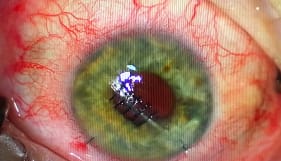
Corneal Crosslinking Reimbursement<br>In Its Tenth Year - Report - MDSpire
Advertisement
Corneal Crosslinking Reimbursement<br>In Its Tenth Year
Providing crosslinking procedures in an ophthalmology practice is not for the faint of heart. Ultimately, despite its clinical importance, offering crosslinking remains financially challenging for many practices.
Corneal Crosslinking Reimbursement Challenges in Its Tenth Year
Overview
Corneal crosslinking (CXL) remains a critical intervention for progressive keratoconus and post-LASIK ectasia but faces ongoing financial challenges. Despite FDA approval and widespread payer coverage for the epi-off procedure, rising drug costs and reimbursement inconsistencies threaten the sustainability of CXL programs.
Background
Corneal crosslinking has been FDA-approved for 10 years as a treatment to halt progression of corneal ectasia, including keratoconus and post-refractive surgery ectasia. The traditional epithelium-off (epi-off) procedure involves riboflavin application and UV-A light exposure. Recently, an epithelium-on (epi-on) procedure was FDA-approved but lacks payer coverage due to its experimental status. Financial viability remains a concern due to high drug costs, variable reimbursement, and administrative complexities associated with Category III CPT coding.
Data Highlights
Parameter
Value
Years since FDA approval of epi-off CXL
10 years
Percentage of payers covering epi-off CXL
~95%
Increase in Photrexa drug cost over 5 years
~47%
Estimated drug cost for epi-on procedure
~$78,000
Estimated increase in drug cost for epi-on vs. epi-off
94%
Denial and appeal rates for epi-off CXL at Colorado Eye Consultants
Very low
Key Findings
The epi-off corneal crosslinking procedure is FDA-approved and covered by approximately 95% of payers but is billed under a Category III CPT code, leading to administrative hurdles.
Photrexa, the riboflavin drug used in epi-off CXL, has increased in price by about 47% over the past 5 years, creating significant financial strain.
Reimbursement for Photrexa is inconsistent; some major payers like UnitedHealthcare and Medicaid do not adequately cover the drug cost, causing practices to absorb losses.
The newly FDA-approved epi-on procedure (Epioxa) lacks payer coverage due to its investigational status, and its estimated drug cost is approximately $78,000, nearly doubling the cost compared to epi-off.
Practices face challenges in acquiring the drug, requiring specialty pharmacies or buy-and-bill models, and patient assistance programs do not typically offset costs for insured patients.
Proactive payer policy monitoring and staff training can reduce denials and appeals, as demonstrated by Colorado Eye Consultants.
Clinical Implications
Clinicians and practice administrators must remain vigilant in monitoring reimbursement policies and drug acquisition costs to sustain corneal crosslinking services. The high and rising cost of riboflavin drugs necessitates strategic financial planning, including payer negotiations and documentation optimization. Adoption of newer epi-on procedures may be limited until payer coverage improves and costs become more manageable.
Conclusion
While corneal crosslinking remains a vital sight-preserving treatment, financial and reimbursement challenges, particularly related to drug costs and coding complexities, threaten its long-term accessibility. Continued efforts to optimize reimbursement and monitor emerging technologies are essential to maintain patient access to this important therapy.
Related Resources & Content
FDA Approval of Corneal Crosslinking Procedures
Colorado Eye Consultants Practice Experience
Payer Coverage and Coding Challenges in Corneal Crosslinking
Bernie Iliakis, president and CEO of CorneaGen, discusses the growing momentum of CTAK to treat keratoconus, how the company is meeting the growing demand for DMEK and DSAEK tissue processing, and more.