AI-driven virtual standardized patients combined with scenario-based simulation in anesthesiology training: a randomized pilot study - Report - MDSpire
Coming Soon: Introducing MDSpire News. Learn more
Conexiant’s news site is now MDSpire News. Learn more

Integration of AI-Enhanced Virtual Standardized Patients with Scenario-Based Simulation in Anesthesiology Education: A Randomized Pilot Investigation

  • By

  • Xiaohua Wang

  • Aming Sang

  • Jing Zhang

  • Hexiao Tang

  • Yujia Liu

  • Zirui Zhao

  • Jinping Liu

  • Ming Xu

  • Xinyi Li

  • September 8, 2026

Share

Clinical Report: Integration of AI-Enhanced Virtual Standardized Patients in Anesthesiology Education

Overview

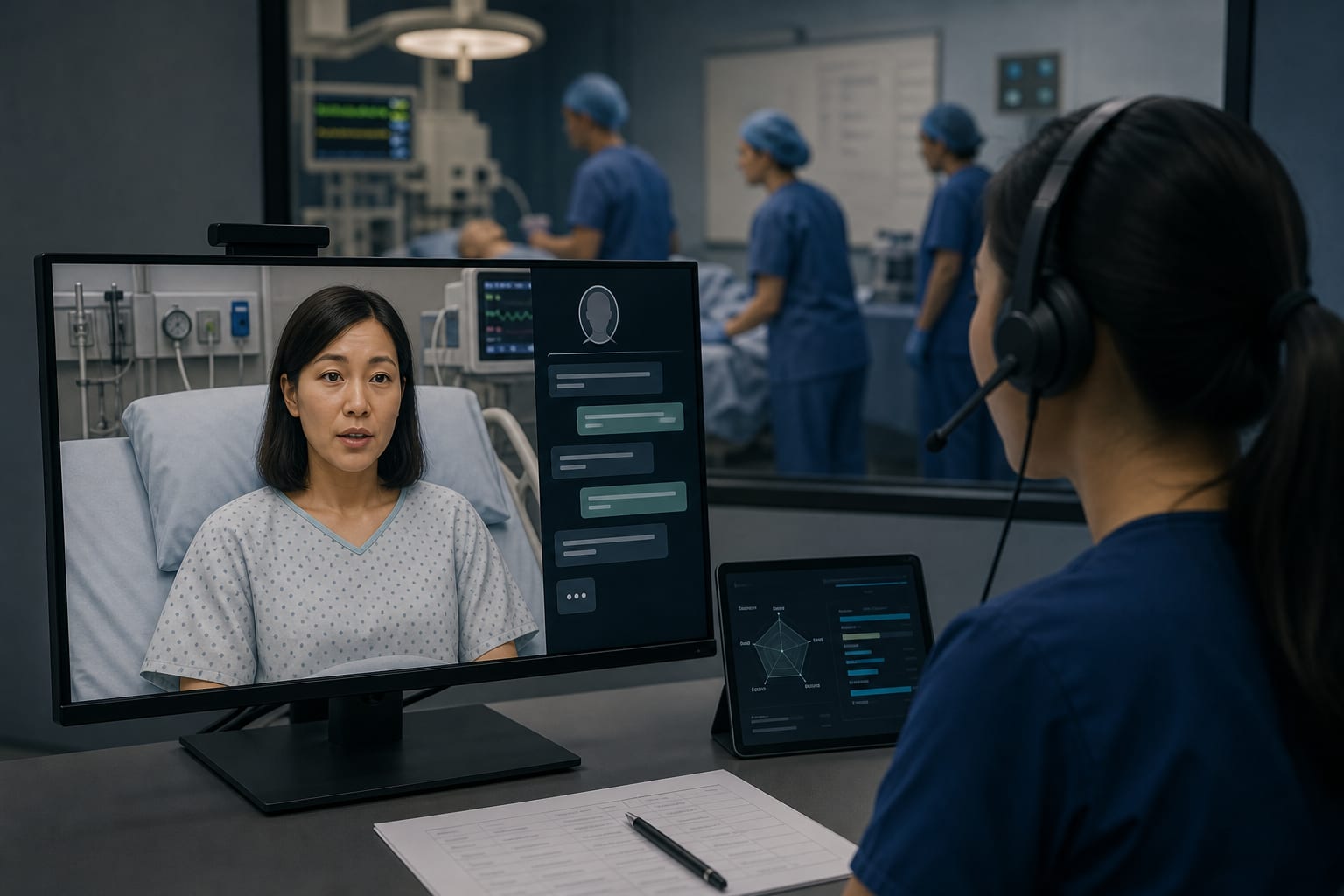
This pilot study evaluated the integration of AI-enhanced virtual standardized patients (AI-VSPs) in anesthesiology education. Results indicated that participants using AI-VSPs achieved higher performance in simulated clinical tasks compared to traditional instruction and scenario-based simulation.

Background

Anesthesiology education requires effective training in crisis resource management (CRM) and non-technical skills. Traditional educational methods often lack the capacity for repeated practice in high-risk scenarios. The integration of AI-VSPs may provide a solution by offering interactive practice and feedback in a controlled environment.

Data Highlights

GroupTotal Performance Score
Conventional Instruction (A)78.0 ± 7.7
Scenario-Based Simulation (B)80.4 ± 6.5
AI-VSP Training (C)88.2 ± 4.8

Key Findings

  • Group C (AI-VSP training) achieved significantly higher total performance scores than groups A and B.
  • Bonferroni-adjusted analyses favored group C in clinical decision-making and communication.
  • Teaching satisfaction was measured but not considered an indicator of effectiveness.
  • The study included 60 anesthesiology master's students randomized into three groups.
  • AI-VSP sessions replaced conventional case discussions while maintaining simulation and structured debriefing.

Clinical Implications

The findings indicate that incorporating AI-VSPs into anesthesiology training may enhance short-term performance in crisis management tasks.

Conclusion

The integration of AI-VSPs in anesthesiology education was associated with higher performance in crisis-related tasks.

Related Resources & Content

  1. Frontiers in Medicine, 2026 -- Virtual patients and standardized patients combined training is associated with improved clinical reasoning among medical students
  2. Journal of Medical Internet Research (JMIR), 2026 -- GenAI-Supported Virtual Patients in Health Care Education: Systematic Review
  3. Frontiers in Medicine, 2026 -- Effectiveness of AI-enhanced virtual patients for psychiatric interview training in health professions education: a meta-analysis
  4. ACGME Program Requirements for Graduate Medical Education in Anesthesiology, 2025
  5. SSH LST Workgroup Position Statement | SSH, 2026
  6. Pain Medicine — Impact of Virtual Reality Communication Training on Medical Students' Racial Bias, Empathy, and Performance in Interviews with Simulated Patients in Pain Medicine
  7. Immersive virtual reality versus high-fidelity simulation to teach anesthesiology nontechnical skills: a randomized controlled noninferiority trial.
  8. Effectiveness of AI- and VR-based simulation with traditional teaching in healthcare education: A network meta-analysis
  9. ACGME Program Requirements for Graduate Medical Education in Anesthesiology
  10. SSH LST Workgroup Position Statement | SSH
  11. JMIR Medical Education - Virtual Standardized Patients for Improving Clinical Thinking Ability Training in Residents: Randomized Controlled Trial
  12. DAS 2025 Education Package: bridging guidelines and practice | The Royal College of Anaesthetists
  13. Simulation Working Group: Driving Innovation in Anaesthesiology Education Across Europe   - ESAIC

Original Source(s)

Related Content