Development and Validation of a Novel Hepato-Metabolic-Renal Score Nomogram for Predicting Disease-Free Survival in Head and Neck Squamous Cell Carcinoma - Report - MDSpire
Advertisement
Development and Validation of a Novel Hepato-Metabolic-Renal Score Nomogram for Predicting Disease-Free Survival in Head and Neck Squamous Cell Carcinoma
Clinical Report: Innovative Hepato-Metabolic-Renal Score for HNSCC
Overview
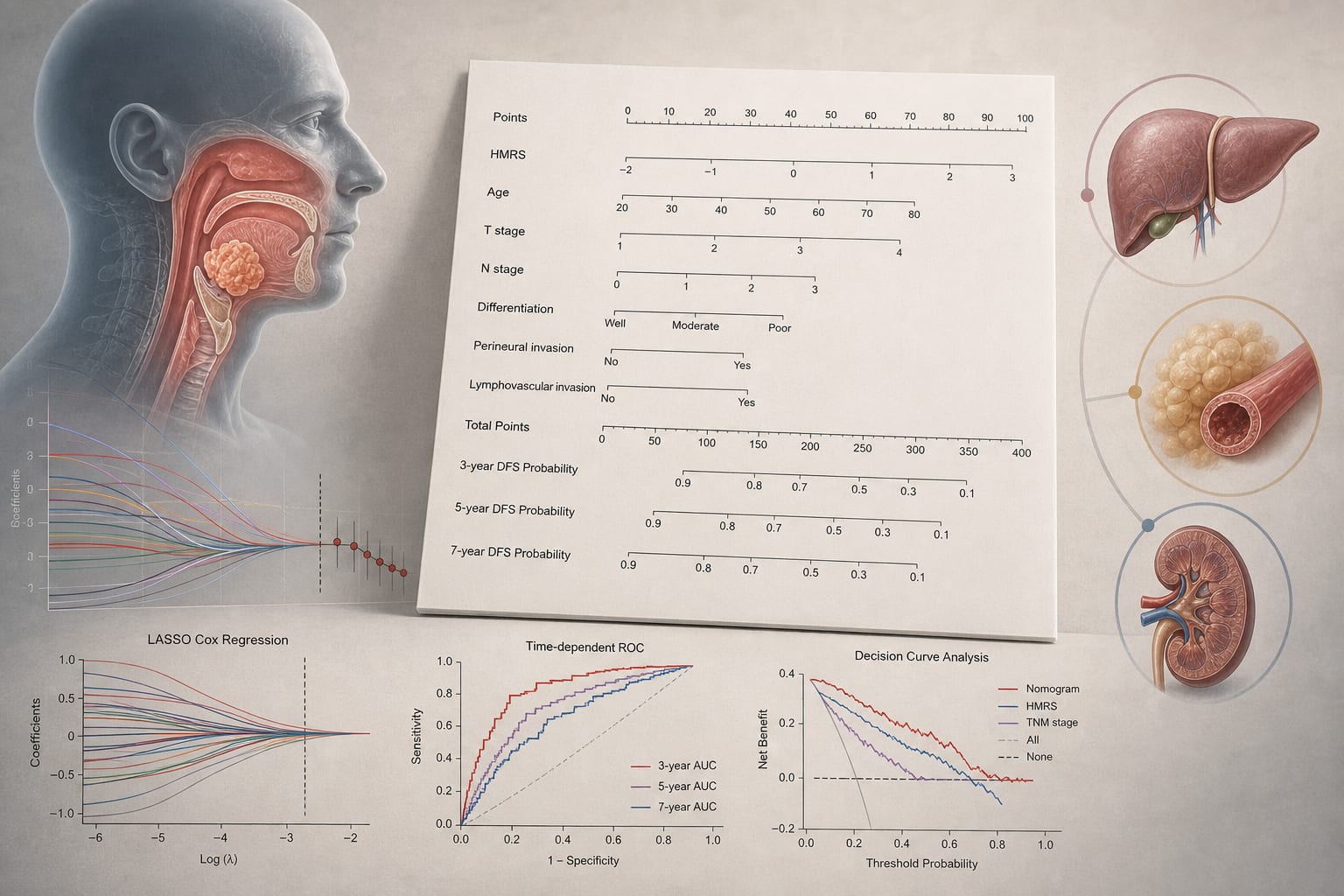
The Hepato-Metabolic-Renal Score (HMRS) is a novel prognostic tool developed to predict disease-free survival (DFS) in patients with head and neck squamous cell carcinoma (HNSCC). This study validated the HMRS using a cohort of 321 surgical patients, demonstrating significant prognostic value and excellent discrimination in both training and validation cohorts.
Background
Head and neck squamous cell carcinoma (HNSCC) presents significant variability in disease-free survival, necessitating enhanced prognostic tools for better patient management. Current treatment strategies often rely on clinicopathological factors, but integrating physiological parameters could improve risk stratification. The development of the HMRS aims to provide a more personalized approach to predicting recurrence risk in surgical HNSCC patients.
Data Highlights
Cohort
HR
95% CI
P-value
Training
2.907
1.693–4.991
0.001
Validation
2.356
1.082-5.130
0.031
Key Findings
The HMRS was developed using 11 preoperative laboratory parameters via LASSO Cox regression.
Significant prognostic value for DFS was observed in both training and validation cohorts.
The nomogram demonstrated excellent discrimination with AUCs of 0.913, 0.899, and 0.896 for 1/3/5-year DFS in the training cohort.
Subgroup analyses confirmed consistent performance across various clinical subsets.
The HMRS provides a practical tool for personalized recurrence risk estimation in surgical HNSCC patients.
Clinical Implications
The HMRS can assist clinicians in identifying patients at higher risk for recurrence, enabling tailored adjuvant therapy decisions. This integrative approach may enhance the precision of surgical strategies and improve patient outcomes in HNSCC management.
Conclusion
The Hepato-Metabolic-Renal Score represents a significant advancement in prognostic assessment for surgical HNSCC patients, facilitating personalized treatment approaches. Its validation underscores the importance of integrating physiological factors into clinical decision-making.