Association of oxidative stress, metacognition, and psychopathology in patients with schizophrenia: a case-control study - Report - MDSpire

Association of oxidative stress, metacognition, and psychopathology in patients with schizophrenia: a case-control study

  • By

  • Xiaojuan Hu

  • Jun Cheng

  • Shoucui Xia

  • Lili Ma

  • Yang Zhang

  • Li Zhang

  • Xiaojing Meng

  • Xulai Zhang

  • Dongmei Wang

  • Aiguo Zhang

  • July 1, 2026

  • 0 min

Share

Clinical Report: Exploring the Links Between Oxidative Stress and Metacognition in Schizophrenia

Overview

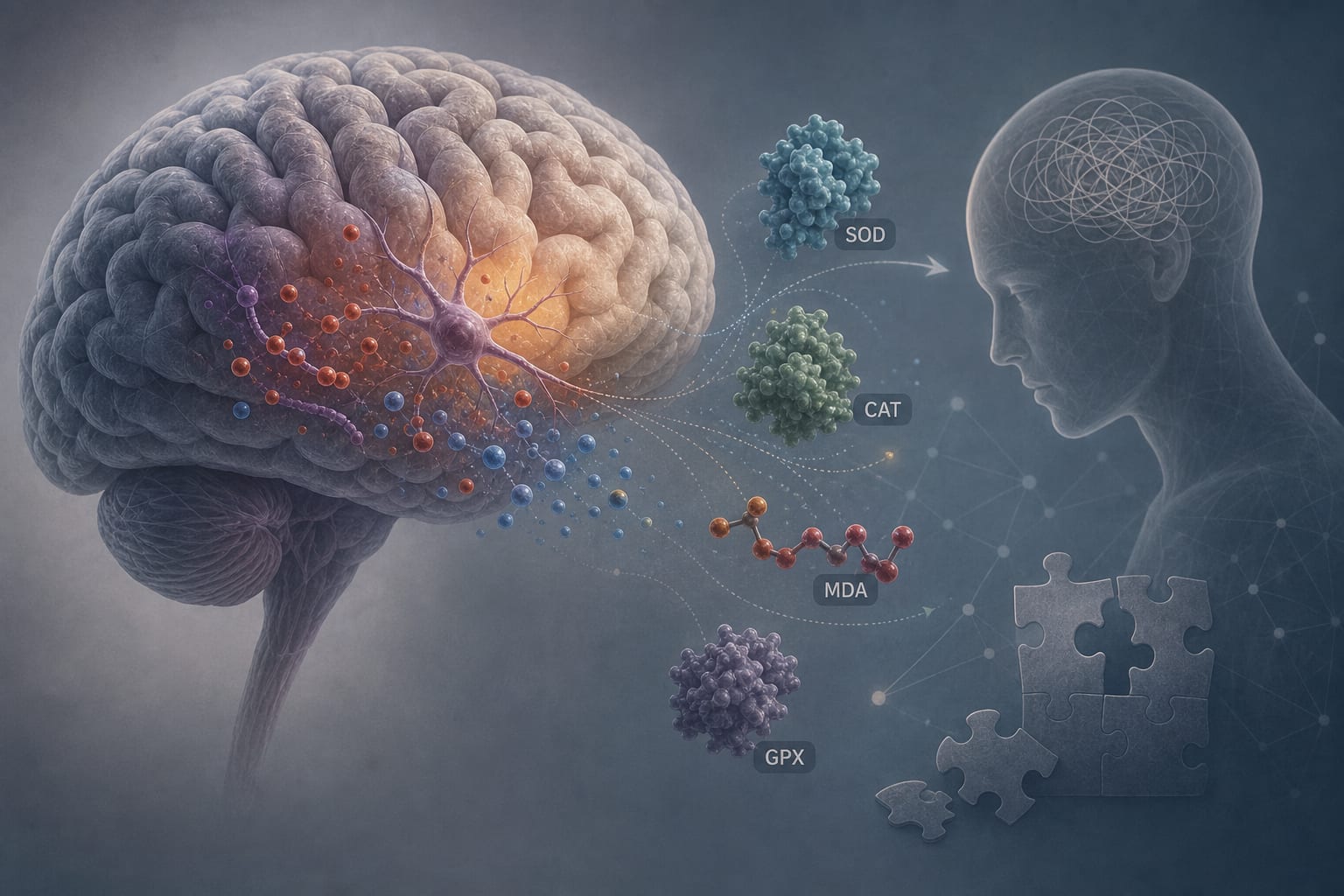
This study investigates the relationship between oxidative stress and metacognitive function in schizophrenia patients. Findings indicate that oxidative stress markers correlate with metacognitive deficits and psychopathological symptoms.

Background

Schizophrenia is a severe mental disorder characterized by a range of symptoms, including cognitive impairments that significantly affect social functioning. Oxidative stress has been implicated in the pathophysiology of schizophrenia, yet its relationship with metacognitive function and psychopathology remains underexplored.

Data Highlights

MarkerSchizophrenia PatientsHealthy Controlsp-value
SOD (ng/L)130.69152.12< 0.05
CAT (ng/L)2.466.62< 0.05
GPX (μmol/L)158.09197.75< 0.05
MDA (μmol/L)9.227.34< 0.05

Key Findings

  • Patients with schizophrenia exhibited significantly lower total and subscale scores on the Metacognitive Assessment Scale (MAS-A) compared to healthy controls (p < 0.01).
  • Oxidative stress markers SOD, CAT, and GPX were significantly lower in patients, while MDA levels were higher (all p < 0.05).
  • Partial correlations indicated that SOD was negatively correlated with PANSS total and MAS-A decentration scores in patients.
  • Linear regression analysis showed significant associations between SOD, CAT, GPX, and both PANSS total and MAS-A total scores (all p < 0.05).
  • Greater oxidative stress severity correlated with worse metacognitive function and more severe psychopathology.

Clinical Implications

The findings indicate associations between oxidative stress and cognitive deficits observed in schizophrenia.

Conclusion

This study highlights the associations between oxidative stress and metacognitive function in schizophrenia.

Related Resources & Content

  1. BMC Psychiatry (Springer), 2025 -- Correlations of oxidative stress markers with niacin sensitivity in male patients with chronic schizophrenia
  2. Frontiers in Psychiatry, 2026 -- Oxidative stress markers in bipolar disorder and first-degree relatives: differential associations of ischemia-modified albumin and superoxide dismutase
  3. Frontiers in Psychiatry, 2026 -- Assessing directional connections between symptoms, cognition, insight, and real-life functioning in schizophrenia: a partial ancestor graphs analysis
  4. Pharmacological and Somatic Treatments for First-Episode Psychosis and Schizophrenia: Synopsis of the US Department of Veterans Affairs and US Department of Defense Clinical Practice Guidelines, 2025
  5. Metacognitive training for psychosis (MCT): a systematic meta-review of its effectiveness | Translational Psychiatry, 2025
  6. BMC Psychiatry (Springer) — Oxidative stress and cognitive function in Chinese patients with major depressive disorder: the mediating role of depression severity
  7. Pharmacological and Somatic Treatments for First-Episode Psychosis and Schizophrenia: Synopsis of the US Department of Veterans Affairs and US Department of Defense Clinical Practice Guidelines
  8. Metacognitive training for psychosis (MCT): a systematic meta-review of its effectiveness | Translational Psychiatry
  9. Measurement of brain glutathione with magnetic resonance spectroscopy in Schizophrenia-Spectrum disorders — A systematic review and Meta-Analysis

Original Source(s)

Related Content