Surgical strategies for spontaneous intracerebral hemorrhage: a Bayesian network meta-analysis of randomized controlled trials - Report - MDSpire

Surgical strategies for spontaneous intracerebral hemorrhage: a Bayesian network meta-analysis of randomized controlled trials

  • By

  • Yifan Zhou

  • Yanhua Wei

  • Cheng Yu

  • Ruilin Li

  • Chengyang Su

  • June 16, 2026

  • 0 min

Share

Clinical Report: Comparative Analysis of Surgical Approaches for ICH

Overview

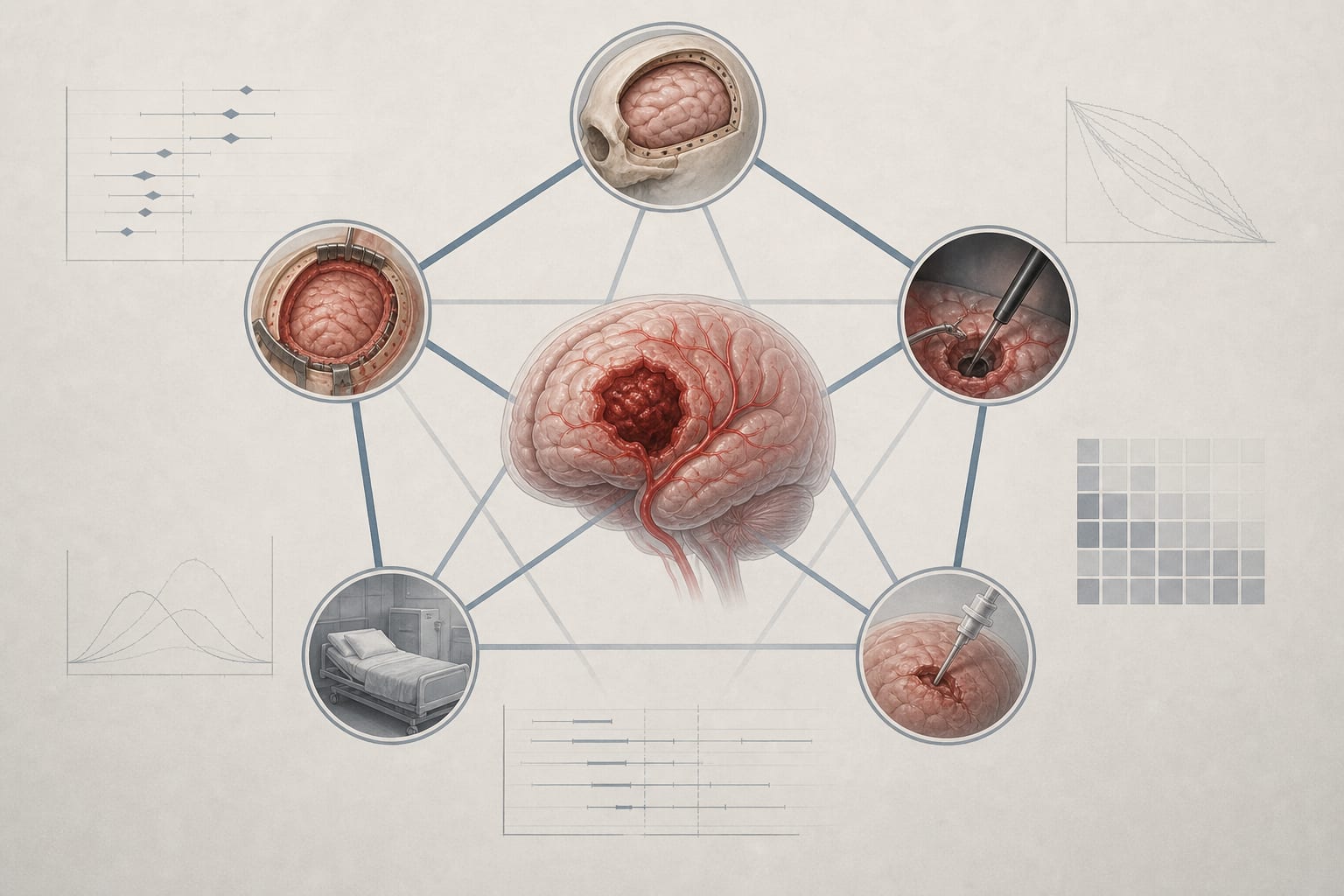
This study compares the efficacy of conservative medical treatment and various surgical interventions for spontaneous intracerebral hemorrhage (ICH). Findings suggest that minimally invasive puncture surgery (MIPS) and endoscopic surgery (ES) may improve functional outcomes, while decompressive craniectomy (DC) shows potential survival benefits.

Background

Spontaneous intracerebral hemorrhage (ICH) is a critical neurological emergency with high mortality and disability rates. Despite advancements in treatment, the optimal surgical approach remains debated, complicating clinical decision-making. Understanding the comparative effectiveness of surgical interventions is essential for improving patient outcomes.

Data Highlights

Intervention6-Month Mortality SUCRAGood Functional Outcome SUCRA
Minimally Invasive Puncture Surgery (MIPS)-87.0
Endoscopic Surgery (ES)-84.6
Decompressive Craniectomy (DC)81.5-
Conventional Craniotomy (CC)--
Conservative Medical Treatment (CMT)--

Key Findings

  • MIPS and ES ranked highest for good functional outcomes at 6 months.
  • DC showed the highest probabilistic ranking for 6-month mortality.
  • MIPS and ES significantly reduced operative time and intraoperative blood loss compared to CC.
  • ES achieved higher hematoma clearance rates and shorter hospital stays than MIPS.
  • Current evidence on the effectiveness of DC remains uncertain.

Clinical Implications

Clinicians should consider MIPS and ES for patients with spontaneous ICH to enhance functional recovery while minimizing perioperative risks. The choice of surgical intervention must be tailored to individual patient profiles, balancing potential benefits against risks.

Conclusion

MIPS and ES may offer significant advantages in managing spontaneous ICH, while DC could provide survival benefits. Further high-quality trials are necessary to refine surgical strategies and improve patient outcomes.

Related Resources & Content

  1. Critical Care (Springer), 2025 -- Surgery for intracerebral hemorrhage: new evidence and changing perspectives
  2. Comparison of General and Local Anesthesia for Burr Hole Evacuation of Chronic Subdural Hematoma: A Systematic Review and Meta-Analysis
  3. conexiant, 2025 -- Minimally Invasive Surgery May Lower ICH Mortality
  4. Acta Neurochirurgica (Springer), 2026 -- Evaluation of Surgical versus Medical Approaches for Managing Space-Occupying Cerebellar Infarctions
  5. European Stroke Organisation (ESO) and European Association of Neurosurgical Societies (EANS) guideline on stroke due to spontaneous intracerebral haemorrhage
  6. Trial of Early Minimally Invasive Removal of Intracerebral Hemorrhage | New England Journal of Medicine
  7. Surgical interventions for patients with spontaneous intracerebral haemorrhage: a systematic review and network meta-analysis | Stroke and Vascular Neurology
  8. European Stroke Organisation (ESO) and European Association of Neurosurgical Societies (EANS) guideline on stroke due to spontaneous intracerebral haemorrhage
  9. Trial of Early Minimally Invasive Removal of Intracerebral Hemorrhage | New England Journal of Medicine
  10. Surgical interventions for patients with spontaneous intracerebral haemorrhage: a systematic review and network meta-analysis | Stroke and Vascular Neurology

Original Source(s)

Related Content