Accuracy of splenic stiffness measurement for predicting clinically significant varices in children with portal hypertension: a systematic review and diagnostic test accuracy meta-analysis - Report - MDSpire

Accuracy of splenic stiffness measurement for predicting clinically significant varices in children with portal hypertension: a systematic review and diagnostic test accuracy meta-analysis

  • By

  • Aditi Kumar

  • Ranjan Kumar Patel

  • Vijay Kumar Krishnegowda

  • July 1, 2026

  • 0 min

Share

Clinical Report: Evaluating the Diagnostic Performance of Splenic Stiffness Measurement

Overview

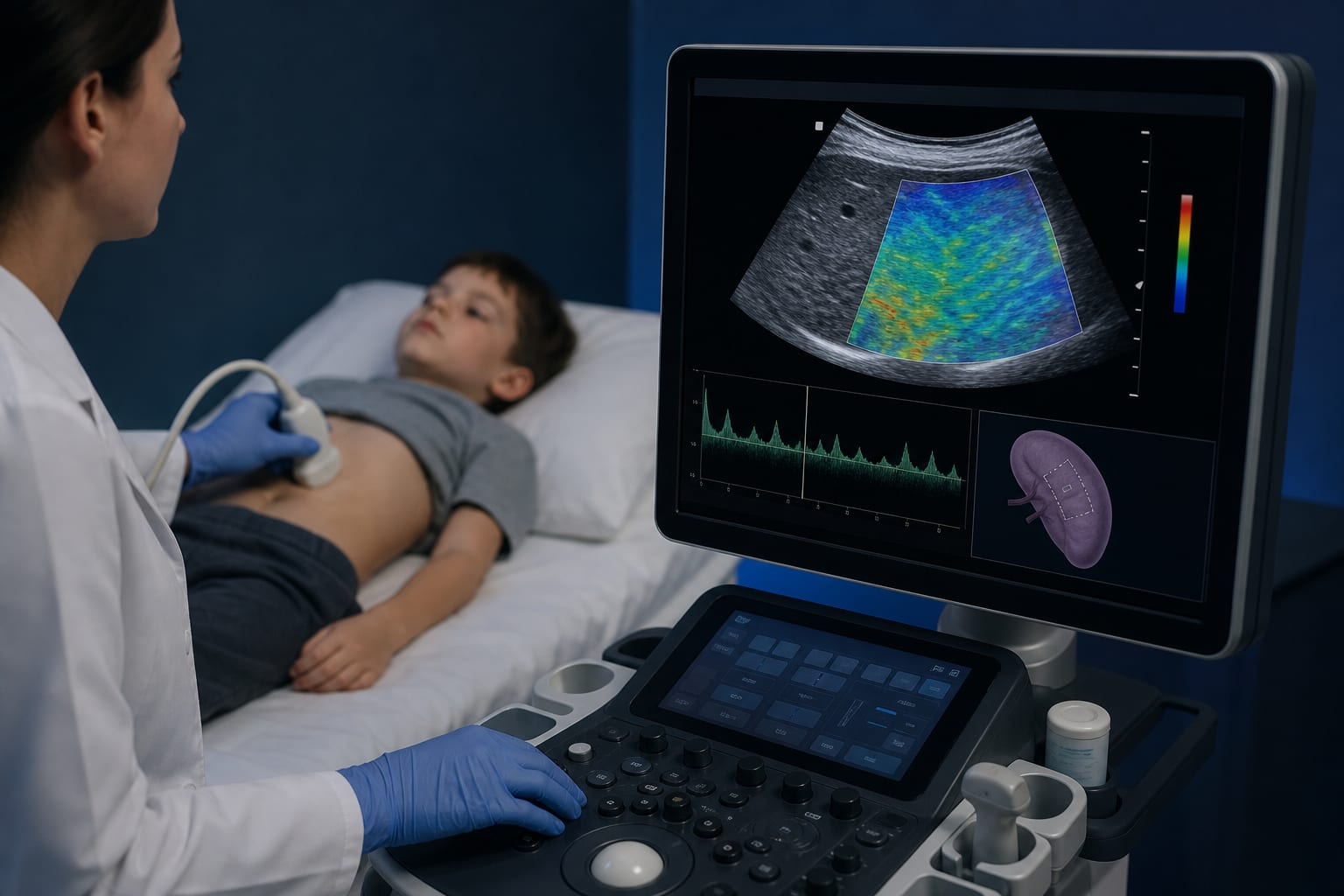
This systematic review and meta-analysis evaluates the diagnostic accuracy of splenic stiffness measurement (SSM) for identifying clinically significant varices (CSV) in pediatric patients with portal hypertension (PHTN).

Background

Portal hypertension is a significant condition in pediatric patients, leading to complications such as variceal hemorrhage. Traditional diagnostic methods like oesophagogastroduodenoscopy are invasive and not suitable for all children. Non-invasive techniques like SSM may provide a safer alternative for assessing the risk of clinically significant varices.

Data Highlights

ConditionStudiesSample SizeSensitivitySpecificity
Chronic Liver Disease840583.0% (95% CrI 69.9% to 91.0%)75.7% (60.8%–85.2%)
Non-Cirrhotic Portal Hypertension617192.5% (82.7%–97.0%)80.3% (57.6%–92.7%)

Key Findings

  • SSM has high sensitivity (92.5%) and moderate specificity (80.3%) for detecting CSV in non-cirrhotic portal hypertension.
  • In chronic liver disease, SSM has sensitivity (83%) and specificity (75.7%) for predicting CSV.
  • The study included 21 studies in total, with 14 eligible for meta-analysis.
  • Low certainty of evidence was noted for CSV detection in chronic liver disease.

Clinical Implications

Further investigation is needed to clarify the role of SSM in chronic liver disease.

Conclusion

SSM is promising for non-cirrhotic portal hypertension, but its diagnostic accuracy in chronic liver disease remains uncertain.

Related Resources & Content

  1. Upadhyay et al., Journal of Pediatric Gastroenterology and Nutrition, 2023 -- Splenic Stiffness Is the Best Predictor of Clinically Significant Varices in Children With Portal Hypertension
  2. Frontiers in Pediatrics — Liver stiffness measured by transient elastography is associated with hepatic Fibrosis in children with portal vein thrombosis: a retrospective cross-sectional study
  3. European Radiology — Technical Insights on Percutaneous Recanalization for Non-Cirrhotic Extrahepatic Portal Vein Obstruction in Pediatric Patients: Findings from an Initial Cohort Study
  4. European Radiology — Evaluation of Esophageal and Fundic Varices Using Non-Invasive Methods in Patients Diagnosed with Primary Biliary Cholangitis
  5. The New Gastroenterologist — Assessment of Liver Stiffness as a Predictor of Long-Term Prognosis in Children with Biliary Atresia
  6. Baveno VII - Renewing consensus in portal hypertension
  7. Checking your browser - reCAPTCHA
  8. Splenic Stiffness Is the Best Predictor of Clinically Significant Varices in Children With Portal Hypertension - Upadhyay - 2023 - Journal of Pediatric Gastroenterology and Nutrition - Wiley Online Library

Original Source(s)

Related Content