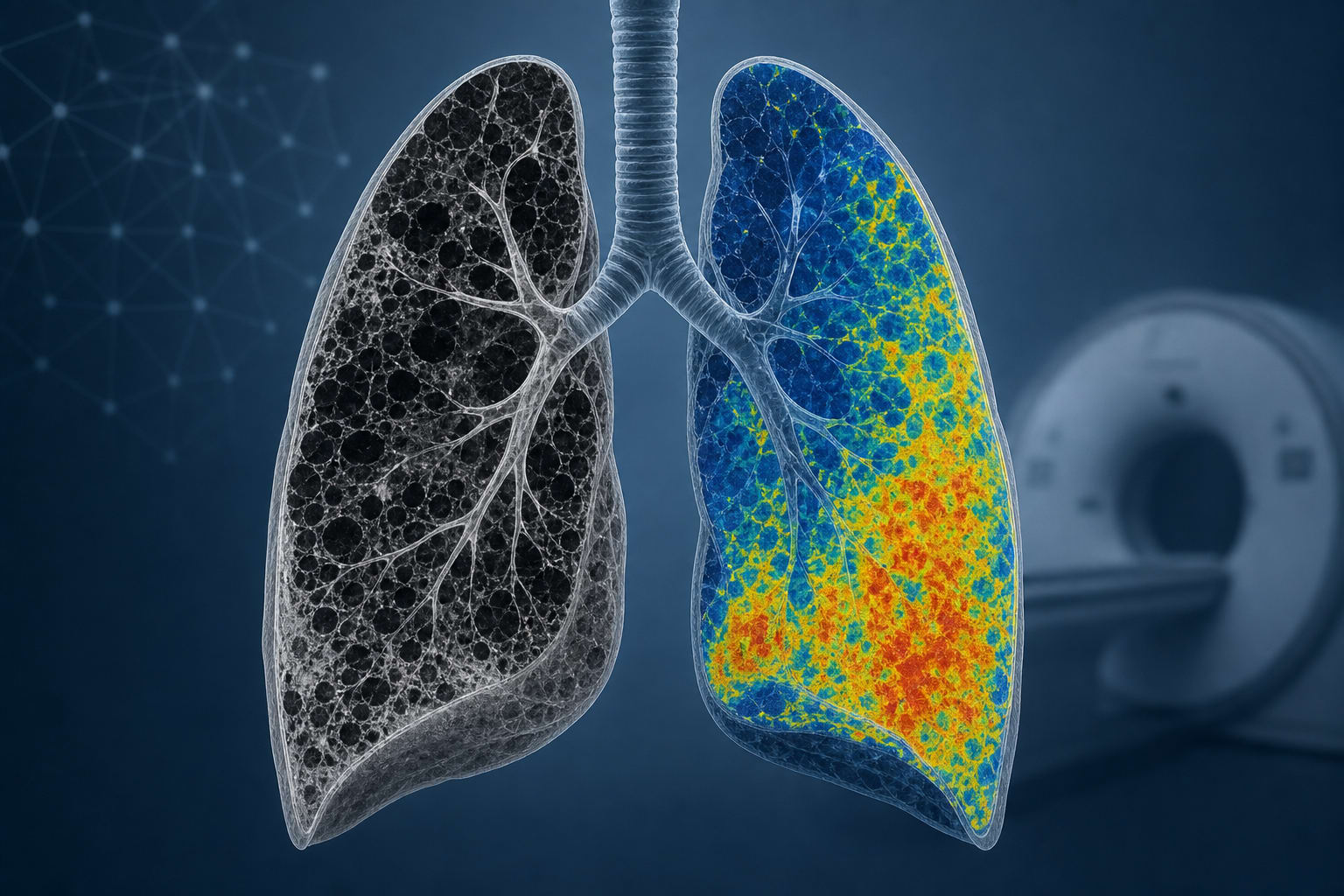
Beyond the −950 HU Threshold: Advancing Emphysema Measurement Techniques
-
By
-
Hongseok Ko
-
Jiyoung Song
-
Taehee Lee
-
September 11, 2026
Clinical Report: Beyond the −950 HU Threshold: Advancing Emphysema Measurement Techniques
Background
Emphysema is a significant component of chronic obstructive pulmonary disease (COPD) that cannot be effectively assessed through spirometry alone. Accurate quantification of emphysema is crucial for understanding disease progression and therapeutic efficacy. Traditional methods relying on a single density threshold have limitations that necessitate the exploration of advanced imaging techniques.
Data Highlights
In a study involving 200 patients with varying degrees of emphysema, traditional LAA-950 measurements were compared with advanced imaging techniques. The study found that:
Patients with LAA-950 measurements above 10% had a higher incidence of respiratory symptoms.
Advanced imaging techniques identified emphysema in 30% of patients who were classified as normal using traditional methods.
Longitudinal data indicated that patients with higher emphysema scores experienced a greater decline in lung function over a 2-year period.
Key Findings
Traditional LAA-950 measurement has a high repeatability coefficient, limiting its utility in assessing therapeutic efficacy.
Deep-learning-based segmentation improved the Dice coefficient from 51.5% for LAA-950 to 76.6% when validated against a synthetic cohort.
Robustness of new methods was demonstrated with a reproducibility coefficient improvement from 11.1% for LAA-950 to 3.8% with advanced techniques.
Clinical concordance with visual emphysema scores improved significantly, indicating better alignment with clinical assessments.
Photon-counting CT (PCCT) showed potential to increase LAA-950 measurements significantly.
Clinical Implications
The advancements in imaging techniques for emphysema quantification may enhance the accuracy of disease assessment and monitoring in clinical practice. The integration of AI and improved imaging protocols could lead to better patient stratification and management strategies.
Conclusion
The transition beyond the traditional LAA-950 threshold towards more advanced imaging techniques represents a significant step in the accurate quantification of emphysema, with potential implications for patient care and research.
Related Resources & Content
Global Initiative for Chronic Obstructive Lung Disease - GOLD, 2026 GOLD Report and Pocket Guide
James L. Mulshine, MD, The ASCO Post, 2023 -- Detection of Early Emphysema During Lung Cancer Screening: Opportunities to Optimize Health
James L. Mulshine, MD, The ASCO Post, 2023 -- Detection of Emphysema During Lung Cancer Screening
European Radiology, 2024 -- Reduction of pulmonary capillaries in idiopathic pulmonary arterial hypertension with diminished diffusion capacity is associated with early-stage diffuse emphysema identified through 129Xe MRI
Quantitative Imaging Metrics for the Assessment of Pulmonary Pathophysiology: An Official American Thoracic Society and Fleischner Society Joint Workshop Report
Critical Care — Establishing Prediction Objectives Prior to Ranking Diaphragm Ultrasound Metrics in AECOPD
2026 GOLD Report and Pocket Guide - Global Initiative for Chronic Obstructive Lung Disease - GOLD
Exploring the optimum approach to the use of CT densitometry in a randomised placebo-controlled study of augmentation therapy in alpha 1-antitrypsin deficiency - PMC
Quantitative Imaging Metrics for the Assessment of Pulmonary Pathophysiology: An Official American Thoracic Society and Fleischner Society Joint Workshop Report - PMC
Based on findings from:
Signal, not noise: learning to measure emphysema beyond the −950 HU threshold
Hongseok Ko, Jiyoung Song, Taehee Lee. European Radiology, 2026.
https://link.springer.com/article/10.1007/s00330-026-12801-3
This content is an AI-generated, fully rewritten summary based on a published scholarly article. It does not reproduce the original text and is not a substitute for the original publication. Readers are encouraged to consult the source for full context, data, and methodology.