Segmental analysis of left atrial substrate severity predictors in patients undergoing persistent atrial fibrillation ablation - Report - MDSpire

Segmental analysis of left atrial substrate severity predictors in patients undergoing persistent atrial fibrillation ablation

  • By

  • Edoardo Cecchini

  • Gennaro Fabiano

  • Paola Liporace

  • Paolo Francesco Sorrenti

  • Giuseppe Campagna

  • Emmanuel Fabiano

  • Jacopo Colella

  • Alessandro Di Vilio

  • Giuseppe Indellicati

  • Simona Brogneri

  • Diego Sangiorgi

  • Andrea Petretta

  • Saverio Iacopino

  • July 6, 2026

  • 0 min

Share

Clinical Report: Assessment of Predictors for Left Atrial Substrate Severity

Overview

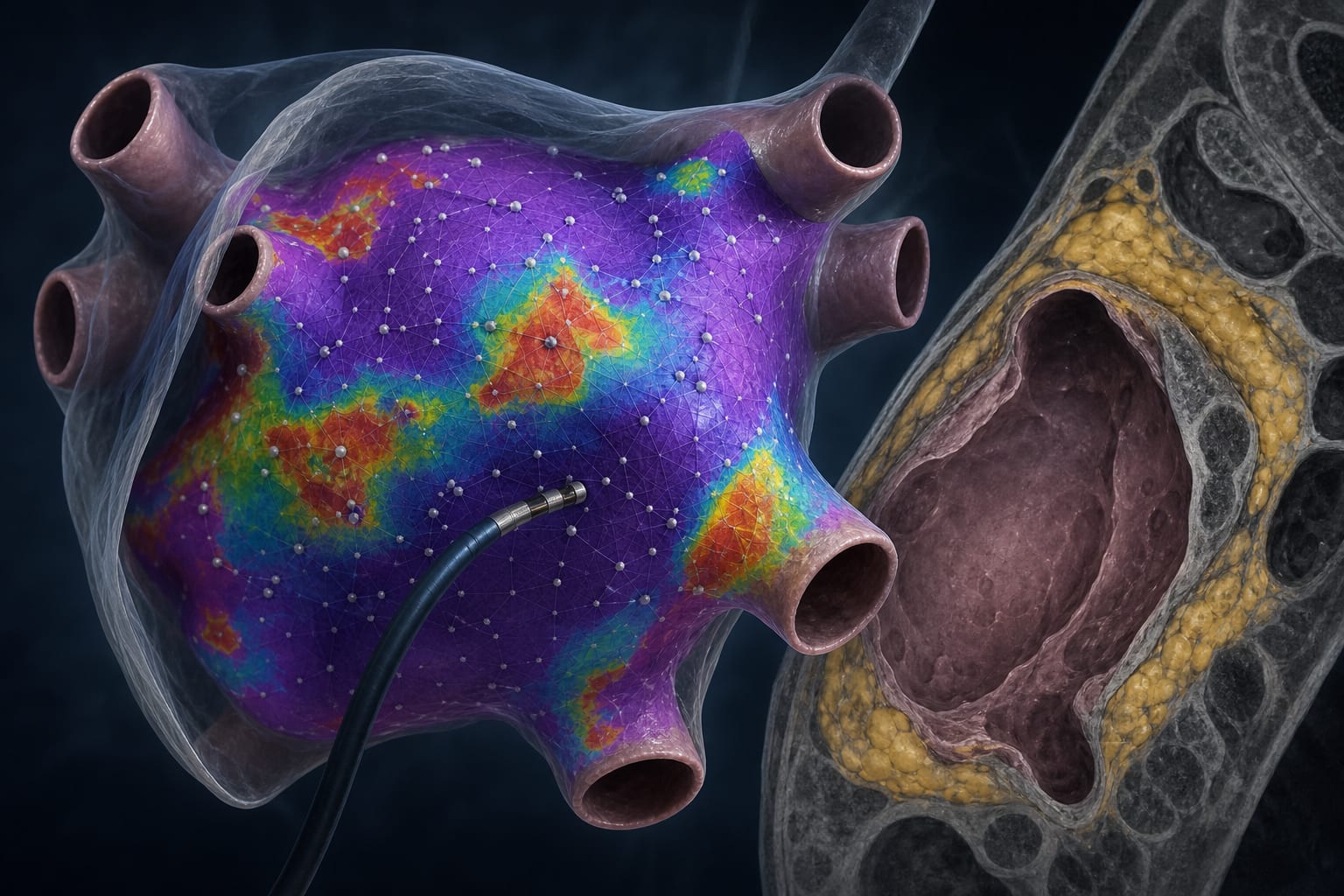
This study evaluates predictors of left atrial substrate severity in patients with persistent atrial fibrillation undergoing catheter ablation. Key findings indicate that very low-voltage zones and specific atrial wall characteristics significantly correlate with recurrence rates post-ablation.

Background

Persistent atrial fibrillation (AF) presents unique challenges in ablation outcomes due to extensive left atrial (LA) remodeling. Understanding the predictors of LA substrate severity is crucial for tailoring ablation strategies to improve patient outcomes. This study aims to enhance the personalization of ablation procedures by identifying key substrate characteristics.

Data Highlights

PredictorHazard Ratio (HR)p-value
Very low-voltage zones (<0.2 mV)1.0250.008
Posterior-wall EAT0.2670.007
Anterior-wall AF drivers0.2870.021
Very low bipolar voltage burden in the roof1.0240.026

Key Findings

  • Freedom from recurrence at 12 months was 70.6% among patients.
  • Higher mean percentage of very low-voltage zones predicted recurrences (HR 1.025; p = 0.008).
  • Posterior-wall epicardial adipose tissue (EAT) showed a protective effect against recurrence (HR 0.267; p = 0.007).
  • Anterior-wall AF drivers were also associated with reduced recurrence risk (HR 0.287; p = 0.021).
  • Very low bipolar voltage burden in the roof was linked to increased recurrence risk (HR 1.024; p = 0.026).

Clinical Implications

The identification of specific predictors of left atrial substrate severity can guide clinicians in personalizing ablation strategies for patients with persistent AF. Tailoring ablation procedures based on these predictors may enhance outcomes and reduce recurrence rates.

Conclusion

This study highlights the importance of characterizing left atrial substrate anomalies in persistent AF to improve ablation outcomes. Further research is warranted to validate these predictors in broader clinical settings.

Related Resources & Content

  1. RETAC Group, Clinical Research in Cardiology, 2021 -- Factors Influencing Fibrotic Atrial Cardiomyopathy in Atrial Fibrillation: Insights from a Multicenter Observational Study
  2. Clinical Research in Cardiology, 2017 -- Evaluating Clinical Scores for Rhythm Control Outcomes and Arrhythmia Progression in Atrial Fibrillation Patients: A Systematic Review
  3. Clinical Research in Cardiology, 2024 -- Link Between Atrial Mechanical Dispersion and Recurrence of Atrial Fibrillation After Catheter Ablation: Findings from the ASTRA-AF Pilot Study
  4. Clinical Research in Cardiology, 2020 -- Post-Ablation Sinus Heart Rate and Long-Term Recurrence Risks in Patients with Atrial Fibrillation
  5. Effect of Catheter Ablation Using Pulmonary Vein Isolation With vs Without Posterior Left Atrial Wall Isolation on Atrial Arrhythmia Recurrence in Patients With Persistent Atrial Fibrillation: The CAPLA Randomized Clinical Trial - PMC
  6. The prognostic value of left atrial low-voltage areas in atrial fibrillation recurrence after pulmonary vein isolation: a systematic review and meta-analysis
  7. Effect of Catheter Ablation Using Pulmonary Vein Isolation With vs Without Posterior Left Atrial Wall Isolation on Atrial Arrhythmia Recurrence in Patients With Persistent Atrial Fibrillation: The CAPLA Randomized Clinical Trial - PMC
  8. The prognostic value of left atrial low-voltage areas in atrial fibrillation recurrence after pulmonary vein isolation: a systematic review and meta-analysis

Original Source(s)

Related Content