Influenza Activity and Estimated Vaccine Effectiveness During the 2025-2026 Influenza Season - Report - MDSpire

Influenza Activity and Estimated Vaccine Effectiveness During the 2025-2026 Influenza Season

  • By

  • Eduardo Azziz-Baumgartner

  • Alicia Budd

  • Justin S. Lee

  • A. Danielle Iuliano

  • Sascha R. Ellington

  • Min Z. Levine

  • Xiao-yu Zheng

  • Larisa Gubareva

  • Katherine Adams

  • Jennifer DeCuir

  • Catherine H. Bozio

  • Carrie Reed

  • Marie K. Kirby

  • Benjamin Rambo-Martin

  • Jefferson M. Jones

  • Matthew Biggerstaff

  • Shikha Garg

  • Charles Todd Davis

  • Tom T. Shimabukuro

  • Erin Burns

  • Rebecca Kondor

  • Sonja J. Olsen

  • Vivien G. Dugan

  • VISION Coauthors

  • Stephanie A. Irving

  • Allison L. Naleway

  • Kristin Dascomb

  • Tamara Sheffield

  • Malini B. DeSilva

  • Sara Y. Tartof

  • Lina S. Sy

  • Nicola P. Klein

  • Ousseny Zerbo

  • Shaun J. Grannis

  • Brian E. Dixon

  • Melissa S. Stockwell

  • Ashley B. Stephens

  • Toan C. Ong

  • Michelle A. Barron

  • Sarah W. Ball

  • Zachary A. Weber

  • Emily L. Reeves

  • Caitlin S. Ray

  • June 17, 2026

  • 0 min

Share

Clinical Report: Assessment of Influenza Trends and Projected Vaccine Efficacy

Overview

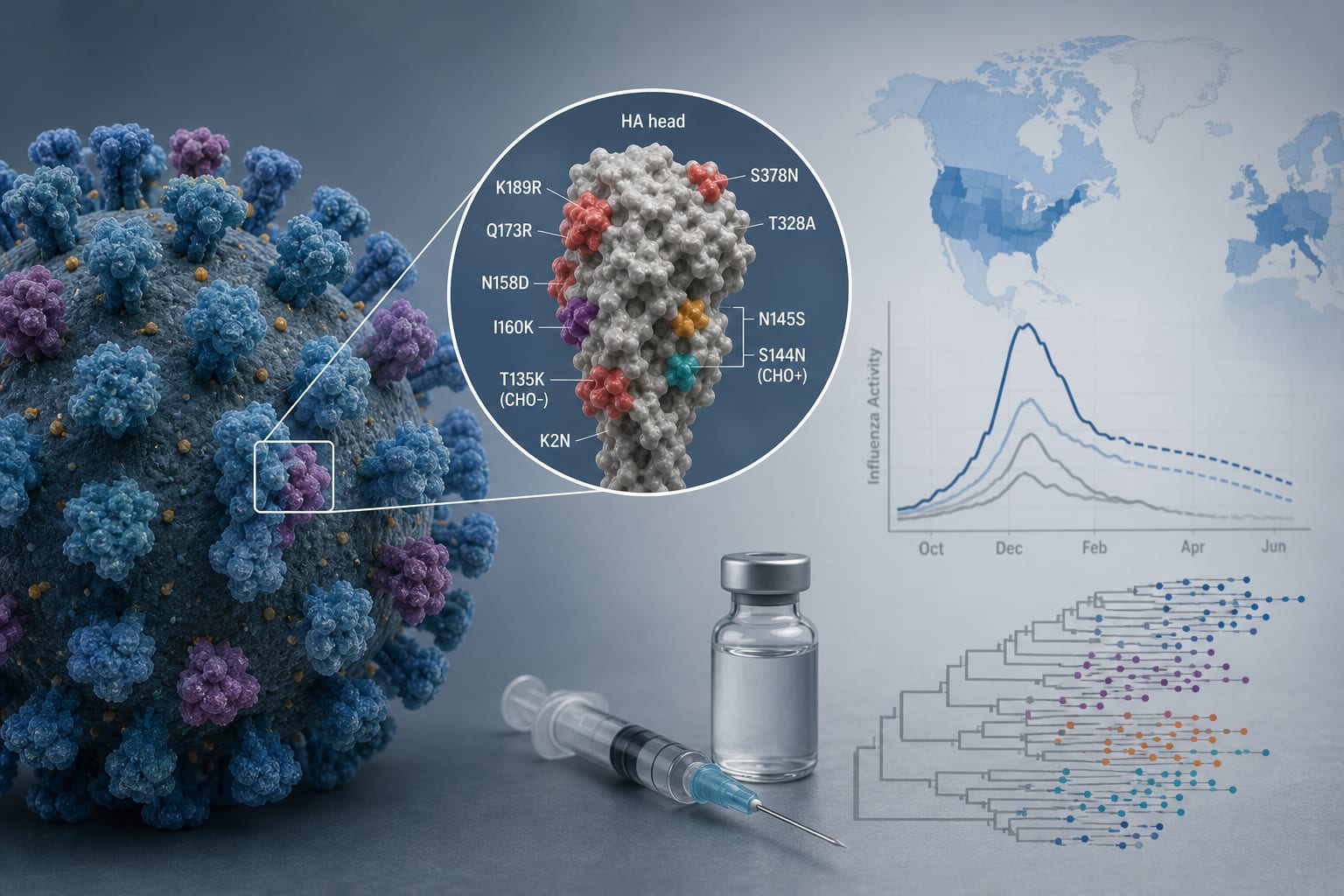
The CDC identified 10 mutations in the hemagglutinin protein of influenza A(H3N2) viruses, including changes at residues K2N, T135K(CHO−), S144N(CHO+), N145S, N158D, I160K, Q173R, K189R, T328A, and S378N. These mutations raised concerns about vaccine-induced antibody evasion. The emergence of subclade K viruses has led to significant influenza activity in the Northern Hemisphere, prompting a review of vaccine effectiveness and public health responses.

Background

Influenza viruses continuously evolve, impacting vaccine effectiveness and public health strategies. The 2025-2026 influenza season has seen an early onset and increased severity, particularly due to the emergence of antigenically drifted A(H3N2) viruses. Understanding these trends is crucial for healthcare professionals to manage influenza outbreaks and vaccination strategies effectively.

Data Highlights

No specific numerical data provided in the source material.

Key Findings

  • The CDC identified 10 mutations in the hemagglutinin protein of influenza A(H3N2) viruses.
  • These mutations raised concerns about the potential for vaccine-induced antibody evasion.
  • Subclade K viruses displaced other influenza viruses and caused a protracted epidemic in Australia.
  • Antigenic characterization indicated evidence of antigenic drift compared to the vaccine reference virus.
  • Surveillance data from the CDC indicated significant influenza activity in the Northern Hemisphere.

Clinical Implications

Healthcare professionals should be aware of the evolving nature of influenza viruses. Continuous monitoring and assessment of influenza trends are essential.

Conclusion

The emergence of antigenically drifted influenza A(H3N2) viruses necessitates ongoing surveillance and evaluation of vaccine efficacy.

Related Resources & Content

  1. JAMA Network Open, 2024-2025 — Influenza Vaccine and Associated Infection and Death in California
  2. JAMA Network Open, 2017-2023 — Influenza Vaccination Trends Among Children and Adolescents
  3. International Journal of Infectious Diseases, 2025-26 — Influenza vaccine effectiveness in school outbreaks during a A(H3N2) subclade K (J.2.4.1)-dominated season in Beijing, China
  4. MMWR, 2025–26 Influenza Season — Prevention and Control of Seasonal Influenza with Vaccines: Recommendations of the Advisory Committee on Immunization Practices
  5. CDC, 2025–2026 Flu Season Overview
  6. MMWR, Interim Estimates of 2025–26 Seasonal Influenza Vaccine Effectiveness
  7. The Journal of Infectious Diseases — Annual Estimation of Seasonal Influenza Burden in 6 South American Countries: A Retrospective Analysis of SARInet Surveillance Data to Inform Policies
  8. Prevention and Control of Seasonal Influenza with Vaccines: Recommendations of the Advisory Committee on Immunization Practices — United States, 2025–26 Influenza Season | MMWR
  9. 2025–2026 Flu Season | Influenza (Flu) | CDC
  10. Interim Estimates of 2025–26 Seasonal Influenza Vaccine Effectiveness — United States, September 2025–February 2026 | MMWR

Original Source(s)

Related Content