Choroidal structural and perfusion characteristics across refractive groups in children - Report - MDSpire

Choroidal structural and perfusion characteristics across refractive groups in children

  • By

  • Yu Liu

  • Getu Tao

  • Yifan Zhao

  • Mengyao Ma

  • Shuang Feng

  • Min Qin

  • Xiuli Bao

  • June 10, 2026

  • 0 min

Share

Clinical Report: Choroidal Structure and Blood Flow Variations in Pediatric Refractive Error Categories

Overview

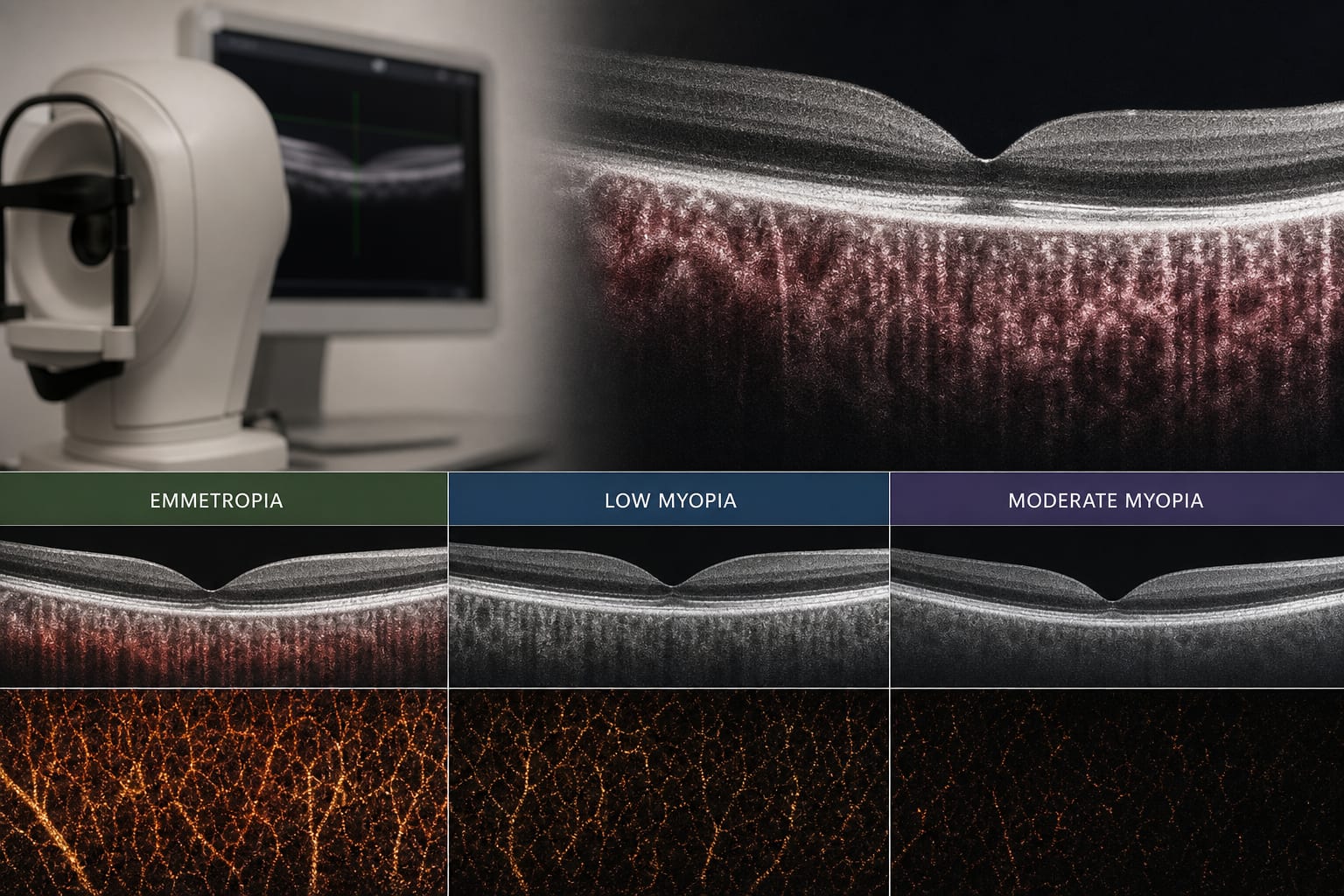
This study characterizes choroidal structural and perfusion changes in children with varying degrees of myopia. Significant correlations were found between choroidal thickness and spherical equivalent refraction, while perfusion parameters showed limited differences across refractive groups.

Background

Myopia is a growing public health concern, particularly among children, with implications for long-term ocular health. Understanding the structural and perfusion changes in the choroid during myopia progression is crucial for early intervention and management. Enhanced imaging techniques like EDI-OCT and OCTA allow for detailed assessment of these changes.

Data Highlights

ParameterEmmetropiaLow MyopiaModerate Myopia
Choroidal Thickness (CT)30 eyes70 eyes40 eyes
Haller Layer Thickness (HLT)MeasuredMeasuredMeasured
Sattler’s Layer Thickness (SLCCT)MeasuredMeasuredMeasured
Full Choroidal Perfusion Density (FCPD)Correlated with SERCorrelated with SERCorrelated with SER

Key Findings

  • Choroidal thickness decreased significantly with increasing myopia severity.
  • Thinning of Haller’s layer was the primary contributor to reduced choroidal thickness.
  • Area-based analysis showed significant reductions in luminal area and total choroidal area.
  • No significant differences in OCTA-derived perfusion parameters between refractive groups.
  • OCT-derived structural parameters were positively correlated with spherical equivalent refraction (SER) and negatively correlated with axial length (AL).

Clinical Implications

The findings indicate that structural changes in the choroid may serve as early indicators of myopia progression in children. Clinicians should consider incorporating EDI-OCT measurements in routine assessments of pediatric patients with refractive errors.

Conclusion

This study highlights the importance of structural changes in the choroid associated with myopia severity in children, while suggesting that perfusion metrics may not provide significant differentiation among refractive error categories.

Related Resources & Content

  1. Retinal Physician, 2014 -- EDI- and SS-OCT Imaging of the Choroid
  2. Optometric Management, 2018 -- CLINICAL: RETINA
  3. Presbyopia Physician, 2024 -- A Review of Changes in High-Order Ocular Aberrations as a Function of Pupil Size and Age
  4. conexiant -- Myopia Severity Tied to Pediatric Retinal Pathology
  5. IMI 2025 Digest -- International Myopia Institute
  6. Impact of atropine on changes in choroidal thickness in children with myopia
  7. The Effect of Repeated Low-Level Red Light Versus 0.01% Atropine Treatment on Axial Length and Choroidal Parameters
  8. Assessment of choriocapillary flow deficits in myopic children by optical coherence tomography angiography
  9. Choroidal structural and perfusion characteristics across refractive groups in children
  10. IMI 2025 Digest

Original Source(s)

Related Content