Comparative Impact of Transcatheter Edge-to-Edge Mitral Valve Repair on Forward Stroke Volume
Overview
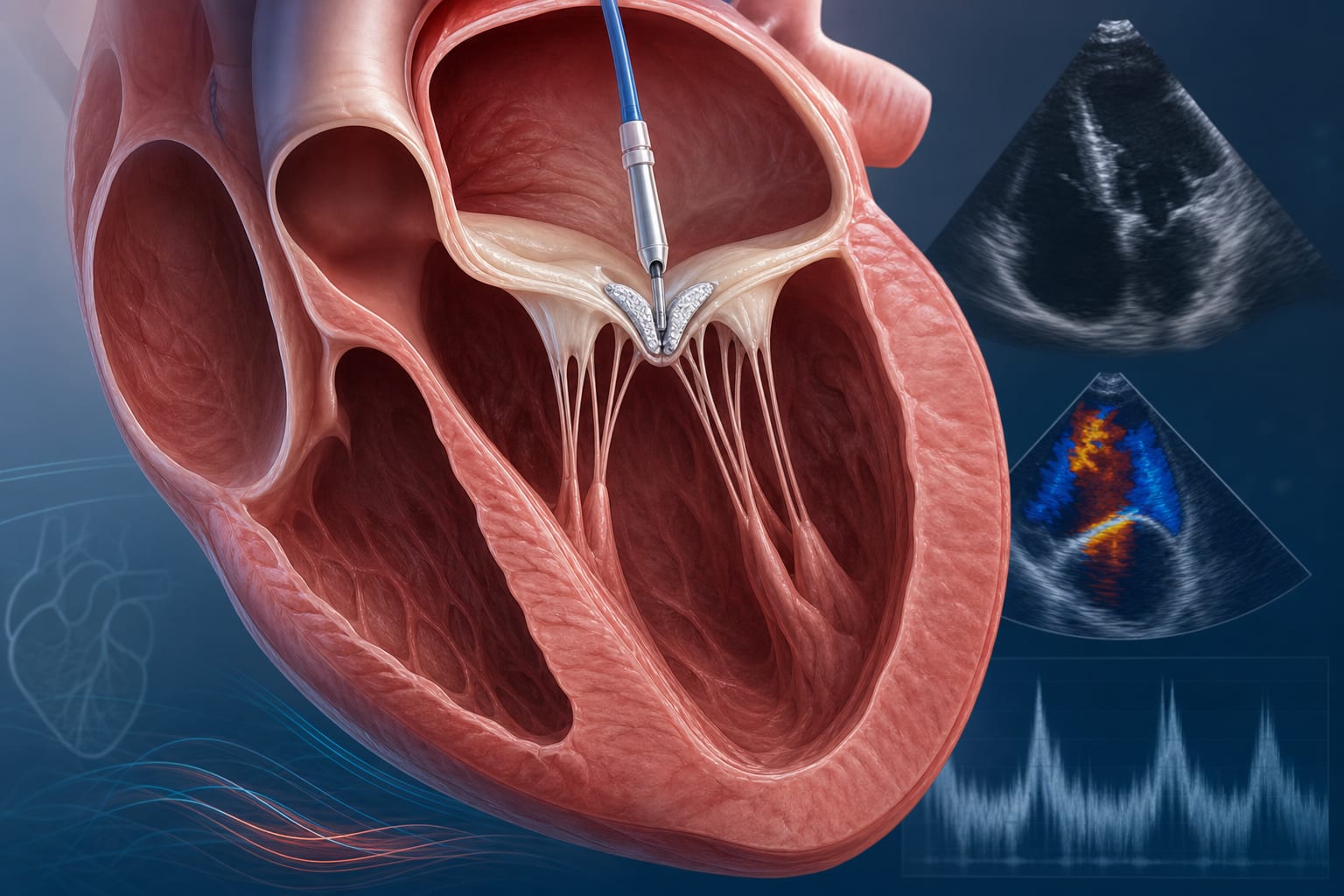
This study evaluates the early effects of transcatheter edge-to-edge mitral valve repair (M-TEER) on forward stroke volume (FSV) in patients with atrial versus ventricular secondary mitral regurgitation (MR). It highlights the potential of FSV as a predictive marker for outcomes related to all-cause mortality and heart failure hospitalization.
Background
Transcatheter edge-to-edge mitral valve repair (M-TEER) is increasingly recommended for patients with severe secondary MR, particularly those at high surgical risk. Understanding the differential impacts of M-TEER on FSV in atrial versus ventricular MR is crucial, as it may guide patient selection and improve clinical outcomes. Current guidelines emphasize the importance of accurate risk stratification and the need for effective interventions in this patient population.
Data Highlights
No numerical data available in the provided material.
Key Findings
M-TEER is recommended for patients with severe secondary MR at high surgical risk.
FSV may serve as a more accurate marker of left ventricular dysfunction compared to left ventricular ejection fraction (LVEF).
Patients with low baseline FSV showed the greatest benefit from M-TEER, despite no improvement in FSV during follow-up.
Atrial MR is recognized as a distinct phenotype with limited evidence for M-TEER, but recent studies suggest similar clinical benefits.
Current guidelines recommend M-TEER for symptomatic patients with atrial MR.
Clinical Implications
Clinicians should consider FSV as a key parameter in assessing patients for M-TEER, particularly in differentiating between atrial and ventricular MR. Understanding the distinct characteristics and outcomes associated with each type of MR can enhance patient selection and optimize therapeutic strategies.
Conclusion
The study underscores the importance of FSV in predicting outcomes following M-TEER in secondary MR. Further research is needed to solidify these findings and refine patient selection criteria.
by Franziska Grewe, Luise Ulrich, Moritz Haus, Philippe Felfeli, Christian Schach, Andreas Luchner, Christoph Birner, Lars S. Maier, Bernhard Unsöld, Christine Meindl, Kurt Debl, Michael Paulus