Clinical Report: Investigating Human-to-Human Transmission of Dabie Bandavirus
Background
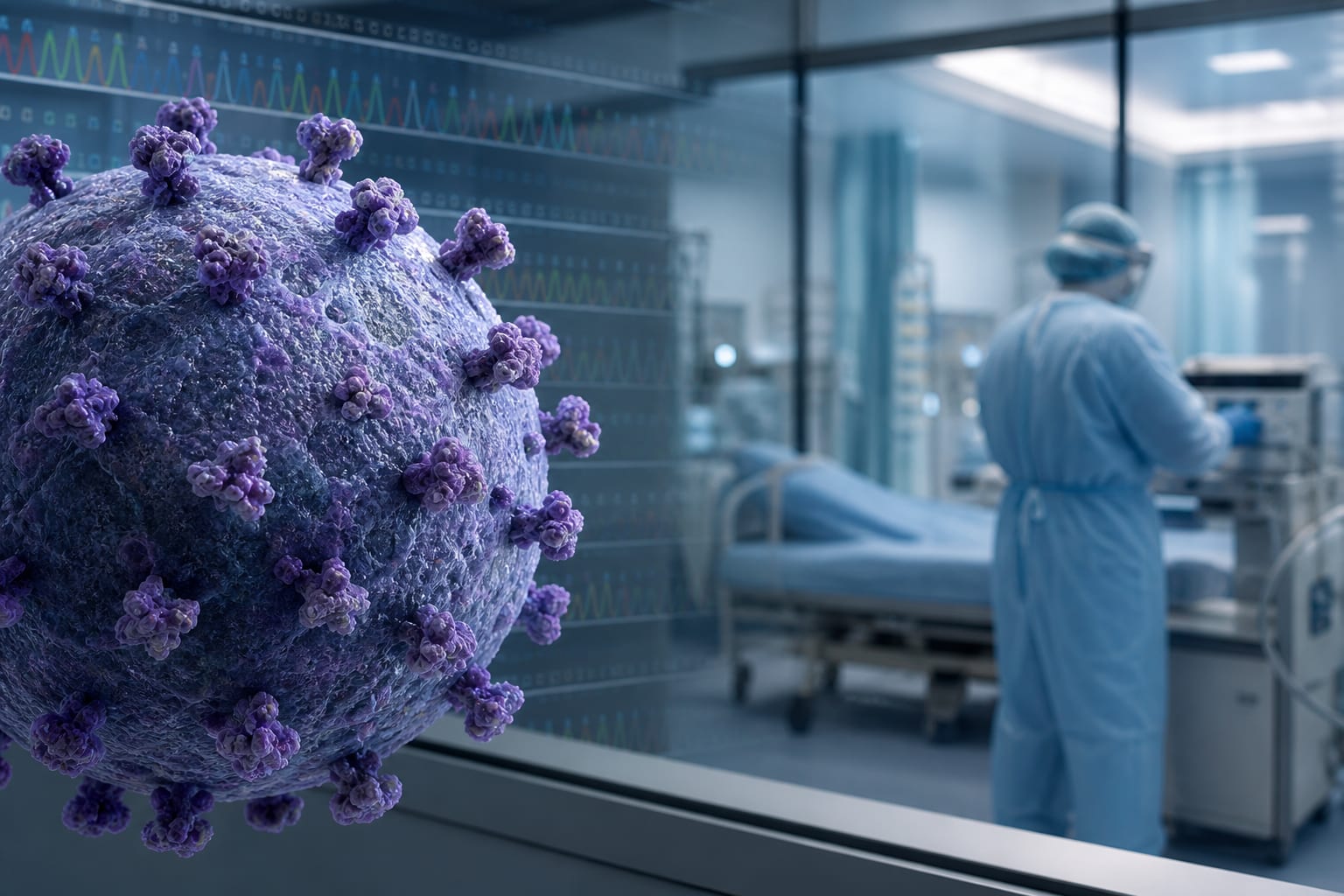
Dabie bandavirus (DBV) causes severe fever with thrombocytopenia syndrome (SFTS), which has an estimated case fatality rate of 12% to 50%. Although DBV is transmitted primarily through tick–vertebrate cycles, human-to-human transmission can occur in healthcare settings, likely through direct contact with infectious body fluids or unprotected ocular exposure.
Data Highlights
Cluster size: Six laboratory-confirmed cases, comprising one index patient and five secondary cases.
Secondary cases: Four healthcare workers and one patient who shared a ward with the index case.
Healthcare-worker symptom onset: Six to 9 days after exposure.
Genomic analysis: Full-length DBV genomes were obtained from the index case and secondary cases S4 and S5.
Viral isolation: DBV was successfully isolated from S4 and S5.
Key Findings
Four healthcare workers developed SFTS after providing invasive care without eye protection.
One secondary patient developed SFTS after sharing a ward with the index patient for 3 days despite having no documented direct contact or shared medical equipment.
Viral genomes from the index case, S4, and S5 clustered together within Clade II and showed high genetic identity, supporting a shared origin and nosocomial transmission.
The route of transmission to the patient who shared the ward could not be determined because environmental air sampling was unavailable.
Neutralizing antibody levels increased over time in all monitored secondary cases.
Clinical Implications
Healthcare facilities should enforce comprehensive infection-control measures when managing patients with severe hemorrhagic DBV infection. Appropriate personal protective equipment, including eye protection, is particularly important during invasive care and exposure to infectious fluids. Contact tracing and whole-genome sequencing can help reconstruct transmission chains and assess infection-control risks.
Conclusion
The investigation provides epidemiological, virological, and genomic evidence of nosocomial human-to-human DBV transmission. Integrating contact tracing, viral isolation, microneutralization assays, and whole-genome sequencing can strengthen outbreak reconstruction and transmission-risk assessment.
Related Resources & Content
Kim WY, Choi W, Park SW, et al. Nosocomial transmission of severe fever with thrombocytopenia syndrome in Korea. Clin Infect Dis. 2015;60:1681–1683.
Hu L, Li J, Zhang H, et al. Predisposing factors for person-to-person transmission of severe fever with thrombocytopenia syndrome bunyavirus. J Hosp Infect. 2022;123:174–178.
Wu YX, Yang X, Leng Y, et al. Human-to-human transmission of severe fever with thrombocytopenia syndrome virus through potential ocular exposure to infectious blood. Int J Infect Dis. 2022;123:80–83.
Bae S, Chang HH, Kim SW, et al. Nosocomial outbreak of severe fever with thrombocytopenia syndrome among healthcare workers in a single hospital in Daegu, Korea. Int J Infect Dis. 2022;119:95–101.
Moon J, Lee H, Jeon JH, et al. Aerosol transmission of severe fever with thrombocytopenia syndrome virus during resuscitation. Infect Control Hosp Epidemiol. 2019;40:238–241.
Ryu BH, Kim JY, Kim T, et al. Extensive severe fever with thrombocytopenia syndrome virus contamination in surrounding environment in patient rooms. Clin Microbiol Infect. 2018;24:911.e1–911.e4.
Sang S, Chen P, Li C, Zhang A, Wang Y, Liu Q. The classification, origin, and evolutionary dynamics of severe fever with thrombocytopenia syndrome virus circulating in East Asia. Virus Evol. 2024;10:veae072.
Sheng R, Cheng T, Wang Y, Wen H. Molecular evolution and geographic migration of severe fever with thrombocytopenia syndrome virus in Asia. PLoS Pathog. 2025;21:e1012970.